Introduction
Google keeps more searches to itself every year. In the first four months of 2026, 68 percent of US Google searches ended without a single click to any website, up from 60 percent just two years earlier. This piece breaks down what’s driving that shift, which SERP features are worth building for, and how to structure content that wins visibility even when nobody clicks through.
Zero-click SEO is the practice of optimizing content to win visibility inside Google’s answer features featured snippets, AI Overviews, and People Also Ask even when the searcher never clicks through to a website. Winning it means writing answer-first content, structuring pages for extraction, and measuring success through impressions and brand visibility instead of clicks alone.
Zero-click searches accounted for 68.01 percent of all US Google searches by early 2026, up from 60.45 percent in 2024, because AI Mode and AI Overviews now answer more queries directly on the results page (SparkToro, June 2026).
AI Overviews cut the click-through rate of the top-ranking organic result by roughly 58 percent as of December 2025, because the summary itself now satisfies most of the searcher’s intent before they reach the blue links (Ahrefs, 2026).
Google retired the FAQ rich-result dropdown from search results on 7 May 2026, so FAQPage schema no longer produces a visible SERP feature, though it still helps AI systems parse question-and-answer content.
A 40-to-60-word answer placed in the first sentences of a section is the format both featured snippets and AI Overviews extract most consistently, because both features pull short, self-contained passages rather than full paragraphs.
Clicks are the wrong success metric on their own, because impressions, branded search growth, and AI citation rate now capture value that never shows up in a session count.
Transactional and comparison queries still send far more clicks than informational ones, because AI systems are cautious about making a final purchase recommendation on Google’s behalf.
What Is Zero-Click SEO?
This is the practice of structuring and writing content so that Google, AI Overviews, and other search features can extract a complete answer directly onto the results page, without the searcher needing to open a website. It uses the same research, structure, and authority signals as regular SEO – the difference is where the value gets delivered.
The term overlaps with “zero-click search,” but the two describe different things. A zero-click search is a search behavior: a query that ends on the results page. This is the response to that behavior a deliberate strategy for winning the spot Google extracts from, even though the reader may never see a site’s design, ads, or navigation. Featured snippets have rewarded this kind of writing since 2014; AI Overviews and AI Mode simply raised the stakes and widened which query types qualify.
Practitioners sometimes label this work Answer Engine Optimization (AEO) or Generative Engine Optimization (GEO). All three terms describe the same underlying skill: writing for extraction rather than for browsing. Search is no longer a single interface a reader typing the same question might see a Google AI Overview, ask ChatGPT or Perplexity, or get a spoken answer from a voice assistant. The discipline treats all of these the same way: as extraction points that reward clear, self-contained, sourced writing over pages built only to be scrolled.
The Types of Zero-Click Search Results You’re Competing With
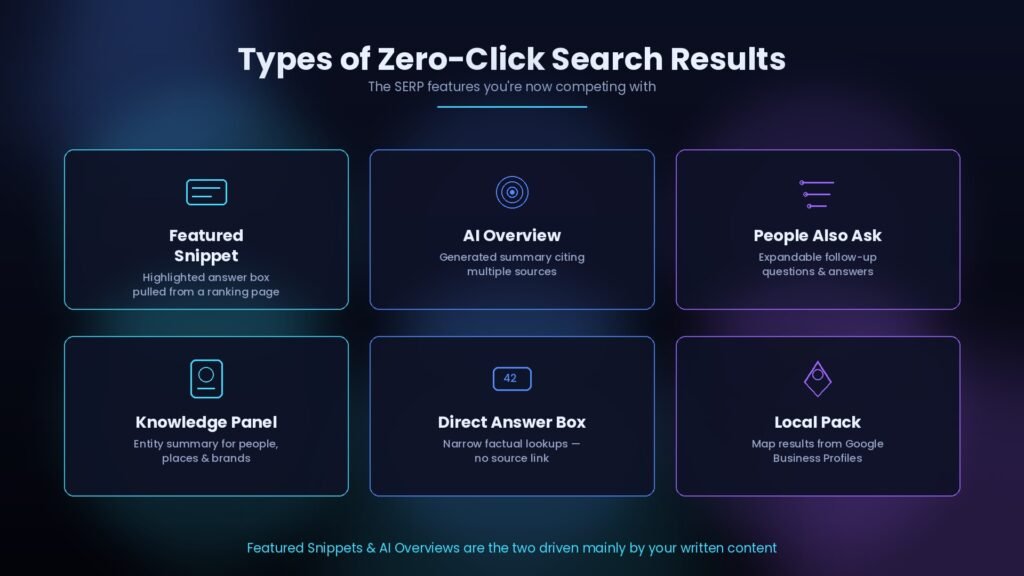
Not every zero-click placement works the same way, and each rewards a different kind of content. Google currently surfaces answers through several recognizable features, and the ones below show up often enough on informational and commercial queries to plan for.
1. Featured snippets – a single organic result promoted into a highlighted box, pulled straight from an existing ranking page’s paragraph, list, or table.
2. AI Overviews – a generated summary that synthesizes several sources into one answer, usually with a handful of citation links attached.
3. People Also Ask – expandable follow-up questions pulled from related pages, each carrying its own short extracted answer.
4. Knowledge panels – entity summaries for people, places, organizations, and products, sourced from structured data and trusted reference sites.
5. Direct answer boxes – narrow factual answers such as unit conversions, calculations, and time zones, usually with no clickable source at all.
6. Local pack – map-based results for “near me” and location-specific queries, sourced from Google Business Profiles rather than web pages.
Of these, featured snippets and AI Overviews are the two worth building a content strategy around, because they’re the only two driven primarily by the quality of your written page rather than a business listing, a calculator, or a licensed data feed.
| Feature | Typical query type | Links back to a website? |
| Featured snippet | Definitional and how-to queries | Yes, one link to the source |
| AI Overview | Broad informational queries | Often, multiple citation links |
| People Also Ask | Related sub-questions | Yes, per expanded question |
| Knowledge panel | Named entities (people, brands, places) | Sometimes, to official or reference sites |
| Local pack | “Near me” and local-intent queries | Yes, to the Business Profile and website |
| Direct answer box | Narrow factual lookups (conversions, time, math) | Rarely |
Why Zero-Click Searches Keep Growing
Zero-click searches are growing because Google now answers more query types itself instead of linking out, and AI-generated summaries have become the default treatment for informational intent. The shift accelerated sharply once AI Overviews expanded past their initial 2024 rollout.
In the first four months of 2026, 68.01 percent of US Google searches ended without any click at all, up from 60.45 percent in 2024, according to SparkToro’s clickstream analysis, published in June 2026. Put differently, only 276 of every 1,000 US searches sent a visitor to the open web in 2026, down from 374 two years earlier, per the same report.
The effect compounds once an AI Overview actually appears on a query. Ahrefs found that the presence of an AI Overview correlated with a 58 percent lower average click-through rate for the top-ranking organic result, based on 300,000 keywords and December 2025 Search Console data. That’s a sharper drop than the 34.5 percent figure Ahrefs reported from its earlier 2025 dataset, which shows the impact is still increasing rather than settling.
Three forces are driving the trend at once: Google keeps expanding which query types trigger an AI Overview, Google’s own AI Mode is pulling multi-turn research sessions away from the traditional results page entirely, and conversational tools such as ChatGPT, Perplexity, and Claude are absorbing queries that would once have started with a Google search.
This acceleration is part of a wider pattern; our look at how AI is reshaping digital marketing tracked the same shift toward AI-generated results months before AI Overviews became the default treatment for informational queries.
Is Zero-Click Search Bad for Your Business?
Zero-click search is not inherently bad for SEO, but it is bad news for one specific business model: sites whose revenue depends on page-view volume from purely informational content. For most other businesses, it changes what winning looks like rather than ending the game.
The businesses feeling the sharpest pain are ad-supported publishers and affiliate sites built around top-of-funnel informational queries “what is X,” “how does Y work.” When an AI Overview answers that question completely, the visit that used to generate an ad impression or an affiliate click never happens. That’s a real, measurable loss, and no amount of on-page structure fixes it if the entire business model depends on that click.
Businesses selling something an AI answer can’t replace tend to come out ahead. A service business, a SaaS product, or a specialist tool still needs a human to evaluate trade-offs, compare pricing, or complete a purchase – an AI Overview can summarize the category, but it can’t close the sale. For these businesses, appearing inside the summary is close to free brand exposure to a reader who was rarely going to convert from a purely informational search anyway.
The fastest way to win an AI Overview citation is to stop writing content that rewards clicking and start writing content that rewards trusting.
If most of your traffic and revenue comes from page views on informational content, treat zero-click growth as an existential risk and diversify toward content that requires a visit – tools, calculators, gated data, or genuinely proprietary research. If your business converts further down the funnel, optimize for visibility first: winning the AI Overview citation for your category builds the recognition that makes a later, high-intent search land on your name specifically.
How to Structure Content to Win Zero-Click Placements
Winning extraction into a featured snippet or AI Overview comes down to one habit: answering the question completely in the first 40 to 60 words of a section, before adding context, examples, or nuance. Everything else – headings, lists, tables – exists to make that answer easy to find and lift.
Apply these structural rules to every section you want considered for extraction:
1. Open with the direct answer. State the conclusion in the first sentence, then explain it; never build up to the point.
2. Name the entity, not the pronoun. Write “AI Overviews summarize” instead of “they summarize,” since an extracted passage loses its surrounding context.
3. Phrase headings as real questions. Use the exact wording a searcher would type, not a clever variation on it.
4. Make every section stand alone. A reader or an AI system should get the full value of a section without reading anything above it.
5. Use numbered lists for anything with steps, factors, or a count. Both snippets and AI Overviews preferentially extract lists over dense paragraphs.
6. Build comparison tables only when there are genuinely three or more options measured on three or more shared attributes, and keep them short.
7. Match the format Google already shows. Search your target query and copy the shape of the existing zero-click result paragraph, list, or table rather than guessing.
For a how-to query, this means stating the outcome first “Restart the router by unplugging it for 30 seconds” before the surrounding safety notes. For a what-is query, it means opening with a one-sentence definition clean enough to stand alone, the way a dictionary entry would, rather than a scene-setting anecdote.
Two mistakes undo this work fast: burying the answer under a three-sentence introduction that just paraphrases the heading, and writing an answer that only makes sense after reading the paragraph above it both defeat the standalone-passage requirement AI systems rely on.
Pro tip: before publishing, search your own target query and copy the exact format paragraph, list, or table that Google is already extracting for it, since that’s the format Google has decided the query deserves. Pro tip: keep your Quick Answer paragraph free of internal links entirely, since embedding a link inside the passage most likely to be extracted invites Google to route attention to a citation partner instead of your own next page.
None of this requires new content; most sites just need to move their existing answer from paragraph three to sentence one.
Where Schema Markup Still Helps in 2026 (and Where It Doesn’t)
Schema markup still helps AI systems parse your content, but it stopped producing a visible SERP feature for FAQ content in 2026 a distinction most zero-click guides still get wrong. Structured data was never a ranking factor on its own; it’s a comprehension aid, and that role hasn’t gone away.
Google’s FAQ rich results the expandable question-and-answer dropdown that used to appear under a search listing stopped showing in Google Search as of 7 May 2026, and Google’s own FAQPage structured-data documentation was updated with that notice. Search Console’s dedicated FAQ report and the Rich Results Test’s FAQ support are scheduled to follow it into retirement by June 2026, with Search Console API support for FAQ data ending in August 2026. Sites that add FAQPage schema today will not get the old dropdown back, no matter how correctly it’s implemented.
That doesn’t make FAQPage markup pointless. The schema type itself remains valid, throws no errors, and continues to give AI systems and crawlers an explicit signal about which text is a question and which is its answer a comprehension layer that matters more for AI Overview and chat-assistant citation than for any classic Google rich result. The practical shift is where the effort should go: stop treating FAQ schema as a way to win a dropdown, and start treating the visible FAQ content itself real questions, concise 40-to-70-word answers, clear headings as the actual lever.
Article and Organization schema remain the two most broadly useful types site-wide: Article helps establish authorship and freshness, and Organization strengthens the entity signals that feed knowledge panels and brand recognition inside AI answers. HowTo schema followed a similar path to FAQ; its rich-result treatment was removed from mobile back in 2023, so treat it the same way: keep the markup for machine clarity, but don’t build a content strategy around a visual SERP feature it no longer earns.
How to Measure Zero-Click Search Success
Measuring this well means adding a small set of visibility metrics to your traffic reports, alongside click-through rate rather than instead of it. Clicks still matter; they just stop being the whole story.
Track these alongside your existing traffic reports:
1. Impressions in Search Console. Rising impressions with flat or falling clicks usually means you’re winning placements, not losing relevance.
2. SERP feature ownership. How often your pages hold a featured snippet, AI Overview citation, or People Also Ask slot for your priority queries.
3. Branded search volume. Growth in searches for your company or product name is a common downstream sign that zero-click visibility is building recognition.
4. AI citation or mention rate. How often AI Overviews, ChatGPT, or Perplexity name your brand or link to your content when answering category questions.
5. Assisted conversions. Whether visitors who convert later through a branded or direct search had previously seen your brand inside a zero-click feature.
None of these numbers replace revenue and pipeline as the actual goal they exist to explain why traffic and revenue might be moving in different directions than they used to.
FAQs
Q. Does zero-click SEO mean I should stop trying to rank in position one?
A. No, Position one remains the primary source Google pulls featured snippets and many AI Overview citations from, so ranking well is still the foundation. This work adds a second layer on top of ranking: structuring that top-ranking content so it can actually be extracted, rather than just linked to.
Q. Is zero-click search the same thing as AI Overviews?
A. No, Zero-click search is the broader outcome of any search that ends without a click, including featured snippets, knowledge panels, and direct answers. AI Overviews are one specific feature driving a growing share of that outcome, alongside older features that predate generative AI entirely.
Q. Do meta descriptions still matter if most searches end in zero clicks?
A. Yes, for the searches that do result in a click. A clear meta description still influences click-through rate on the results that remain, and it can also get pulled into a snippet when your on-page copy doesn’t provide a clean 40-to-60-word answer of its own.
Q. Will FAQ schema hurt my rankings now that Google retired FAQ rich results?
A. No, Google has described the change as a search-appearance update, not a ranking change, so existing FAQPage markup won’t cause a penalty. It simply stops producing the visible dropdown it used to earn, while remaining valid, parseable structured data.
Q. How long does it take to see zero-click visibility improve?
A. Most sites see featured snippet or AI Overview movement within four to eight weeks of restructuring a page’s top sections, since these features are re-evaluated frequently. Knowledge panel and entity-level changes typically take longer, because they depend on broader trust signals building across the whole site.
Q. Do all industries lose the same amount of organic traffic to zero-click search?
A. No, Informational and definitional queries lose the most, since AI systems can fully answer them without a visit. Transactional, comparison, and highly specific queries pricing, availability, product specs still send more clicks meaningfully, because AI systems tend to avoid making the final recommendation for the user.
Conclusion
Treat visibility and clicks as two separate goals your content now has to hit at the same time. Start by auditing your best-performing pages for a 40-to-60-word answer at the top of each main section, since that single change affects both featured-snippet and AI Overview eligibility. Zero-Click SEO isn’t a reason to abandon organic search optimization it’s a reason to stop measuring it by clicks alone.