
Introduction
Most beginners open a blank document and start writing before deciding who the content is for or what it is supposed to achieve. That produces scattered posts that compete with each other instead of building on each other, so traffic never compounds. This guide walks through the sequence that produces compounding results instead: pick one goal, research the audience’s real questions, choose topics with actual search demand, then turn that plan into a calendar that gets executed on schedule. It also covers two things most beginner guides skip the blog SEO fundamentals that decide whether any of this gets found, and an honest timeline for when results actually show up.
Quick Answer
A content marketing strategy is a written plan that defines who content is created for, the problems it solves, which formats and channels to use, and how success gets measured. For beginners, building one comes down to picking a single goal, researching the audience’s real questions, choosing topics with search demand, then scheduling consistent publishing against a calendar.
Key Takeaways
A strategy needs one measurable goal set before any writing starts, because vague goals produce content with no way to check whether it worked.
Topic research beats guessing, because it shows what people are already typing into search engines instead of what a brand assumes they want to read.
A content calendar is what turns a plan into consistent output, since irregular publishing is one of the most common reasons beginner efforts stall.
Blog SEO and content strategy are the same job, not two separate ones, because a well-researched article that search engines cannot parse never reaches its audience.
Organic content usually needs several months of steady publishing before traffic compounds, because search engines need time to crawl, index and build trust in new pages.
Repurposing one piece of research across formats returns more value than starting from a blank page for every channel.
What Is a Content Marketing Strategy?
A content marketing strategy is the document that explains why a brand creates content, who it is for, and what business result it is meant to produce. It sits above two things beginners often confuse it with. A content plan is the layer underneath the strategy: the actual list of topics, formats and owners that will execute it. A content calendar is the execution layer below that: the dates, deadlines and publishing slots that turn the plan into a shipped schedule.
The Content Marketing Institute frames strategy work as an organization’s underlying reason for creating content why it publishes, who it is trying to help, and how it can help them in a way no competitor already does. That framing matters because it forces a decision before any content gets written: what result is this actually for.
Skipping straight to a calendar without a strategy is why many beginner content efforts feel busy but produce nothing measurable. The publishing cadence exists, but there is no goal it is working toward, so nobody can say afterward whether it succeeded.
Why a Strategy Matters Before You Write Anything
Three failure patterns show up repeatedly in beginner content efforts, and all three trace back to skipping the strategy step.
The first is writing for an audience that was never defined, which produces content that reads well but does not match what any specific group of people is searching for. The second is publishing without a goal, so growth in traffic or followers has nothing to be measured against and nobody can tell if the effort is working. The third is inconsistency: a few posts in the first month, then a long gap once the initial motivation fades, which resets any momentum the content had started to build with search engines.
A strategy fixes all three before a single word gets written. It forces a decision on who the content serves, what it should achieve, and how output will stay consistent enough to compound. None of that requires a large team or a big budget a single beginner working alone can run a full strategy, provided each step below actually gets done rather than skipped.
How to Build a Content Marketing Strategy: 7 Steps
The following sequence works for a solo beginner or a small team. Each step builds on the one before it, so work through them in order the first time.
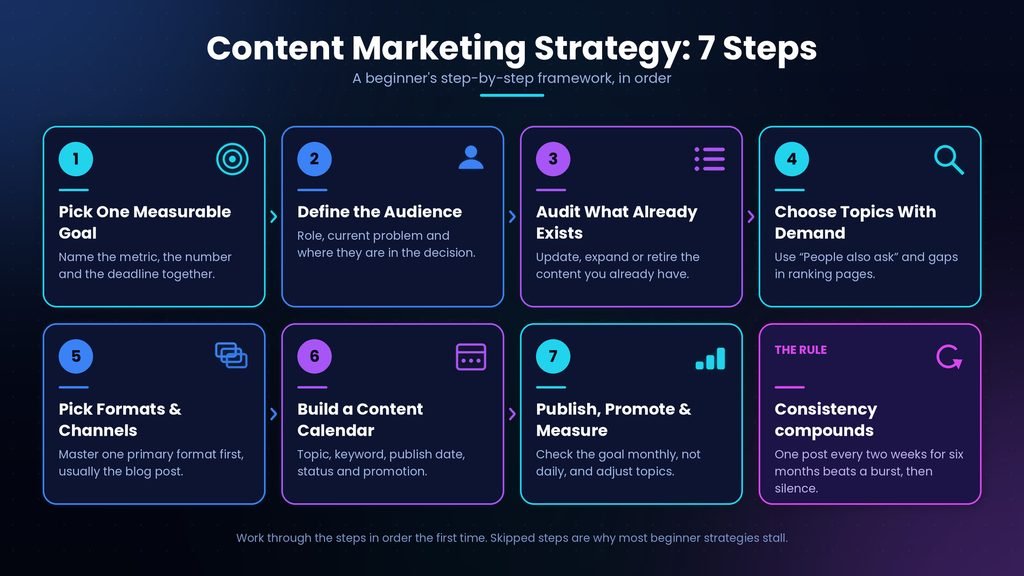
1. Pick One Measurable Goal
Start with a single goal stated in a form that can be checked later, not a general ambition like “grow the blog.” A workable goal names the metric, the number and the deadline together: reaching a stated count of monthly organic visitors, ranking for a defined set of topics, or generating a stated number of newsletter signups within a set number of months.
Pick one goal, not three. Beginners who chase traffic, engagement and leads at the same time end up optimizing for none of them, because each goal points toward different topics and different formats. The goal chosen here also decides which metrics matter in the measurement step below, so revisit it before writing the first article.
2. Define the Audience in Specific Terms
Write down who the content is for using specifics that would let a stranger recognize that reader in a room: their role or situation, the problem they are trying to solve right now, and where they are in the buying or decision process. Adobe describes this as moving through awareness, consideration and decision stages, with each stage needing a different kind of content.
A reader in the awareness stage needs a plain-language explanation of a problem; a reader in the decision stage needs a comparison or a checklist that helps them commit. Writing the same generic piece for both is a common beginner mistake, because neither reader gets what they actually came for.
3. Audit What Already Exists
Before creating anything new, list what already exists: past blog posts, social captions, case studies, FAQs answered in customer emails, even an old presentation. Most of this material was never optimized for search or organized around a topic, but it saves real research time once it is mapped against the audience defined in step two.
Group the audit into three buckets: content that can be updated and republished as-is, content that can be expanded into something more complete, and content that should be retired because it no longer matches the goal. Skipping this step means beginners frequently rewrite something that already exists in a rougher form.
4. Choose Topics With Real Search Demand
Pick topics using what people are actually typing into search engines, not what sounds interesting to write. A simple beginner method: type a candidate topic into a search engine, note the questions that appear in the “People also ask” box, and check what the currently ranking pages cover and leave out. The gap what none of them explain well is usually the strongest topic to write next.
Group topics into a small number of pillars tied to the goal from step one, then list specific article ideas under each pillar. Three to five pillars is enough for a beginner; more than that spreads research effort too thin to produce anything genuinely complete.
5. Pick Formats and Channels Deliberately
Choose formats based on where the defined audience already spends time and what the goal actually requires, not every format available. A written blog post supports search-driven goals because it can be indexed and ranked; short video and social posts support awareness and distribution goals but rarely rank on their own.
A beginner with limited time should pick one primary format to master first, usually long-form blog content, because it can be repurposed into the others afterward. Trying to run a blog, a newsletter, a podcast and three social channels at once from a standing start is how beginner strategies collapse under their own workload within a few weeks.
6. Build a Content Calendar
Turn the topic list from step four into a calendar with real dates, owners and a status for each piece, so the plan becomes something that actually gets published rather than a list that sits unused. The dedicated content calendar section below covers the specific columns and cadence that work for a beginner.
7. Publish, Promote and Measure Against the Goal
Publishing is not the last step. Each piece needs a short promotion pass sharing it where the audience already gathers, linking to it from older related content, and answering related questions where they come up because a new page rarely gets found by search engines alone in its first weeks.
Measurement closes the loop: check the metric named in step one on a fixed schedule, not daily, since search-driven metrics move slowly and daily checking mostly produces anxiety rather than insight. Compare actual numbers against the goal every month, and use what is and is not working to adjust the topic list rather than abandon the strategy after one slow month.
Blog SEO Basics Every Content Marketing Strategy Needs
Blog SEO is not a separate task bolted onto a finished article it is what makes the research from the steps above findable. A piece can answer a question completely and still never get read if search engines cannot understand what it is about.
Cover these fundamentals on every post:
- Match the title and the first paragraph to the actual search term, so the exact question a reader typed gets answered within the first few sentences.
- Use one clear heading structure a single main title, then subheadings that break the topic into the questions a reader would ask next.
- Link to other relevant posts on the same site using descriptive anchor text, which helps both readers and search engines understand how the topics connect.
- Write a meta description that states the specific answer inside the post, not a vague teaser, so the search results listing itself earns the click.
- Keep paragraphs short and the structure skimmable, since most readers decide within seconds whether a page is going to answer their question.
None of this replaces good writing it just makes sure the writing gets found by the people it was written for.
How to Build a Content Calendar That Actually Gets Used
A content calendar is the schedule that turns a topic list into published work. For a beginner, a simple spreadsheet does the job better than a specialized tool, because the goal at this stage is consistency, not automation. HubSpot’s content planning template is a reasonable starting structure to copy from.
At minimum, track five columns: the topic, the target keyword or question it answers, the publish date, the status (drafted, in review, published), and where it will be promoted once live. Add a sixth column once the audit from step three is folded in, marking whether a piece is new, updated, or repurposed from something that already existed.
Set a cadence that can actually be sustained rather than one that looks impressive on paper. One well-researched post every two weeks, published consistently for six months, outperforms four rushed posts in the first month followed by silence, because search engines respond to sustained publishing far more than to a short burst.
Review the calendar monthly against the goal from step one, not against the calendar itself. If a topic pillar is not producing movement toward the goal after several published pieces, that is the signal to research a new pillar rather than keep filling the same one on schedule.
How Long Before a Content Marketing Strategy Shows Results
There is no single number that applies to every site, because the timeline depends on factors that vary by business: how competitive the chosen topics are, how much authority the domain already has, how consistently content gets published, and how much of the promotion step actually happens.
What is consistent across most sources on this question is the shape of the curve, not a specific figure: new organic content typically needs a period of several months of steady, consistent publishing before search engines fully crawl, index and begin ranking it, and before that ranking translates into meaningful traffic. Expecting a measurable lift within the first few weeks is the most common reason beginners abandon a strategy before it has had time to work.
The practical response is to set the review cadence from the measurement step to match this reality check monthly, not weekly and to keep publishing on the calendar through the early period rather than pausing to wait for results before continuing.
Common Mistakes Beginners Make (and How to Avoid Them)
These mistakes account for most beginner content efforts that stall out within the first few months:
- Publishing without a defined goal, which makes it impossible to know later whether the effort is working.
- Writing for an assumed audience instead of a researched one, which produces content nobody was searching for.
- Choosing every format and channel at once instead of mastering one, which spreads a beginner’s limited time too thin to produce anything complete.
- Treating blog SEO as a final polish step instead of building it into the research and writing from the start.
- Abandoning the calendar after a slow first month, before organic content has had time to be indexed and ranked.
- Never revisiting the audit, so older content that could be updated gets ignored in favor of writing something new that covers the same ground.
Most of these come from skipping a step above rather than doing any step badly, so the fix is usually to go back and finish the step that got rushed.
Conclusion
Start with the goal, not the writing. Define one measurable target, research the audience’s actual questions, and build a calendar that can be sustained for months rather than weeks a solid content marketing strategy is built in that order, not by publishing first and figuring out the plan afterward. Blog SEO and a working content calendar are not optional add-ons; they are what turn a good plan into content that actually gets found and read.
The next concrete step is the one most beginners skip: open a spreadsheet today and fill in the five calendar columns from step six with three real topic ideas before writing anything else.
Frequently Asked Questions
1. What is the difference between a content strategy and a content plan?
Ans. A content strategy is the “why” the goal, the audience and the result content is meant to produce. A content plan is the “what” underneath it: the actual topics, formats and owners chosen to reach that goal. Beginners often use the terms interchangeably, but treating them as one step skips the goal-setting that makes the rest of the work measurable.
2. How much should a beginner publish per week?
Ans. There is no fixed number, but consistency matters more than frequency. One well-researched post every one to two weeks, published on a schedule that can be sustained for months, produces better results than a burst of daily posts that stops after a few weeks. Match the pace to the time actually available, then hold it.
3. Do I need a content calendar if I am a solo blogger?
Ans. Yes, A calendar matters most for solo bloggers, because there is no team to catch a missed week or maintain momentum during a busy period. A simple spreadsheet with topic, date and status columns is usually enough; the tool matters far less than actually keeping the publishing date.
4. What tools does a beginner actually need to start?
Ans. A beginner needs very little to start: a spreadsheet for the calendar, a search engine for topic research, and a place to publish, such as a blog. Paid research or scheduling tools can help later, but none of them are required to run the seven steps described above.
5. How is content marketing different from social media marketing?
Ans. Content marketing is the practice of creating information that serves a reader’s problem, published wherever it makes sense, often as blog content a business owns outright. Social media marketing is one distribution channel for that content, built on platforms the business does not own. A content strategy usually includes social distribution, not the other way around.
6. Can content marketing work without SEO?
Ans. It can, if distribution comes entirely from channels like email, social sharing or partnerships instead of search traffic. But for most beginners relying on a blog, skipping SEO means well-researched content never gets found, because search engines cannot rank a page they cannot understand. Blog SEO is what connects the writing to an audience actively searching for it.