Introduction
Search marketers keep hearing that links are losing ground to something vaguer called brand presence. The claim rests on real data, yet it is usually repeated without its limits, and some advice built on it can put a site on the wrong side of Google’s spam rules. This guide separates what Google has said, what the Ahrefs studies measured and what nobody has proven. It then shows how to earn mentions and links safely and how to tell whether the work is paying off.
Quick Answer
No, backlinks are not dead, but brand mentions and backlinks now do different jobs. Backlinks still help one specific page get found and ranked. Plain-text mentions on trusted sites track more closely with a brand appearing in AI answers, according to Ahrefs data from 75,000 brands, although that data shows correlation rather than proof of cause.
Key Takeaways
Backlinks are not dead, because Google’s spam policies still treat manipulative links as spam and its guide to generative AI features says those features run on the same core ranking systems as ordinary results.
Branded web mentions correlated at 0.664 with AI Overview brand visibility in Ahrefs data, against 0.218 for backlinks, but correlation does not show that earning mentions causes visibility.
An unlinked mention passes no link signal, according to Google’s John Mueller, so it works through awareness and AI recall rather than through link-based ranking.
Buying or faking mentions is a poor bet, because Google’s guide calls seeking inauthentic mentions less helpful than it seems and its spam policies now cover attempts to manipulate generative AI responses.
A linked mention on a relevant page that points to a page worth citing is the strongest single outcome, because it serves awareness, discovery and ranking together.
Citation building SEO now means two jobs: matching business details across local listings, and earning the source links that AI answers show.
What counts as a brand mention, a backlink and a citation?
A backlink is a clickable link from another website to one of your pages. A brand mention is any reference to your brand, product or people on someone else’s page, with or without a link. A citation is the source that a local directory or an AI answer attaches to a business or a claim.
A linked mention is both a mention and a backlink. An unlinked brand mention names the brand in plain text, so a crawler has no link to follow and the page sends no link signal. Both kinds still tell readers, and AI systems that read web text, that the brand exists and what it is associated with.
The terms overlap in practice. Ahrefs counts branded web mentions as mentions of a brand name anywhere across the web, linked or unlinked, so a study of mentions can include linked ones. Readers new to the AI-search side of this topic can start with Arcnet’s guide to GEO compared with SEO.
Are backlinks dead?
No. Google’s spam policies, last updated on 28 August 2026, still define link spam as creating links to or from a site mainly to manipulate rankings, a rule that only makes sense if links still carry weight.
Google’s guide to generative AI features, last updated on 10 July 2026, adds that AI Overviews and AI Mode rely on core Search ranking and quality systems, and that a page must be indexed and eligible to appear with a snippet to show up in them.
What has changed is the size of the claim. Percentages that split ranking influence between links and mentions circulate widely, yet none of the Google documents reviewed for this article publishes such a split, so treat those percentages as opinion.
Backlinks keep four practical jobs that plain-text mentions do not do.
- Give crawlers and readers a direct path to one specific page.
- Act as an editorial endorsement of that page from a relevant site.
- Send referral visitors who arrive already interested in the topic.
- Show up in link-analysis tools, which makes the work measurable.
Those jobs explain why links remain the better tool when a single commercial page must compete for a ranking.
Brand mentions vs backlinks: what the Ahrefs data shows
In Ahrefs’s studies of 75,000 brands, branded web mentions tracked brand appearances in AI answers far more closely than backlinks did, but the studies report correlation, so they do not show that earning mentions causes visibility.
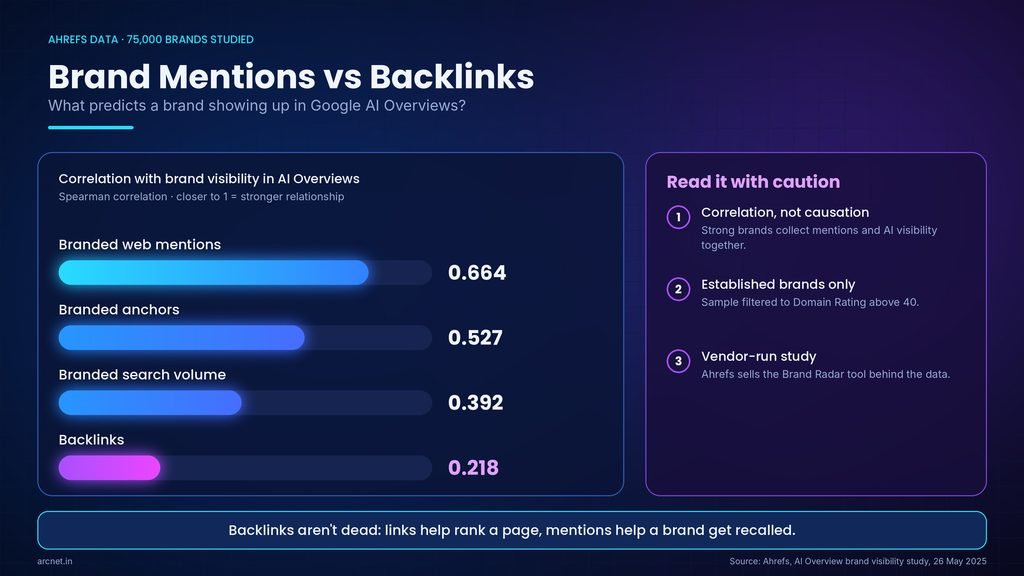
The first study, the Ahrefs AI Overview study published on 26 May 2025, used Spearman correlation, where values closer to 1 mean a stronger relationship. It reported 0.664 for branded web mentions and 0.218 for backlinks against brand visibility in Google AI Overviews, with branded anchors at 0.527 and branded search volume at 0.392.
A follow-up published on 12 December 2025 added ChatGPT and Google AI Mode. Ahrefs reported branded web mentions between 0.66 and 0.71 across the three platforms, with YouTube mentions highest at about 0.737.
The follow-up also found ChatGPT less tied to classic authority signals, with Ahrefs reporting 0.266 for Domain Rating there, so Ahrefs suggested that ChatGPT may be the easier platform for a lesser-known brand to enter.
A third Ahrefs analysis of the top 50 domains found that mentions on pages with many referring domains correlated at 0.70 with Google AI Overviews, 0.40 with Perplexity and 0.12 with ChatGPT. Its author called the result unsurprising, since prominent brands tend to be mentioned on pages that other sites link to, which suggests the two signals travel together more than they compete.
Why these numbers do not prove mentions cause visibility
Five limits apply to every figure above.
- Ahrefs states that correlation is not causation, and strong brands tend to collect mentions and AI visibility together.
- Ahrefs filtered for domains with a Domain Rating above 40 and a top keyword of at least 800 monthly searches, so the data describes established brands rather than new sites.
- The three platforms differ, and Ahrefs reported different patterns for AI Overviews, AI Mode and ChatGPT.
- Ahrefs sells the Brand Radar tool used to gather the data, so the studies are informative but not neutral.
- Being named in an AI answer is not the same as being cited with a link, so a mention count does not equal traffic.
Read the results as a pattern worth testing, and keep building links to the pages that need to rank.
Does Google treat unlinked brand mentions like links?
No. In a Google SEO office hours session, John Mueller said that a mention without a link passes no signal the way a link does, putting it as “we don’t treat these as links,” according to this report on Mueller’s answer from Search Engine Journal in April 2022.
Mueller added that this does not make such mentions bad, and that readers may still see the name and search for the site. Ahrefs content director Ryan Law drew a similar line, as quoted in the AI Overview study, saying unlinked mentions have little effect on classic SEO but a larger effect on generative AI visibility.
Google’s generative AI guide also says its AI features can show what is said about products and services across blogs, videos and forum discussions, which is the channel unlinked mentions travel in.
Unlinked brand mentions still pay off in four ways, even though they pass no link signal.
- A reader sees the name and searches for it.
- Branded search interest can grow over time.
- AI answers can draw on what is said about the brand across the web, as Google’s guide describes.
- Each mention is an outreach target for a link request, covered later in this guide.
None of those four routes passes link-based ranking credit, so they supplement links instead of replacing them.
Which signal fits which goal?
Backlinks fit goals tied to one page, such as ranking and referral traffic. Mentions fit goals tied to the brand, such as awareness and appearing in AI answers. A linked mention on a relevant page serves both.
In the brand mentions vs backlinks comparison below, no option wins every row, and the AI row reflects Ahrefs’s correlation figures of 0.664 for web mentions and 0.218 for backlinks.
| Trait | Backlink | Unlinked mention | Linked mention |
| Counts as a link | Yes | No | Yes |
| Points to a specific page | Yes | No | Yes |
| Sends referral visitors | Yes | Indirect | Yes |
| Builds awareness | Some | Yes | Yes |
| Correlation with AI visibility (Ahrefs) | Weaker | Stronger | Stronger |
| Measurable in link tools | Yes | Harder | Yes |
| Risk if paid for | Link spam | Inauthentic mention | Link spam |
A link points at a page; a mention points at a name. Search engines rank pages, while AI answers recommend names.
Five questions that decide the order
Answer these in order; the first “no” shows where to start.
- Do people search for your brand name? If not, start with mentions in places your audience already reads.
- Do mentions exist but point nowhere useful? If so, improve the target pages and then request links.
- Must one commercial page win a competitive query? If so, prioritise backlinks to that page.
- Is the business local? If so, fix the Google Business Profile and local listings first.
- Which AI platform matters? ChatGPT showed weaker ties to established authority than AI Mode in Ahrefs data, so a newer brand should expect AI Mode to be harder.
Where a choice is possible, take the linked mention on a relevant page, because it serves awareness, discovery and ranking at once, and accept that mentions are harder to measure than links.
How do you earn mentions that count?
Earn mentions by publishing something others have a reason to reference, then making it easy for relevant publications, creators and communities to find it. Google’s guide favours content with a unique point of view over content that restates what already exists, and that advice applies to mention-worthy assets too.
Six steps cover most of the work.
- Publish a reference-worthy asset, such as original data, a clear definition, a free tool or a tested method, and plan it inside a content marketing plan.
- Write one plain sentence describing what the brand is and who it serves, and use it in every bio, boilerplate and profile so descriptions stay consistent.
- Pitch the asset to publications and communities where your audience already reads about the topic, naming the exact page you want people to see.
- Appear on video, since the December 2025 Ahrefs study found YouTube mentions had the strongest correlation, about 0.737, with AI brand visibility; Arcnet’s guide to ranking videos on YouTube covers the video side.
- Take part in forums and communities as a real participant, follow each community’s rules and disclose any connection to the brand.
- Correct errors at the source by contacting the publisher when a third-party page misdescribes the brand.
Each step produces a mention that exists for a real reader, which is the only kind worth earning.
Consider a hypothetical invoicing tool for freelancers. It publishes a dataset of typical freelance payment terms, a few trade newsletters quote it, and a founder answers questions on a freelancer forum while disclosing the affiliation. None of those mentions was bought, each names the product and its audience in similar words, and each can carry a link to the dataset page.
Which mention tactics to avoid
Four tactics create policy risk or waste effort.
- Buying mentions or seeding posts: Google’s generative AI guide says seeking inauthentic mentions is less helpful than it seems, and its spam policies, updated on 28 August 2026, now cover attempts to manipulate generative AI responses.
- Paying for links without qualifying them: Google’s spam policies treat buying or selling links for ranking purposes as link spam, though sponsored links are acceptable when qualified with nofollow or sponsored.
- Counting mentions without checking source relevance, since a mention on an unrelated page adds to a total but gives no reason to trust the brand.
- Publishing mention-bait pages in bulk, which Google’s guide places under its scaled content abuse policy when pages exist mainly to manipulate rankings or AI responses.
Slow, relevant mentions carry less policy risk than fast bought ones.
How do you turn unlinked brand mentions into links?
Find pages that name your brand without a link, confirm each one is relevant and accurate, then ask the author to link to the most useful page. Never offer payment for the link, because Google’s spam policies treat paid links that pass ranking credit as link spam.
The process below needs only a web browser and an email account.
- Search Google for your brand name in quotation marks and exclude your own domain, using the line below, which should return pages from other sites that name the brand.
“Your Brand Name” -site:yourdomain.com
- Open each result and find the brand name; if it is plain text and not clickable, the mention is unlinked.
- Discard pages that are low quality, off topic, or describe the brand wrongly or negatively.
- Pick the destination page that most closely matches what the sentence says, not automatically the home page.
- Email the author or editor with the exact sentence, the destination URL and one line on why the link helps readers.
- Record the reply and thank anyone who adds the link.
Run the search again each quarter, because new unlinked mentions appear as coverage grows.
Where link reclamation fails
Two failure points come up most often.
- No reply or a refusal: accept it, because pressure or payment turns a mention into a policy risk.
- A link added with nofollow or sponsored: keep it, since Google’s spam policies treat qualified links as the correct form for paid or sponsored placements, and the mention and referral traffic remain.
In both cases the plain-text mention still counts as a mention, so nothing is lost by asking.
Citation building SEO: local listings and AI citations
Citation building SEO covers two separate jobs. For local businesses it means keeping the name, address and phone number identical across directories and the Google Business Profile; for AI search it means becoming a page that AI features retrieve and link to as a source.
Local citations: a consistency task
Google’s generative AI guide says Google Business Profile and Merchant Center can help products and services appear in AI responses and other Search results, so local listings are mostly a hygiene task.
- Claim and complete your Google Business Profile.
- Decide one exact format for the business name, address and phone number, and reuse it everywhere.
- Audit existing listings for mismatches before adding new ones.
- Add listings only in directories relevant to your category and region, since directories differ by country.
- Re-check every listing whenever the business moves or changes number.
Once listings match, shift the saved time to earning real mentions.
AI citations: earning the source link
An AI citation is the link an AI answer shows beside a claim, and Google’s guide says its features retrieve pages from the Search index to support answers.
- Make sure the page is indexed and eligible to appear with a snippet, as Google’s guide requires for its AI features.
- Add first-hand experience, original data or a distinct point of view, which the guide calls non-commodity content.
- Structure the page for readers with clear headings and short sections, because the guide says content does not need chunking or rewriting only for AI.
- Keep the brand’s description and facts consistent across your site and third-party profiles.
- Strengthen the on-page basics using Arcnet’s guide to optimizing blog posts for SEO.
This list and the mention steps above feed each other, because a page worth citing is also a page worth mentioning.
How do you measure brand mentions without a vanity count?
Measure quality in buckets instead of totals: where each mention appears, how relevant it is, whether it links and which page it names.
Track these six things together.
- Source relevance: how closely the page matches your topic and audience.
- Link status: the share of mentions that link and the share that do not.
- Destination: whether links go to a specific page or the home page.
- Branded search: the branded queries filter that Google announced for Search Console on its Search Central blog in November 2025 lets you separate branded queries from the rest.
- AI answers: run the questions your buyers ask in the AI tools you care about, record whether the brand is named and linked, and use the Generative AI performance report in Search Console for Google’s own AI features.
- Tool claims: Google’s guide warns that no third-party tool has access to Google’s internal ranking or AI systems, so treat any claim of Google metrics with caution.
A short monthly record of these six items beats a single mention count.
What to do next
Backlinks are not dead, and mentions are not a replacement for them. The brand mentions vs backlinks question is better treated as a sequencing problem: earn mentions that name the brand in the right context, then make sure each one points to a page worth citing. Unlinked brand mentions are the cheapest place to start, because they already exist and only need a polite request. The first step is to run one Google search for your brand with your own domain excluded and list the ten most relevant pages that name you without a link.
Frequently Asked Questions
1. Can negative brand mentions hurt rankings?
None of the Google documents reviewed for this article lists sentiment on other websites as a ranking factor. Negative coverage can still affect whether people click, buy or search for the brand, so respond where possible and correct factual errors at the source. Treat it as a reputation task rather than an SEO penalty.
2. Are nofollow links worth getting?
Yes, for most goals other than passing link credit. A nofollow link still puts the brand name and a destination in front of readers, and Google’s spam policies name nofollow and sponsored as the correct way to qualify paid or sponsored links. Judge such a link by the audience it reaches, not by its attribute.
3. Does ChatGPT care about backlinks the way Google does?
Less, according to Ahrefs data. Its December 2025 study reported weaker correlations with authority signals in ChatGPT, such as 0.266 for Domain Rating, than in Google’s AI features. That is correlation from one vendor’s dataset, so treat it as a hint that mentions and YouTube presence may matter more there.
4. How many brand mentions do I need?
No verified public benchmark gives a number. Ahrefs reports only relative groups: in its May 2025 study, brands in the top quartile for web mentions averaged a median of 169 AI Overview mentions, against 14 for the next quartile down. The threshold depends on category, competition and platform, so compare against competitors instead of a fixed target.