Introduction
Shopping for a portable gaming device changed sharply this year, and most comparison pages still describe the market as it looked before the changes. Rising memory and component costs led Nintendo and Valve to raise prices on the Switch 2 and the Steam Deck, and the price gap now runs the opposite way from what older reviews say. This guide compares a Windows or SteamOS handheld with the Switch 2 on current prices, speed, battery life, game costs and the limits each one hits in daily use. It also names the hidden costs and the mistakes that cause buyer’s remorse, so the decision does not depend on a second article.
Quick answer
The Nintendo Switch 2 wins for most buyers in 2026: it costs $499.99 in the US per Nintendo, while a handheld gaming PC 2026 shopper faces $789 for a Steam Deck OLED per Engadget and $1,000 for an ROG Xbox Ally X per PC Gamer. PC handhelds win mainly for existing Steam owners.
Key takeaways
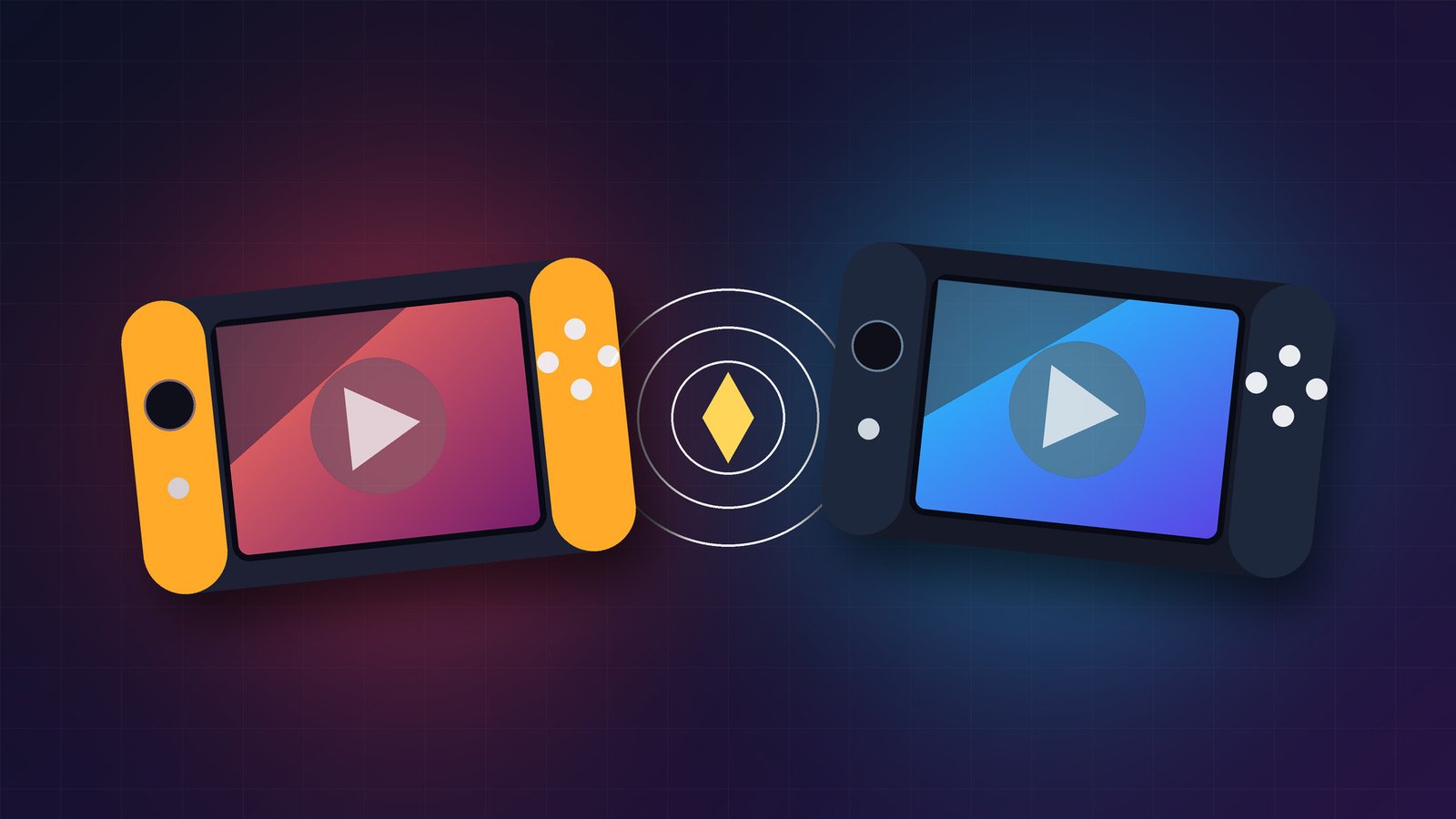
A PC handheld and the Switch 2 solve different problems, because one runs open PC software through Windows or SteamOS and the other runs a closed console library with games found on no other hardware.
The old advice that the Steam Deck is the budget choice no longer holds, because Nintendo lists the Switch 2 at $499.99 from 1 September 2026 while Engadget lists the Steam Deck OLED at $789 after Valve’s May 2026 increase.
Raw speed rarely decides the winner, because Engadget puts the Switch 2 at about 1.71 TFLOPS in handheld mode against 1.6 for the Steam Deck, and the gap opens only when the Switch 2 is docked at up to 3.7 TFLOPS.
Battery life is a weak point on both sides, because Nintendo rates the Switch 2 at 2 to 6.5 hours while PC Gamer’s gaming battery test ran for 125 minutes on the ROG Xbox Ally X.
Software prices decide the long-run total, because Steam discounts older and indie games often while Engadget says flagship Nintendo titles such as Mario Kart World rarely drop in price.
Your existing game library should decide the purchase, because Steam games move to a PC handheld without repurchase and Nintendo exclusives never leave Nintendo hardware.
What separates a handheld gaming PC from the Switch 2?
A handheld gaming PC is a portable computer, usually running Windows 11 or SteamOS, that plays games from open stores such as Steam. The Nintendo Switch 2 is a closed hybrid console built around a custom Nvidia processor, according to Nintendo’s technical specifications page, and it plays games licensed for Nintendo hardware.
That difference shapes everything else. The Steam Deck, the ROG Xbox Ally X and the MSI Claw 8 EX AI+ use x86 processors from AMD or Intel, the same processor design as desktop PCs, so they can run PC games natively on Windows or through the Proton compatibility layer on SteamOS. The Switch 2 uses Arm cores, and PC Gamer’s June 2025 comparison notes that this helps efficiency but limits which software can run. A hybrid console, in plain terms, works both as a handheld and docked to a TV.
SteamOS is Valve’s Linux-based operating system for the Steam Deck, built to feel like a console. Windows handhelds such as the ROG Xbox Ally X add an Xbox full screen experience over Windows 11, which PC Gamer says is still less unified than SteamOS. The Switch 2 runs Nintendo’s own system software, so there are no operating system choices to make.
How much do these devices cost in 2026?
In the US, the Switch 2 is the cheapest device in this comparison, at $499.99 from 1 September 2026 according to Nintendo’s price notice, up from $449.99.
Valve raised Steam Deck OLED prices in May 2026, and Engadget’s September 2026 comparison lists the 512 GB model at $789 and the 1 TB model at $949, up from $549 and $649.
PC Gamer’s handheld guide, last updated on 29 October 2026, puts the ROG Xbox Ally X at $1,000 and the MSI Claw 8 EX AI+ at $1,800, and says price rises have removed the Steam Deck from its budget pick.
Regional prices differ. In its May 2026 notice, as reproduced by Gematsu, Nintendo lists Canada rising from $629.99 to $679.99 CAD before tax and Europe from €469.99 to €499.99 including tax on 1 September 2026, and the Japanese-language system in Japan rising from ¥49,980 to ¥59,980 on 25 May 2026. The US figures here do not tell you what any device costs in your country, so check the local store, because tax rules and availability vary by region.
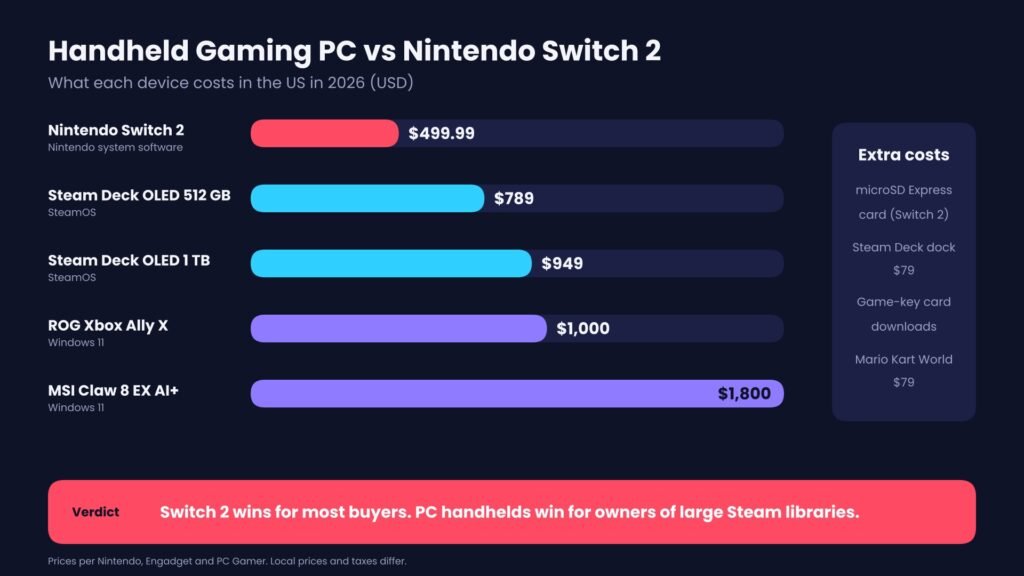
Specs and prices come from Nintendo, Engadget, Digital Trends and PC Gamer as cited above, in US dollars, and local pricing and taxes differ.
| Device | Operating system | Screen | US price (USD) |
| Nintendo Switch 2 | Nintendo system software | 7.9-inch LCD, 1920×1080, up to 120 Hz | $499.99 |
| Steam Deck OLED 512 GB | SteamOS | 7.4-inch OLED, 1280×800 | $789 |
| Steam Deck OLED 1 TB | SteamOS | 7.4-inch OLED, 1280×800 | $949 |
| ROG Xbox Ally X | Windows 11 | 7-inch IPS, 1920×1080 | $1,000 |
| MSI Claw 8 EX AI+ | Windows 11 | 8-inch IPS, 1920×1200 | $1,800 |
At these prices, the Switch 2 is the sensible pick for a first-time buyer who mainly wants to play on a TV and on the go, and a PC handheld is worth the premium only when a Steam library or Windows software justifies it.
What drives the price of each device?
Four factors explain most of the price gap between the two categories, and the first is new in 2026.
- Memory and storage costs: Valve attributed its May 2026 increase to them, as Engadget reported, while Nintendo cited market conditions.
- Storage tier: Engadget lists the Steam Deck OLED 1 TB at $949 against $789 for the 512 GB model.
- Chip memory demand: PC Gamer says the MSI Claw 8 EX AI+ price is unlikely to fall soon because its Intel chip needs large amounts of fast memory.
- Region and tax: Nintendo’s prices differ by market, with US and Canadian figures excluding tax and European figures including it.
Memory costs touch all four factors, so confirm the price on the vendor’s page on the day you buy.
What costs extra after you buy the device?
The sticker price leaves out items that many buyers need within the first month.
- A microSD Express card for the Switch 2, because Nintendo’s specifications say its slot accepts only that card type, up to 2 TB.
- A dock for the Steam Deck, which Engadget prices at $79 for TV play.
- Storage and a download for game-key cards, because Nintendo’s game-key card page says the full game must be downloaded to system memory or a microSD Express card.
- Full-price first-party games, because Engadget reports Mario Kart World still retailing at $79 when it wrote its September 2026 comparison.
Add these items to the console price before comparing totals, because the lowest sticker price is not always the lowest setup cost.
Steam Deck vs Switch 2: which one is faster?
Slightly, and mostly when docked. Engadget puts the Switch 2’s graphics at about 1.71 TFLOPS in portable play against 1.6 TFLOPS for the Steam Deck, and up to 3.7 TFLOPS docked. A TFLOPS is a trillion floating-point calculations per second, a rough measure of graphics throughput.
The processors trade strengths. The Switch 2 has eight Arm cores against four Zen 2 cores on the Steam Deck, but Engadget notes the Deck’s cores reach 3.5 GHz while the Switch 2’s normally run at 1.1 GHz, and the Deck carries 16 GB of memory against 12 GB. An upscaler renders a game at a lower resolution and enlarges the image, and Nvidia’s DLSS gives the Switch 2 an edge in some games, helping Cyberpunk 2077 reach 1080p when docked, according to Engadget. AMD’s FSR fills the same role on the Deck.
Optimisation matters as much as hardware. Engadget explains that the Switch 2 is a fixed platform, so developers tune each game for one set of hardware, while many modern PC titles need lowered settings on a Steam Deck even with the Steam Deck Verified label.
Newer Windows handhelds are clearly faster than both. PC Gamer’s guide records an average of 41 frames per second in Cyberpunk 2077 at 1080p medium settings on the ROG Xbox Ally X and 51 on the MSI Claw 8 EX AI+, against 35 on the Lenovo Legion Go S running SteamOS.
Some newer handhelds, such as the MSI Claw 8 EX AI+ with its Intel Arc G3 Extreme chip, borrow designs from laptops, so terms like NPU, a chip block for AI tasks, now appear in handheld marketing.
These frame rates come from PC Gamer’s and Engadget’s published testing, not from Arcnet’s own benchmarks.
How do display and battery life compare?
The Switch 2 has the larger screen and the Steam Deck OLED has the better panel, while battery life is modest on both sides. Nintendo specifies a 7.9-inch LCD at 1920×1080 with variable refresh rate up to 120 Hz, and rates the battery at 2 to 6.5 hours depending on the game.
Engadget says the Steam Deck’s OLED display gives it an edge for pure handheld play despite its lower 1280×800 resolution, because the Switch 2’s LCD is a step down in picture quality. Variable refresh rate matches the screen’s refresh to the game’s frame rate, and Digital Trends’ April 2025 comparison lists it on the Switch 2 but not on the Steam Deck OLED.
Battery tests use different methods, so treat them as separate yardsticks. PC Gamer’s June 2025 comparison found the Switch 2 lasted about two hours fifteen minutes in Cyberpunk 2077 at full brightness against one and a half hours for the Steam Deck LCD model. In its handheld guide, PC Gamer’s gaming battery test ran 125 minutes on the ROG Xbox Ally X, 153 minutes on the MSI Claw 8 EX AI+ at full power and 308 minutes in the Claw’s 20 W Endurance mode.
Which platform has better games and cheaper software?
A PC handheld gives you the open PC catalogue and frequent discounts, while the Switch 2 gives you Nintendo’s own games, which exist on no other hardware. Engadget notes that daily Steam sales make discounted games easier to find than on the Switch 2, and that Nintendo’s flagship titles rarely get big price cuts.
The Switch 2 accepts both Switch 2 and original Nintendo Switch game cards, according to Nintendo’s specifications, and Engadget points to Donkey Kong Bananza as the kind of must-buy exclusive that justifies the console. Some physical Switch 2 releases are game-key cards, which Nintendo’s game-key card page says hold no game data: the full game must be downloaded, and the card must stay inserted to play.
A PC handheld reaches Steam, and Windows models run the same launchers and anti-cheat software as a desktop PC, though support still varies by game. Valve’s Steam Deck Verified label shows which games run well without tweaks, but GamingOnLinux reported in September 2024 that GTA Online stopped working on Steam Deck after Rockstar added BattlEye anti-cheat without enabling Linux support, and it listed several Battlefield games that moved from Playable to Unsupported because of EA’s anti-cheat. Check a game’s current status before buying.
For example, a reader who already owns hundreds of Steam games moves them to a PC handheld at no extra software cost, while a reader who wants the newest first-party Nintendo release has no PC option at all.
Three cost patterns separate the platforms over a year of play.
- Discounts: Steam sales are frequent, while Engadget says Nintendo’s flagship titles rarely drop.
- Existing library: Steam purchases move to a PC handheld without repurchase, and PC Gamer’s 2025 comparison says the value depends on how large your backlog is.
- Physical copies: Switch 2 boxes marked with a key icon hold no game data, so plan for the download and the storage.
Count the library you already own before you count the hardware price.
Where does each device fall short?
Each device has limits that reviews often skip: the Switch 2 cannot leave Nintendo’s ecosystem, and PC handhelds cost more and ask more of the owner. The two lists below name the main limits so you know what you accept.
Switch 2 limits
Four limits matter most for the Switch 2 in daily use.
- It plays Nintendo-licensed games only, and PC Gamer notes its Arm processor limits which software it can run.
- Game storage grows only through microSD Express cards, according to Nintendo’s specifications.
- Repairability is low: iFixit scored it 30 percent against 70 percent for the Steam Deck, as PC Gamer reported in June 2025.
- The LCD panel is a step below OLED in picture quality, according to Engadget.
These limits matter most to players who travel often or keep a console for many years.
PC handheld limits
Five limits matter most for PC handhelds.
- Price: Engadget lists the Steam Deck OLED at $789 and PC Gamer lists the ROG Xbox Ally X at $1,000.
- Windows handhelds add an overlay over Windows 11, which PC Gamer says is still less unified than SteamOS.
- SteamOS compatibility depends on each game, and anti-cheat can block online play, as GamingOnLinux reported.
- Screens vary: the Steam Deck’s is 1280×800, and PC Gamer calls the ROG Xbox Ally X screen dull.
- TV play is less simple, because Engadget says the Steam Deck’s dock experience is not as user-friendly as the Switch 2’s home screen.
These limits matter most to buyers who want a device they never have to think about.
Is a handheld gaming PC 2026 purchase still worth it after the price rises?
It is worth it for buyers who already own a Steam library, need Windows software or enjoy adjusting settings. After the 2026 price rises, the extra money over a $499.99 Switch 2, per Nintendo, has to buy something you will use.
Two examples show the split. A player with a large Steam library who wants those games on a sofa or a train gets immediate value from a PC handheld. A parent buying one device for two children who share a TV will usually be better served by the Switch 2, because its dock and simple menus need little setup.
Seven inputs decide this choice, so weigh each against your own situation.
- Existing library: owned Steam games favour a PC handheld.
- Exclusives: any must-play Nintendo title favours the Switch 2.
- Budget ceiling, including dock, card and first games.
- Where you play: switching between a TV and handheld suits the Switch 2.
- Tolerance for settings, updates and compatibility checks.
- Online multiplayer: check anti-cheat support for your games.
- Region: local prices, tax and stock differ.
If most inputs point one way, that device is your answer.
Portable gaming comparison: which one wins for your situation?
The Switch 2 wins for first-time buyers, families and anyone who wants Nintendo games, and a PC handheld wins for existing PC gamers who want their library on the move. Choosing a handheld is choosing a software library first and a chip second.
Match your situation to one of these five profiles.
- Nintendo fan or family buyer: choose the Switch 2 at $499.99 per Nintendo, for exclusives and simple TV switching.
- Steam owner who values the screen: choose a Steam Deck OLED at $789 per Engadget, if the price is acceptable.
- Windows user who needs other launchers: choose a Windows handheld such as the ROG Xbox Ally X at $1,000 per PC Gamer.
- Speed first, cost second: choose the MSI Claw 8 EX AI+, which PC Gamer calls the fastest handheld it has tested and compares, at $1,800, to the cost of a full gaming PC with a Radeon RX 9070 XT.
- Tight budget with Steam games: PC Gamer names the non-X ROG Xbox Ally as its budget pick and says it costs significantly less than the X model.
Arcnet’s pick for most readers is the Switch 2, and for owners of a large PC library, the PC handheld that fits their budget.
Common mistakes and practical tips
Mistakes to avoid
Most buyer’s remorse in this category comes from four avoidable mistakes.
- Trusting 2025 prices: PC Gamer’s June 2025 comparison lists the Switch 2 at $450 and the Steam Deck LCD at $399, figures that no longer apply.
- Buying the Steam Deck for its old budget reputation, which PC Gamer says price rises have ended.
- Forgetting storage and downloads, such as a microSD Express card or a game-key card download.
- Assuming every PC game runs on SteamOS, when anti-cheat can block online modes.
Checking these four items before checkout removes most surprises.
Frequently asked questions
1. Can a PC handheld play Nintendo Switch 2 games?
No. PC Gamer’s comparison states that you cannot legally play Switch 2 games on any other device, because Nintendo’s titles are made for its own hardware. A PC handheld plays PC games from stores such as Steam instead, so owners who want Nintendo exclusives still need a Switch 2.
2. Can a PC handheld connect to a TV like the Switch 2?
Yes. Engadget says the Steam Deck can connect to a TV through a dock that costs $79, though it describes the experience as less user-friendly than the Switch 2’s home screen. Nintendo’s specifications list TV output of up to 4K at 60 frames per second for the Switch 2.
3. Does the Switch 2 play original Switch games?
Mostly. Nintendo’s specifications say the Switch 2 accepts both Switch 2 and Nintendo Switch game cards, and Nintendo publishes a game compatibility list on its site. Some older titles may not be compatible, so check that list for any game you care about before relying on it.
4. How much memory and storage should a PC handheld have?
PC Gamer’s handheld guide recommends 16 GB of memory as the minimum, because the memory is shared between the system and graphics, and says around 1 TB of storage is the sweet spot, though larger capacity adds to the price. The ROG Xbox Ally X has 24 GB of memory and 1 TB of storage, according to the same guide.
5. Do Switch 2 game-key cards need internet to play?
Only at first. Nintendo’s game-key card page says an internet connection and enough free storage are needed to download the game, and a connection is required only when the game launches for the first time. The card must stay inserted whenever you play.
6. Is a Steam Deck 2 coming?
PC Gamer has reported that Valve is still developing a Steam Deck 2 and that the memory shortage has not really affected that work. None of the sources reviewed for this guide gives a release date or price, so treat any date you see as unconfirmed until Valve announces it.
What to do next
Start with the library you already own, because that decides the platform before any benchmark does. For most readers the Switch 2 is the sensible choice at its current list price, while a handheld gaming PC 2026 purchase fits owners of large Steam libraries who accept the higher cost. In any Steam Deck vs Switch 2 decision, the games you want matter more than the chip. Before paying, open the vendor’s store page for your country and total the console, dock, storage card and first games for each device.