
Introduction
AI answer engines now write a response first and show links second, which changes what it means to be found online. A new label for working in that environment has spread quickly, and so has confusion about whether it replaces search engine optimization or simply renames it. This guide separates what is documented from what is marketing: where the term came from, what the research found, what Google itself says, and which steps are worth taking. It also covers the gaps most explainers skip, including crawler access, measurement and who can safely ignore the topic.
Quick Answer
Generative engine optimization (GEO) is the practice of preparing content and site access so AI answer engines, such as ChatGPT, Perplexity and Google’s AI Overviews, can retrieve and cite it. SEO competes for a position in a list of links. GEO competes for a place inside the generated answer, and it builds on SEO instead of replacing it.
Key Takeaways
Google’s documentation says optimizing for generative AI search is still SEO, so a page must be indexed and eligible for a snippet in Google Search before it can appear as a supporting link in AI Overviews or AI Mode.
The research behind GEO is split, with one benchmark reporting visibility gains from citations and statistics and another finding most such tactics ineffective, so edits aimed at AI answers should be treated as tests, not guarantees.
Blocking a search crawler removes a site from that engine’s answers, while blocking a training crawler does not, so each user agent needs its own decision.
Files such as llms.txt, content chunking and special markup are not needed for Google’s AI features, so effort is better spent on original information that other pages lack.
Citations and impressions can be measured in Search Console and Bing Webmaster Tools, but chat referrals may be misattributed as direct traffic, so no single number should decide whether GEO is working.
GEO pays off most for sites whose audience researches through AI assistants and whose pages are already indexed, while for everyone else the first investment is basic SEO.
What Is Generative Engine Optimization (GEO)?
Generative engine optimization (GEO) is the practice of shaping content and site access so AI answer engines can find a page, understand it and cite it in a generated response. A generative engine retrieves web pages, then uses a large language model (LLM), a model trained on text, to write an answer from them.
The term was formalized in a KDD 2024 research paper by Pranjal Aggarwal and colleagues, first posted to arXiv in November 2023. The authors framed GEO as a way for content creators to improve visibility in generative engine responses, where creators otherwise have little control over how their content is displayed.
People who search for “generative engine optimization GEO” usually want one of two things: a definition, or a verdict on whether it replaces search engine optimization. The definition is stable enough to use. The verdict is contested, and Wikipedia’s entry on the topic notes that no consensus definition separating GEO from related terms had been established in the academic literature as of early 2026.
What Do AEO, LLMO and AI Search Optimization Mean?
They are overlapping labels for the same area of work. Answer engine optimization (AEO), large language model optimization (LLMO), artificial intelligence optimization (AIO) and AI search optimization all describe efforts to appear in AI-generated answers, and practitioners use them interchangeably. Google’s guide to generative AI search mentions AEO and GEO by name as terms used for this work, and this guide treats GEO and AI search optimization as the same thing.
How Do AI Answer Engines Choose Their Sources?
Most AI answer engines retrieve a set of web pages first, then write an answer grounded in what they retrieved. Google describes this as retrieval-augmented generation (RAG), also called grounding, in its guide to generative AI features in Search, and says the retrieval step relies on its core ranking systems and Search index.
Google’s documentation also describes query fan-out, in which the model runs several related searches at once to gather material for one question. A question about fixing a lawn full of weeds, for example, can expand into separate searches about weed-control products, chemical-free removal and prevention. The consequence is that a page can be retrieved for a sub-question the reader never typed.
Visibility inside these answers is not a rank position. The KDD paper measured it by how many words of the answer are attributed to a source and how early those sentences appear, because a generated response has no simple ranked list.
GEO vs SEO: What Actually Changes?
SEO aims to earn a high position in a ranked list of links, while GEO aims to have a page retrieved, used and cited inside a generated answer. The two share most of their foundation, because Google states that its generative AI features are rooted in its core Search ranking and quality systems.
The table compares three environments using Google Search Central, OpenAI and Perplexity documentation as sources, and it shows that GEO is not one system with one rulebook.
| Attribute | Classic Google Search | Google AI Overviews and AI Mode | ChatGPT search and Perplexity |
| What users see | Ranked links | Generated answer with supporting links | Generated answer with source links |
| Eligibility | Indexed; meets technical requirements | Indexed, snippet-eligible, not excluded in Search Console | Search crawler allowed in robots.txt |
| Crawler to manage | Googlebot | Googlebot | OAI-SearchBot; PerplexityBot |
| Training crawler | Not applicable | Google-Extended for some other systems | GPTBot (OpenAI) |
| Built-in reporting | Performance report | Generative AI performance report | Check vendor documentation |
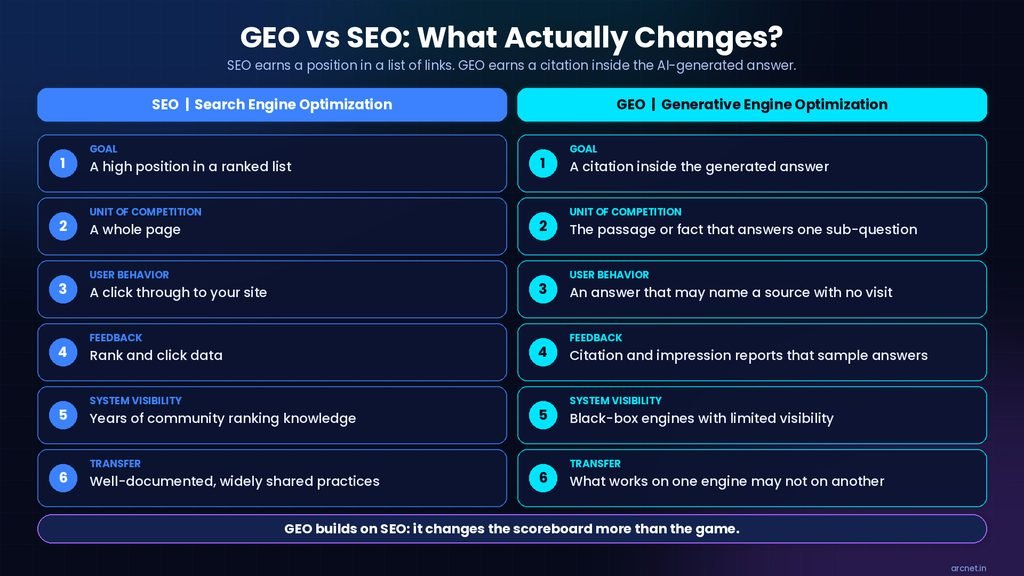
Six differences matter in day-to-day work.
- Goal: a high position in a list versus a citation inside an answer.
- Unit of competition: a whole page versus the passage or fact that answers one sub-question.
- User behavior: a click to your site versus an answer that may name a source without a visit.
- Feedback: rank and click data versus citation and impression reports that sample answers.
- Visibility into the system: years of community knowledge about ranking versus engines the KDD paper calls black boxes.
- Transfer: tactics that work on one answer engine may have no effect on another, and the KDD paper found effectiveness varies by query domain.
In practice, GEO changes the scoreboard more than the game, so the sound approach is to treat it as an extension of SEO with extra checks, not as a separate budget.
What Does the Research Say About GEO Tactics?
The research is real but thin, and parts of it contradict each other. The KDD 2024 paper reported visibility gains of up to 40 percent in generative engine responses, while the C-SEO Bench study, a NeurIPS 2025 benchmark paper, found most conversational SEO methods largely ineffective.
What the KDD 2024 paper tested
The authors built GEO-bench, a benchmark of 10,000 queries across 25 domains, and used a language model to rewrite source pages with nine different methods, according to the paper. The paper states that its test engine fetched the top five Google results for each query and passed them to the gpt-3.5-turbo model to write the answer.
Five findings stand out in the paper’s results.
- The paper reports that citing sources, adding quotations and adding statistics raised visibility by 30 to 40 percent on its position-adjusted word count metric.
- Clearer, more fluent writing raised visibility by 15 to 30 percent in the paper’s results.
- A more authoritative tone produced no significant improvement, according to the paper.
- Keyword stuffing gave little to no improvement, and on Perplexity it scored about 10 percent below the unedited baseline, the paper reports.
- When every source was optimized at once, the paper reports that citing sources raised visibility for fifth-ranked pages by 115.1 percent while the top-ranked page lost 30.3 percent on average.
Read together, these results suggest that evidence and clarity help while keyword repetition does not.
Why the results do not settle the question
The test engine was a simplified research setup, and the authors note in their limitations that methods may need to adapt as generative engines evolve. The edits were also produced by a language model rewriting existing pages, which is not the same as a publisher adding original reporting.
The C-SEO Bench authors tested question answering and product recommendation, with three domains each, and report that most tested methods were largely ineffective while traditional SEO strategies, which improve a source’s ranking in the model’s context, worked significantly better. They also found that gains shrink as more publishers adopt the same methods, which they describe as a congested, zero-sum problem.
The two studies measure different engines, tasks and tactics, so neither is a verdict on every engine. A defensible reading is that citing named sources and writing clearly are inexpensive and also help human readers. A tactic that stops working once competitors adopt it is a temporary edge, not a strategy.
How Do You Start With Generative Engine Optimization GEO Without Wasting Effort?
Start with access, then content, then measurement. Access comes first because an engine cannot cite a page it cannot fetch. Google’s guide to generative AI search states that a page must be indexed and eligible to appear in Search with a snippet, and that the site must be included in Search generative AI features in Search Console, to be eligible for display in AI Overviews and AI Mode.
Make sure engines can reach your pages
These steps need only access to your robots.txt file, your hosting or CDN settings and Search Console.
- Open your robots.txt file by adding /robots.txt to the end of your domain. Expected result: plain-text rules grouped by User-agent.
- Search the file for rules that disallow OAI-SearchBot or PerplexityBot, because OpenAI’s crawler documentation says sites opted out of OAI-SearchBot will not be shown in ChatGPT search answers.
- Remove or narrow those rules if you want to appear in those engines’ answers.
- Decide separately about GPTBot, because OpenAI documents it as the training crawler and treats each setting as independent.
- Open the URL Inspection tool in Search Console and test your most important page. Expected result: confirmation that Google has indexed it.
- Check in Search Console that your site has not been excluded from Search generative AI features, which Google’s help page for the Generative AI performance report lists as a possible reason for missing data.
- Ask your host or CDN provider to allow the crawlers’ published IP ranges if bot protection is active, because OpenAI and Perplexity both recommend allowing requests from their published ranges.
To allow both search crawlers explicitly, add these lines to robots.txt:
User-agent: OAI-SearchBot
Allow: /
User-agent: PerplexityBot
Allow: /
Consider a site whose robots.txt welcomes every crawler while its CDN’s bot protection returns an error to unrecognized user agents. The file looks correct, yet the pages never reach the engine. Two failure points are worth checking when pages still do not appear.
- A firewall or CDN rule blocks the crawler even though robots.txt allows it. Recognize it by 403 or blocked responses for those user agents in server logs, and fix it by allowing the published IP ranges.
- The change has not taken effect yet. OpenAI states that its search systems can take about 24 hours to adjust after a robots.txt update, so wait before reverting.
Make each page worth citing
Content changes come second, and each one also serves human readers.
- Put a direct answer in the first two or three sentences under each question-style heading, then add detail.
- Name the source in the same sentence as any figure, so a passage lifted out of the page still carries its evidence.
- Add something other pages lack, such as first-hand detail, original data or a decision with its trade-offs.
- Keep key facts in text, and add images or video where they clarify the point, following YouTube SEO practice for any video you publish.
- Update pages when facts change, because Google says grounding relies on retrieving up-to-date pages from its index.
These edits overlap with ordinary on-page work, so a guide on how to optimize blog posts for SEO covers the same ground in more detail.
Pro tip: ask the same question in two or three answer engines, then note which sources are cited and how each cited page opens. That shows the pattern engines currently reward for your topic.
Common mistakes to avoid
Four mistakes are worth avoiding.
- Blocking every crawler with a blanket rule, which also blocks the search crawlers that surface pages in answers.
- Inserting invented or unsourced statistics to imitate the paper’s statistics method, which misleads readers and weakens trust.
- Assuming a tactic proven on one engine or topic works everywhere, when the research shows results vary by domain.
- Reading a drop in ChatGPT referrals as lost demand before checking direct traffic and attribution changes.
Which GEO Tactics Can You Skip?
Skip any tactic that promises a secret formula for AI answers. Google’s guide, last updated on 10 July 2026, names several popular practices as unnecessary for Google Search, and it adds that creating files such as llms.txt for other services is fine because Google Search ignores them.
Google’s list, plus one finding from the research, covers six tactics.
- llms.txt and other AI-specific files: Google Search does not use them, though other services might.
- Chunking content into tiny pieces: Google says there is no such requirement, because its systems can show the relevant part of a page that covers several topics.
- Rewriting pages only for AI systems: Google says its systems understand synonyms and general meaning, so you need not chase every long-tail variant.
- Seeking inauthentic mentions across the web: Google says this is less helpful than it seems, because its systems also block spam.
- Special structured data for AI features: Google says no special schema.org markup is required, though structured data still supports rich results.
- Keyword stuffing: the KDD paper found it gave little to no improvement in generative engine responses.
Google’s statements apply to Google Search and other engines publish less guidance, so the cautious reading is to spend effort on original information, which Google’s guide describes as the largest long-term influence on presence in generative AI search.
How Do You Measure Results From AI Search?
Measure AI visibility with several imperfect signals together, because no single report shows rankings, citations and clicks across every engine. Google’s Search Console Help states that, as of 31 August 2026, its Generative AI performance report is available to all websites worldwide, and the report covers impressions from AI Overviews and AI Mode.
Microsoft launched AI Performance in Bing Webmaster Tools in public preview on 10 February 2026, according to Search Engine Land, and the dashboard reports total citations, grounding queries and page-level citation activity. Grounding queries are sample phrases that AI systems used to retrieve and cite a publisher’s content, and Search Engine Land notes that the metrics show citation frequency, not ranking, prominence or clicks.
Six signals are worth tracking together.
- Search Console Generative AI performance report: impressions from AI Overviews and AI Mode by page, country, device and date.
- Bing Webmaster Tools AI Performance report: citations and grounding queries for Microsoft’s AI surfaces.
- Server logs: requests from OAI-SearchBot and PerplexityBot, which show access, not citation.
- Referral analytics: visits from chat assistants, read with the attribution caveat below.
- Manual prompt sampling: the same questions asked on a schedule in several engines, with cited sources recorded.
- Third-party AI visibility trackers: useful for sampling, though Google warns that no third-party tool has access to its internal ranking or AI systems.
Because each signal is partial, a change in one should prompt a check of the others before anyone calls it a trend.
Why does AI referral traffic look unreliable?
Search Engine Land reported on 15 October 2026 that ChatGPT links appear to have stopped carrying the utm_source=chatgpt.com parameter, which can make visits arrive as direct traffic, and that OpenAI had not confirmed the change. A falling ChatGPT referral line alongside rising direct traffic may therefore reflect a tracking change rather than lost interest, so review both together.
Is GEO Worth the Effort, and Who Can Ignore It?
GEO deserves deliberate effort when your audience researches through AI assistants and your pages are already indexed, because those conditions make citation possible and measurable. It deserves little effort when basic SEO is unfinished, since Google ties AI visibility to its existing Search index and quality systems.
Six factors decide whether to invest.
- Access: confirm that search crawlers can fetch and index your pages before anything else.
- Audience behavior: check referral and Search Console data for signs that readers arrive from AI features.
- Content type: original, specific information benefits, while commodity content, Google’s term for advice anyone could write, does not.
- Measurement: without at least one of the reports above, the effort cannot be judged.
- Cost: editing time plus any tracking subscription, and tracker pricing differs by vendor and plan, so check each vendor’s pricing page before committing.
- Competition: the C-SEO Bench authors found gains shrink as adopters multiply, so a durable edge comes from information competitors lack.
The defensible default is to fix SEO fundamentals, open access for the engines that matter, and apply GEO edits only to pages that already earn attention.
What GEO cannot do
GEO cannot guarantee a citation. Google states that meeting every requirement does not guarantee that it will crawl, index or serve a page, and the KDD paper describes generative engines as black boxes whose source selection creators cannot see. Forrester analyst Nikhil Lai argued in 2025, as cited on Wikipedia’s entry on GEO, that AEO and related terms differ from SEO significantly but not fundamentally, a view consistent with Google’s position. Because original information is what engines reward, GEO belongs inside a wider content marketing strategy, not beside it.
What to Do Next
The evidence supports a modest conclusion: AI answer engines reward the same foundations that search engines do, plus clear evidence and open access. Treat generative engine optimization GEO as SEO with extra access checks, sourced writing and wider measurement, because the research is mixed and Google’s guidance points back to fundamentals. The GEO vs SEO question is mostly about scoreboards, not rival playbooks. Before spending on AI search optimization, open your robots.txt file and confirm that neither OAI-SearchBot nor PerplexityBot is disallowed, then check that your CDN lets them through.
Frequently Asked Questions
1. Is GEO the same as answer engine optimization (AEO)?
Largely yes. Practitioners use GEO, AEO, LLMO and AI search optimization interchangeably, and Wikipedia notes that no consensus definition separating these terms had been established as of early 2026. Google’s guide mentions AEO and GEO together as terms describing work on AI search visibility, and the practical steps overlap almost completely.
2. Does GEO replace SEO?
No. Google states that its generative AI features are rooted in its core Search ranking and quality systems, so SEO fundamentals remain the base. The C-SEO Bench authors likewise found traditional SEO strategies significantly more effective than most conversational SEO methods. GEO works as an added layer of checks and edits.
3. Do I need an llms.txt file for GEO?
Not for Google Search. Google’s guide says Search does not use llms.txt files and that creating one will neither help nor harm visibility there. Other services may read such files, so adding one is optional, but it should not take priority over crawl access and original content.
4. Does blocking GPTBot remove my site from ChatGPT search?
No. OpenAI documents GPTBot as the training crawler and OAI-SearchBot as the crawler that surfaces sites in ChatGPT search, and it says each robots.txt setting is independent. Sites that opt out of OAI-SearchBot will not be shown in ChatGPT search answers, though they can still appear as navigational links.
5. Do GEO tactics work the same way on every AI search tool?
No. The KDD paper found that the effectiveness of GEO methods varies across query domains, and the C-SEO Bench authors note that methods for one domain may not work for others. Engines also use different crawlers and retrieval systems, so test a tactic on the engines your audience actually uses.