Introduction
Almost every large company has an AI agent pilot to show, and far fewer can point to a finance report that changed because of one. The failure statistics circulating online make the problem sound uniform, but they come from different studies that measured different things, and several are quoted with the wrong label attached. This guide traces each headline number to its primary source, defines what a project must demonstrate before it counts as paying off, and lists the decisions that separate stalled pilots from deployments finance recognises. It also covers the cost, governance and ownership questions that most pages leave to the last paragraph or skip.
Quick Answer
Enterprise AI agent adoption disappoints because most projects start from a demo rather than a measured business outcome, then meet messy data, legacy systems, missing governance and costs nobody modelled. Surveys from MIT NANDA, Deloitte and McKinsey agree that pilots are plentiful and enterprise-level financial impact is rare, which points to organisational causes more than model quality.
Key Takeaways
The most-quoted failure rates measure different things, so quoting them side by side overstates the evidence: Gartner issued a forecast, MIT NANDA studied returns from generative AI, and IDC counted proofs of concept that reached production.
Pilots are reaching production more often while financial payoff is not improving, because McKinsey’s State of AI 2026 survey reports that 37 percent of respondents attribute any earnings before interest and tax (EBIT) impact to AI, essentially the same share as a year earlier.
An agent pays off only when its cost per completed task sits below the fully loaded cost of the work it replaces, so the baseline has to be measured before the build starts.
Agents expose broken processes instead of repairing them, so redesigning the workflow matters more than choosing a model.
Production turns the question from whether an agent can do a task into who is accountable when it gets one wrong, so permissions, audit trails and escalation paths must exist before launch.
Buying beats building only for commodity workflows, because MIT NANDA’s build-versus-buy gap is self-reported and may reflect which organisations choose to buy.
How Bad Is Enterprise AI Agent Adoption, Really?
AI agent adoption is widespread but shallow: most large organisations are experimenting, a minority are scaling agents, and fewer can show financial impact. No single failure rate describes this, because the headline figures come from separate studies that counted different things. Read at the source, they paint a mixed picture, not a collapse.
Gartner’s number is a forecast, not a measurement. In a press release dated 25 June 2025, Gartner predicted that more than 40 percent of agentic AI projects will be cancelled by the end of 2027, citing escalating costs, unclear business value and inadequate risk controls. The same release describes agent washing, the rebranding of assistants, chatbots and robotic process automation (RPA) as agents, and Reuters reported that Gartner estimates only about 130 of the thousands of agentic AI vendors are real.
The 95 percent figure is the most quoted and the most mislabelled. MIT’s NANDA initiative (Networked Agents and Decentralized Architecture) published The GenAI Divide report in July 2025, saying 95 percent of organisations are getting zero return from generative AI, against an estimated 30 to 40 billion US dollars of enterprise investment. The MIT NANDA report rests on interviews with 52 organisations, a survey of 153 senior leaders and a review of more than 300 public initiatives, gathered between January and June 2025. MIT NANDA’s authors describe the figures as directionally accurate because they come from interviews rather than company reporting.
The MIT NANDA report also tracks task-specific enterprise tools separately: 60 percent of organisations evaluated them, 20 percent reached pilot and 5 percent reached production. It studied generative AI broadly, so none of these numbers is an agent-specific failure rate.
The 88 percent figure is a general AI proof-of-concept statistic, not an agent one. CIO reported on 25 March 2025 that research by International Data Corporation (IDC) with Lenovo found four of every 33 AI proofs of concept reached production, which the publication headlined as 88 percent failing to reach production. Several pages repeating the number attach it to AI agents or to other research firms, but its traceable origin is IDC and Lenovo.
A later edition of the same programme reports a higher figure, although its sample differs. Lenovo’s CIO Playbook 2026, built on IDC research among 800 IT and business decision-makers in Europe and the Middle East, says 46 percent of proofs of concept reach production, and that 16 percent of those organisations use agentic AI significantly while 54 percent are exploring or piloting it. Lenovo commissioned the research, and the regions and samples differ, so the two IDC figures are not a like-for-like trend.
Deloitte’s State of AI in the Enterprise 2026 report found that only 25 percent of respondents had moved 40 percent or more of their AI pilots into production.
McKinsey’s State of AI 2026 survey, fielded from 4 May to 8 June 2026 with 1,719 participants in 97 nations, found that 40 percent of respondents from organisations with more than 1 billion US dollars in annual revenue report scaling AI agents, up from 27 percent a year earlier, while smaller organisations stayed flat at 22 percent. The same McKinsey survey found that 37 percent of respondents attribute any EBIT impact to AI, essentially unchanged from 2025, and that about 6 percent qualify as AI high performers.
The table lists each source, its date and what it actually counted; every figure in it belongs to the source named in the first column of its row.
| Source and date | What it counted | Who was studied | What it cannot tell you |
| Gartner, 25 June 2025 | Forecast of agentic AI projects cancelled by end of 2027 | Analyst prediction | Whether projects have been cancelled yet |
| MIT NANDA, July 2025 | Organisations with no measurable return from generative AI | 52 interviews, 153 leaders surveyed, 300+ initiatives | Agent-specific results |
| IDC with Lenovo, reported by CIO, 25 March 2025 | AI proofs of concept reaching production | Organisations surveyed by IDC | Whether those in production paid off |
| Lenovo with IDC, January 2026 | Proofs of concept reaching production | 800 decision-makers, Europe and Middle East | Results outside that region |
| Deloitte, 2026 | Organisations that moved 40 percent or more of pilots to production | Leaders surveyed across 24 countries | Whether the pilots were agents |
| McKinsey, 25 August 2026 | Agent scaling and enterprise EBIT impact | 1,719 respondents in 97 nations | Whether EBIT impact came from agents |
The most decision-useful figure here is McKinsey’s EBIT share, because it measures the outcome a finance team cares about, with the caveat that respondents report it themselves. The weakest evidence is any agent-specific failure rate, because none of the sources reviewed publishes a verified one.
Every figure above carries limits that change how far it can be pushed.
- Definitions differ: failure means cancelled, never reached production or no measurable return, depending on the study.
- Samples are self-selected: MIT NANDA’s appendix warns that organisations willing to discuss AI may differ from those that decline.
- Windows are short: MIT NANDA measured return six months after each pilot and says that window may understate success for complex systems.
- Sponsors have interests: Lenovo commissioned the IDC playbook research, and vendor pages often quote these numbers selectively.
Use these figures to calibrate expectations, not to forecast a specific project.
How Do You Measure AI Agent ROI?
AI agent return on investment (ROI) is the net business outcome an agent delivers after subtracting everything it costs to run, supervise and maintain, measured against the fully loaded cost of the work it replaces or improves. Time saved is a leading indicator, not a return. A project pays off when a metric that finance already tracks moves.
McKinsey’s State of AI 2026 survey shows why the distinction matters: 80 percent of respondents say AI improved their own productivity, yet only 37 percent attribute any EBIT impact to AI. Saved minutes are scattered across many people, and they become money only when they remove a contract, avoid a hire, shorten a measured cycle or reduce a measured error.
MIT NANDA’s report found its clearest savings in back-office work, where AI replaced outside spend such as business process outsourcing (BPO) contracts and agency fees rather than internal staff time. The same MIT NANDA report found that executives directed a large share of generative AI budgets to sales and marketing, partly because those outcomes are easier to attach a metric to, while stronger returns sat in functions where the benefit was harder to surface.
Cost per completed task is the number to model, and six inputs move it.
- Model usage: tokens consumed per task, which rise with long prompts, retrieval and repeated tool calls.
- Retries and loops: failed steps, re-planning and repeated calls multiply usage on the hard cases.
- Platform and integration: licences, hosting, connectors and identity setup, priced per seat, per task or per outcome depending on the vendor.
- Human supervision: review time for every output below the confidence threshold.
- Monitoring and evaluation: logging, testing and incident handling after launch.
- Maintenance: models, prompts, data and policies change, so someone must retest and update.
McKinsey’s State of AI 2026 survey reports that about 20 percent of respondents say AI operating costs, including token costs, have constrained their organisation’s use of AI, so cost ceilings are already a practical limit.
The comparison side is the fully loaded cost of the current process: salaries and overhead, outsourcing fees, rework, error costs and delay. Pro tip: record that baseline across one full business cycle before the pilot begins, because without it no later improvement can be shown. Common mistake: counting every saved minute as cash. Teams that already run cloud cost reviews can reuse the same discipline, as FinOps practices for cloud spend explains.
Time saved is a feeling an employee reports; payoff is a number finance recognises.
What Causes Agent Projects to Stall Before Payoff?
Agent projects stall because the decisions that determine payoff are made before any code runs: which outcome counts, which process to automate, who owns the result and what it may cost. MIT NANDA’s report says the gap appears to come from approach rather than model quality or regulation.
Research from IDC, Gartner, MIT NANDA and Deloitte points to eight recurring causes, most of them decisions rather than defects.
- No defined outcome: the charter says “improve productivity” with no baseline, target or owner, so finance cannot see what changed.
- The wrong tool: Gartner’s June 2025 release says many use cases positioned as agentic do not need agentic implementations, so a fixed workflow would have done.
- Process left unchanged: an agent added to an undocumented, exception-heavy process inherits every workaround and gap.
- Data the agent cannot trust: IDC’s authors, quoted by CIO, list insufficient AI-ready data among the obstacles.
- Integration and access: pilots use curated exports, production needs live systems, and Lenovo’s playbook lists integration among the top agentic challenges.
- Risk reviews done last: security, legal and audit teams see the project after the demo and can stop it.
- No accountable owner: the pilot team moves on and no business leader answers for results after launch.
- Costs modelled on the demo: pilot volume hides production volume, retries and supervision time.
Because most of these are decisions, they can be changed before money is spent.
McKinsey’s State of AI 2026 survey shows the same split from the other side: its high performers are twice as likely as others to report that senior leaders show commitment to AI and that defined processes measure impact, and nearly three-quarters of them have fundamentally redesigned workflows, against one-quarter of other respondents.
A hypothetical example shows the pattern. A shared-services team builds an agent to resolve invoice mismatches. In the demo it handles a tidy sample and the room is impressed. In production, invoices arrive in several formats, suppliers use different purchase order references, and approvals sit with managers who were never consulted. Accuracy was never the constraint; the approval path and the data matching were.
What Changes for AI Agents in Production?
AI agents in production meet conditions a pilot hides: unpredictable inputs, real volume, live permissions and no team watching every run. The question shifts from whether the agent can do the task to whether the organisation can supervise and correct it. Deloitte’s 2026 survey of 3,235 leaders in 24 countries found only 21 percent have a mature governance model for agentic AI.
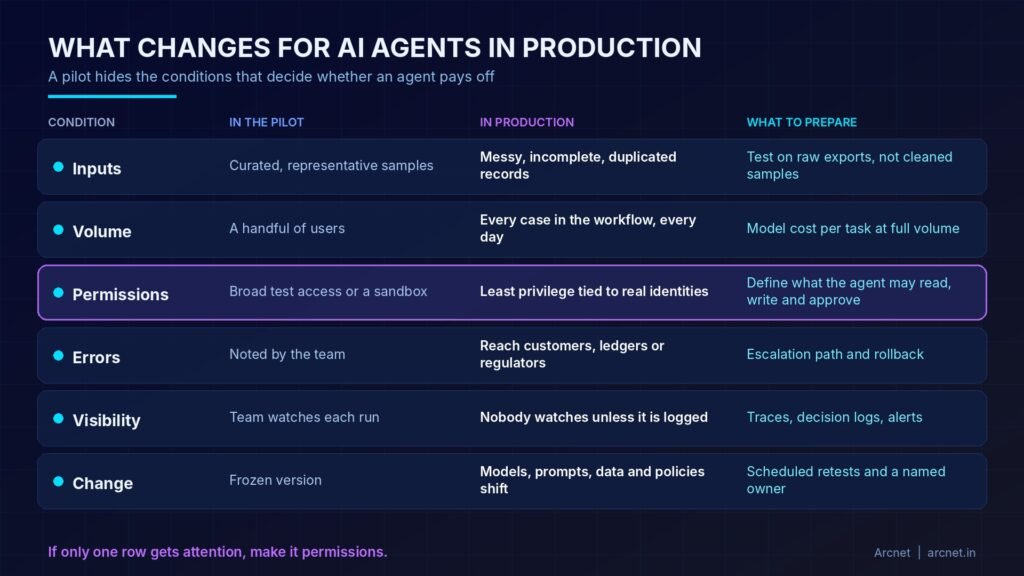
The table compares what a pilot assumes with what production delivers and what to prepare.
| Condition | In the pilot | In production | What to prepare |
| Inputs | Curated, representative samples | Messy, incomplete, duplicated records | Test on raw exports, not cleaned samples |
| Volume | A handful of users | Every case in the workflow, every day | Model cost per task at full volume |
| Permissions | Broad test access or a sandbox | Least privilege tied to real identities | Define what the agent may read, write and approve |
| Errors | Noted by the team | Reach customers, ledgers or regulators | Escalation path and rollback |
| Visibility | Team watches each run | Nobody watches unless it is logged | Traces, decision logs, alerts |
| Change | Frozen version | Models, prompts, data and policies shift | Scheduled retests and a named owner |
If only one row gets attention, make it permissions, because an agent with broad access turns every other failure into a larger one.
The Deloitte Insights analysis describes mature governance as clear limits on which decisions an agent may make alone, real-time monitoring that flags unusual behaviour, and audit trails covering the chain of agent actions. Lenovo’s CIO Playbook 2026 adds that agent permissions and identity belong inside existing security controls, and it warns against agent sprawl, meaning many agents with overlapping duties and unclear access. Rules also differ by region: the European Union’s AI Act applies in the EU, and other regions set their own requirements, so legal review belongs before the pilot.
Pro tip: launch supervised, with the agent drafting and a person approving, then remove approval one task type at a time once its error rate is measured. Common mistake: letting the pilot team double as the operations team, which leaves nobody accountable once the pilot is declared a success.
Agents that read outside text also inherit its risks, and how prompt injection works shows how hidden instructions in a document or web page can redirect an agent.
Should You Build, Buy or Skip the Agent?
Buy for commodity workflows, build only where the workflow is a competitive edge, and skip the agent when a fixed workflow would do. MIT NANDA’s interviews show externally built tools reaching deployment about twice as often as internal builds, but its authors warn the gap may reflect organisational differences rather than the approach.
Seven questions decide the choice, and the first two decide whether an agent is needed at all.
- Is the path predictable? Fixed steps and rules suit a workflow engine or RPA, which cost less and audit more easily.
- Does the task need judgment on unstructured input such as emails, contracts or free-text requests? That is where agents earn their cost.
- What does a wrong action cost, and can it be reversed? Irreversible actions need approval gates whichever route you choose.
- How many cases flow through each month? Low volume rarely repays a custom build.
- Does a system you already run ship this capability? Check the existing ERP, CRM or service platform before commissioning anything.
- Can your team operate it after launch, including monitoring, testing and updates? Building without operating capacity creates abandoned tools.
- Is the process or data your competitive edge? If so, building is defensible.
If the answer to the first question is yes and the answer to the fourth is low volume, skip the agent.
MIT NANDA’s report quotes a corporate lawyer whose firm paid 50,000 US dollars for a specialised contract-analysis tool yet who still defaulted to a general chatbot for drafting, because the purchased tool’s summaries were rigid. A purchased tool that users route around produces cost without adoption, and the same MIT NANDA report says workers at over 90 percent of surveyed companies reported regular use of personal AI tools while only 40 percent of companies had bought an official subscription. That gap is the pattern described in Arcnet’s piece on the shadow AI problem.
The calculation is also moving: McKinsey’s State of AI 2026 survey found that 32 percent of respondents decided against buying at least one software product or feature because agentic coding tools could build it in-house. Cheaper building does not remove the cost of running what is built, and Arcnet’s explainer on long-horizon coding agents covers how far unattended coding agents can currently go.
The safer default is to buy for commodity workflows such as service-desk triage or document intake, and to build only where the workflow differentiates the business. Negotiate exit and data-export terms at signing, because MIT NANDA’s interviews with buyers describe switching costs that become prohibitive once a system has learned a workflow.
How Do You Get an AI Agent Project to Pay Off?
Pick one high-volume workflow, record its baseline cost and error rate, write the success metric and the stop condition before building, redesign the process around the agent, and expand only after measured results hold for a full business cycle. Launch supervised; autonomy is earned task by task.
McKinsey’s State of AI 2026 survey reports that respondents most often scale agents in IT, knowledge management and software engineering, which suggests where well-defined workflows already exist.
The sequence below keeps each decision reversible until the evidence is in.
- Choose one workflow with high volume, clear inputs and an existing human process to compare against.
- Record the baseline cost per case, cycle time and error rate across one full business cycle.
- Write the success metric and the stop condition into the project charter, signed by the business owner and finance.
- Redesign the process on paper, removing steps that existed only because people did the work.
- Model cost per completed task at full volume, including retries and supervision time.
- Launch supervised, with the agent drafting, a person approving and every action logged.
- Review results against the baseline at fixed intervals, and remove approval only for task types with measured accuracy.
- Scale, fix or stop according to the written criteria, not enthusiasm.
Expected result: by step eight, the decision to continue rests on a comparison finance has already accepted.
Two failure points appear most often. The first is a skipped baseline, which shows up as a pilot report full of time-saved anecdotes and no number owned by finance. The second is approvals that never come off, which shows up as review time cancelling the agent’s savings, so track review minutes per case from the first week.
What to Do Next
Enterprise AI agent adoption pays off for organisations that treat each agent as an operational change with an owner, a baseline and a stop condition, not as a technology demonstration. The research shows pilots are easy to launch and production is getting easier, while financial impact stays concentrated in a small group that redesigned its workflows. Measuring AI agent ROI against a fully loaded baseline is what separates a credible case from a hopeful one. Before approving the next pilot, write down the current cost per case, cycle time and error rate of the workflow it targets, and get finance to sign that sheet.
Frequently Asked Questions
1. Does the MIT 95 percent figure apply to AI agents?
Not specifically. MIT NANDA’s July 2025 report studied generative AI initiatives broadly, and its 95 percent figure refers to organisations getting no measurable return rather than to agent projects. The report names agentic systems as a direction for fixing the learning gap. Treat the number as a signal about generative AI pilots, not an agent failure rate.
2. What is agent washing?
Agent washing is the rebranding of existing products, such as AI assistants, chatbots and robotic process automation, as agentic AI without real autonomy. Gartner used the term in its June 2025 press release and, as reported by Reuters, estimated that only about 130 of the thousands of agentic AI vendors are genuine. Ask vendors to demonstrate multi-step tool use on your own data.
3. How long does an AI agent take to show ROI?
No universal benchmark appeared in the sources reviewed, and the answer depends on workflow, volume and baseline. MIT NANDA measured return six months after each pilot and says that window may understate success for complex systems. Set a review date in the charter, compare against the baseline then, and agree in advance what result justifies continuing.
4. Do AI agents need human approval?
Not for every action, but every agent needs defined boundaries. Deloitte describes mature governance as clear limits on which decisions an agent makes alone, plus monitoring and audit trails. Lenovo’s CIO Playbook 2026 advises setting triggers, decision limits and points where humans must step in. Start with approval on everything and relax it task by task as accuracy is measured.
5. What is a good first use case for an AI agent?
A good first use case is high in volume, rules-heavy and well defined, with an existing human process to compare against. Lenovo’s CIO Playbook 2026 recommends high-volume, rules-heavy tasks in well-defined processes, and Deloitte says companies succeeding with agentic AI start with lower-risk use cases. Back-office work such as invoice exceptions or IT service requests fits that profile.