Introduction
Agentic AI changes what a data centre is asked to do. A chatbot answers once, but an agent plans, calls tools, checks its own work and loops, so a single task can mean many model steps separated by ordinary software running in between. This article traces how NVIDIA’s chips, memory, CPUs, networking and software are built around that pattern, which of its published claims rest on NVIDIA’s own tests, and where rivals and power limits push back. It also sets out the criteria for deciding whether to build, rent or wait.
Quick Answer
NVIDIA powers agentic AI by supplying the whole production line, not only chips. Its AI factory design pairs Rubin GPUs for model inference with Vera CPUs for tool calls and sandboxes, adds fast networking and orchestration software, and judges the result by tokens produced per unit of power.
Key Takeaways
Agentic AI turns inference into a long loop of model steps and tool calls, so an agent is limited by memory capacity, GPU-to-GPU bandwidth and CPU speed as much as by raw GPU arithmetic.
An AI factory is judged by tokens per watt and cost per token, which makes electricity access, not floor space, the first planning constraint.
A slow tool call can push an agent’s cached context out of GPU memory and force a costly rebuild, so CPU speed and memory sit on the critical path.
NVIDIA’s headline multipliers, such as up to 10x more agentic throughput per unit of energy than Blackwell, come from NVIDIA’s own tests on internal workloads, so treat them as targets to verify on your own agent traces.
Custom chips from Google, OpenAI and others are a real alternative for operators whose own models fill most of their fleet, but not for buyers who need one platform for training, fine-tuning and serving.
Build, rent or wait comes down to utilisation, power access, data rules, skills and exit path, not to which hardware generation is newest.
What Is Agentic AI, and Why Does It Need Different Hardware?
Agentic AI is software that pursues a goal by reasoning, planning, calling tools and checking results across many steps, instead of answering a single prompt. That changes the hardware demand from one burst of computation to sustained inference with low delay at every step, long context and large memory, as NVIDIA’s engineers describe it.
Three terms explain the rest of this article. Inference is a trained model producing output, a token is the small chunk of text it reads or writes, and the key-value cache, or KV cache, is the model’s working memory of the conversation so far. Keeping that cache intact between steps saves rework, and deciding what goes into it is a discipline of its own, covered in Arcnet’s explainer on context engineering.
A task such as fixing a bug or reconciling an invoice strings together reasoning, a tool call, a result check and more reasoning. Each pause between model steps is time the GPU either waits or spends on another user, and that tension drives most agentic infrastructure problems. Agents that run for hours push the pattern to its limit, as Arcnet’s guide to long-horizon coding agents explains.
What Are NVIDIA AI Factories, and How Do They Differ From a Data Centre?
NVIDIA AI factories are data centres designed around one product: intelligence, measured in tokens. NVIDIA’s glossary defines an AI factory as specialised computing infrastructure that manages the full AI life cycle, from data ingestion through training and fine-tuning to high-volume inference, while a general-purpose data centre handles a mixed set of workloads.
The difference shows up in what gets measured. NVIDIA’s token economics post, published on 27 May 2026, says AI factory economics are defined by tokens per second, tokens per watt, cost per token, utilisation and uptime. A general-purpose facility is usually judged on uptime, flexibility and cost across many applications instead.
In NVIDIA’s framing, the factory is the whole stack: GPUs, CPUs, high-speed networking, storage, liquid cooling, orchestration software and design tools, delivered through reference architectures and validated designs that partners such as Dell, HPE and Supermicro build on. NVIDIA says an AI factory can start small for one business unit or workload, or be built from the ground up for large-scale inference and training.
The term is part design distinction and part branding. Any site with AI-capable hardware is an AI data centre, and calling it a factory signals that the building, power, cooling and software were planned together as one piece of AI infrastructure around token output. A useful test is whether the operator tracks cost per token and utilisation, because that is what separates the two in practice.
How Does GPU Computing Power Agentic Workloads?
GPU computing helps agents by running huge numbers of matrix operations in parallel, but agentic inference is often limited by memory rather than arithmetic. NVIDIA’s Rubin GPU deep dive, published on 21 July 2026, says the generation phase of inference is bound by the memory subsystem, so the Rubin GPU pairs up to 288 GB of HBM4 memory with up to 22 TB/s of bandwidth.
HBM4 is high-bandwidth memory stacked beside the GPU. During generation, the model reads its weights and its KV cache for every token it writes, so more capacity keeps more of that cache on the GPU and more bandwidth feeds the compute units fast enough to use it. NVIDIA says the 22 TB/s figure is a 2.8x increase over Blackwell and Blackwell Ultra.
Large models are split across many GPUs, so GPU-to-GPU traffic matters as much as memory. NVIDIA’s Rubin post states that NVLink 6, its GPU interconnect, provides 3,600 GB/s of scale-up bandwidth, meaning traffic between GPUs inside one rack, and that the Vera Rubin NVL72 rack works as one execution domain with its own liquid cooling and power management.
NVIDIA’s headline claim is up to 10x more agentic throughput per unit of energy than Blackwell, measured on an internal workload that its post describes as a two-trillion-parameter mixture-of-experts model. A mixture-of-experts model routes each token to a subset of specialist networks, so results shift with model shape. Treat the multiplier as a design target, not a promise for your workload.
Pro tip: ask any vendor for the model, context length and response-speed target behind a multiplier, because the same chip yields very different ratios at different latency targets.
Why Do AI Agents Also Need CPUs?
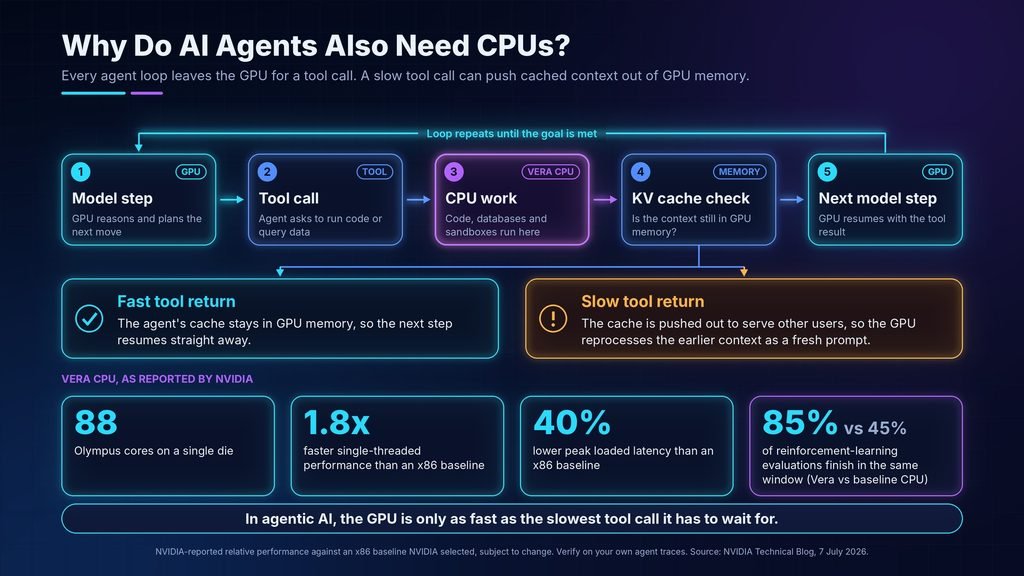
Agents spend part of every task outside the model, running code, querying databases and waiting on tools, and that work runs on CPUs. NVIDIA’s Vera CPU technical blog, published on 7 July 2026, argues that slow CPU steps leave GPUs idle or force them to evict cached context, which is why NVIDIA now designs a CPU for agent workloads.
Here is the mechanism. While an agent waits for a tool, a busy GPU fleet turns to other users’ requests. If the pause runs long, the agent’s KV cache can be pushed out of GPU memory, and when the tool returns the GPU must reprocess the earlier context as a fresh prompt. Faster tool execution shortens that window and keeps more context in memory.
NVIDIA reports that the Vera CPU has 88 Olympus cores on a single die, 1.8x faster single-threaded performance and 40 percent lower peak loaded latency than an x86 baseline. For reinforcement learning, a training method where a model improves from rewards earned in simulated tasks, NVIDIA says up to 85 percent of evaluations finish in the same window, versus 45 percent on a baseline CPU.
NVIDIA labels these results as relative performance based on its measured data and subject to change, and the baseline is the latest x86 CPU as NVIDIA chose it. The practical lesson holds either way: in agentic AI, the GPU is only as fast as the slowest tool call it has to wait for.
Pro tip: when testing hardware, record a full agent trace, including every tool call and pause, instead of measuring model tokens per second alone.
Why Is Power the Real Limit on AI Infrastructure?
Power is usually the scarcest input, because AI racks draw far more electricity than conventional ones and grid connections move slower than chip orders. The International Energy Agency’s outlook estimates global data centre electricity use roughly doubling from 485 terawatt-hours (TWh) in 2025 to about 950 TWh in 2030, around 3 percent of global electricity demand, with AI-focused data centres tripling over the same period.
NVIDIA’s answer is to treat the factory as one system. Its Rubin post describes power smoothing that absorbs swings in GPU demand, plus a software layer called DSX MaxLPS that NVIDIA says can let operators provision up to 40 percent more GPUs within the same power budget at efficient operating points.
The token economics post claims that GB300 NVL72 systems produce up to 50x more tokens per megawatt and 35x lower cost per token than the Hopper platform, citing SemiAnalysis InferenceX benchmarks. On the software side, NVIDIA says its Dynamo framework orchestrates long-context reasoning and inference throughput, and its Omniverse digital twins let teams model a facility’s power, cooling and hardware before it is built.
Both multipliers compare against older NVIDIA generations, so they show NVIDIA’s own progress more than any advantage over rivals. For a buyer, the more useful number is tokens per megawatt at the response speed your agents need, and no public figure replaces testing it.
What Drives the Cost of an AI Factory?
Cost is driven by how many useful tokens the system produces per unit of power, not by chip prices alone. NVIDIA’s own framing says cost per token decides whether an enterprise can scale AI profitably, and six factors feed that ratio for any buyer.
1. Utilisation: an idle GPU still consumes power and depreciates, so average load matters more than peak specifications.
2. Power and cooling: access to electricity and liquid cooling can delay a build whatever the budget.
3. Supply: Semiconductor Engineering reports that NVIDIA’s finance chief said demand might be larger without supply limits, so delivery dates can matter more than list prices.
4. Networking and storage: the networks and storage feeding the GPUs sit in the budget too, and a weak link leaves expensive chips waiting.
5. Software: the AI software layer has its own licence terms, and moving CUDA-tuned workloads to other vendors’ chips takes engineering effort.
6. People: running liquid-cooled racks, orchestration and security needs skills many IT teams do not yet have.
Turn each factor into a monthly cost and a delivery date for your site, using the habits of FinOps practices for cloud bills, and check current vendor terms because currencies, taxes and electricity prices differ by region.
Are There Real Alternatives to NVIDIA for Agentic AI?
Yes, mainly for operators that run large inference workloads of their own. A Semiconductor Engineering analysis published on 9 September 2026, citing Epoch AI data, reports that GPUs make up 70 percent of installed worldwide AI compute capacity, while custom silicon, mostly from Google and Amazon, makes up 30 percent.
The same analysis says NVIDIA held 90 percent of installed capacity and Google 10 percent in 2023, so the shift is real, yet GPUs still hold the majority. It also reports that Vera Rubin racks are running at CoreWeave, Google Cloud, Microsoft Azure, Oracle Cloud and Nebius.
The table summarises the chips the analysis says were presented at Hot Chips 2026. Every row rests on vendor-presented material, and the author discloses board roles at two interconnect companies.
| Option | Chip type | Aimed at | Main trade-off |
| NVIDIA Vera Rubin NVL72 | GPU plus Vera CPU, rack-scale | Training, fine-tuning and inference on one platform | Supply limits and software tied to NVIDIA tooling |
| AMD Helios (MI455X) | GPU, 72-GPU rack-scale system | A full-rack GPU alternative | No AI workload performance chart shown at Hot Chips |
| Google TPU 8t and 8i | Custom chips for training and inference | Google’s own models and Google Cloud customers | Centred on Google Cloud |
| OpenAI Jalapeño | Custom inference chip | OpenAI’s own workloads | Inference only, early vendor-run benchmarks |
For most organisations that buy capacity, NVIDIA’s platform remains the default pick, because it is offered across several clouds and covers training, fine-tuning and serving. Custom silicon becomes attractive when one company’s own models fill most of the fleet, which the analysis gives as the reason Google, OpenAI and Meta build their own. The analysis also lists Cerebras, Microsoft, SambaNova and d-Matrix among the vendors that presented accelerators, so the field is wider than the table.
Should You Build, Rent or Wait for AI Infrastructure?
Build only when AI is central to operations and utilisation will stay high; otherwise rent capacity or use managed services. NVIDIA’s glossary says AI factories can be deployed on premises, in the cloud or in hybrid setups, so the choice is rarely all or nothing.
1. Utilisation: steady, heavy load favours owning, while spiky or experimental load favours renting.
2. Data rules: laws such as the General Data Protection Regulation in the European Union can limit where data may be processed.
3. Power and site: confirm that your site can get the electricity and liquid cooling before ordering hardware.
4. Agent design: agents that make many tool calls perform well when compute sits close to the data and tools they call.
5. Skills: someone must operate the cluster, the orchestration software and its security.
6. Exit path: check how hard it is to move workloads later, because software tuned to one vendor’s chips is costly to port.
If most of these point the same way, that is your answer; if they split, rent first, measure your own agent traces and weigh the exit costs discussed in Arcnet’s piece on cloud repatriation.
Two Examples of AI Factories in Use
NVIDIA runs its own enterprise AI factory, and its token economics post says hundreds of autonomous agents assist engineering, software and operations teams there. That is a vendor describing its own deployment, so it shows feasibility, not independent proof.
NVIDIA’s glossary reports that Telenor in Norway launched an AI factory, with a stated focus on upskilling its workforce and sustainability. A national telecom operator building its own is the kind of enterprise and sovereign deployment the glossary describes.
Mistakes to Avoid
These three mistakes follow directly from how agents use hardware.
1. Sizing for peak GPU specifications instead of tokens per watt at the response speed your agents need.
2. Ignoring the CPU, memory and network around the GPU, where tool calls and cache pressure create idle time.
3. Comparing vendor multipliers that use different baselines, models or latency targets.
Each one is cheaper to catch in a pilot run than in a signed purchase order.
Frequently Asked Questions
1. What is a token in AI?
A token is a small chunk of text, such as a word or part of a word, that a language model reads or writes as its basic unit. Models generate answers one token at a time, which is why NVIDIA’s glossary describes an AI factory’s output as intelligence measured by token throughput. More reasoning steps mean more tokens per task.
2. What is NVIDIA Vera Rubin?
Vera Rubin is NVIDIA’s platform pairing the Rubin GPU with the Vera CPU, networking and rack-scale systems such as Vera Rubin NVL72. NVIDIA’s technical blog describes it as a way to treat the data centre as a single unit of compute for agentic workloads. Semiconductor Engineering reported in September 2026 that racks were running at several cloud providers.
3. Does an AI factory have to run on premises?
No. NVIDIA’s glossary lists three deployment options: on premises for full control over data and performance, in the cloud for scalability, and in hybrid setups that combine both. The right choice depends on data rules, utilisation and who operates the hardware, as the build-or-rent criteria above show.
4. Can a small organisation use an AI factory?
Yes, in principle. NVIDIA’s 27 May 2026 blog says AI factories can start small to support one business unit or workload, and the glossary lists cloud and hybrid options that avoid building a facility. Small teams usually begin by renting capacity or using managed services, then buy hardware only when utilisation stays high.
5. What is the difference between training and inference?
Training teaches a model by adjusting its weights on large datasets, while inference runs the finished model to produce output. NVIDIA’s glossary describes an AI factory as covering both, plus fine-tuning. Agentic AI raises the share of work that is inference, because every reasoning step and tool-assisted action is another round of model output.
What to Do Next
Agentic AI rewards infrastructure that keeps GPUs, CPUs, memory and power working as one system, which is the real idea behind NVIDIA AI factories. Because the boldest numbers in this space are vendor-measured, the dependable next step is to test your own workload. Record one real agent run, including every tool call and pause, and use it to compare GPU computing options on tokens per watt and cost per token before committing to any AI infrastructure plan.