Introduction
A ring and a watch can both track your sleep, heart rate and activity, yet they fail in different places. Most comparison pages stop at “ring for sleep, watch for workouts”, which skips the costs, the compatibility limits and the evidence behind those claims. This guide covers what each device measures, how far the research supports it, what a membership really adds, and which Oura ring alternatives exist. By the end you will have six questions that settle the choice for your own phone, budget and training habits.
Quick Answer
Choose a smartwatch if you want live workout data, notifications or on-demand heart-rhythm checks on your wrist. Choose a smart ring if sleep and recovery data from something you will wear every night matters more. The smart ring versus smartwatch decision mostly comes down to training style, phone platform and subscription tolerance.
Key Takeaways
A ring is easier to wear through the night because nothing sits on your wrist, but Oura’s support documentation states that its ring cannot show live workout heart rate without a separate sensor.
In a Brigham and Women’s Hospital study published in Sensors, all three tested devices detected sleep with sensitivity of at least 95 percent, yet nightly deep-sleep and rapid eye movement (REM) totals agreed poorly with the sleep-lab reference, so treat sleep stages as rough trends.
Oura’s membership turns a one-off purchase into a recurring cost, because the 69.99 United States dollar annual price on Oura’s support page adds 209.97 United States dollars over three years before tax.
Heart-rhythm features such as electrocardiogram (ECG) checks sit on the watch side, because Apple’s health page lists them for supported Apple Watch models, so treat a watch as the starting point unless a specific ring documents them.
Phone platform and country decide more purchases than sensors do, because the Samsung Galaxy Ring works only with Android phones that can run Samsung Health and Oura’s membership works only in supported countries.
What Actually Separates a Smart Ring From a Smartwatch?
A smart ring is a screenless wearable that reads your body through the finger, while a smartwatch is a wrist computer with a display, apps and notifications. Both use optical heart-rate sensors and motion sensors, but the ring trades interaction for comfort, and the watch trades comfort for interaction.
Because a ring has no screen, every number appears in a phone app after the event, and nothing shows the time or buzzes with a message. A watch shows data as it happens and runs apps, which is why it draws more power. Samsung’s United Kingdom buying guide rates the Galaxy Ring at up to 7 days per charge and says the figure varies by ring size, while watches with bright displays generally need charging more often, so check the rated figure for the exact model.
Fit matters more for a ring than for a strap. A ring that spins or loosens can lose skin contact and drop readings, so use the maker’s sizing kit where one is offered. Both devices belong to a wider wave of body-worn technology that now includes artificial intelligence (AI) glasses.
Smart Ring vs Smartwatch: The Decision in One Table
The table compares a ring, a watch and wearing both on the points that most often decide a purchase. Cells describe typical behaviour, so confirm any feature you depend on on the maker’s page for your exact model and country.
| Factor | Smart ring | Smartwatch | Ring plus watch |
| Live workout data | Not on the ring alone | On the wrist | From the watch |
| Overnight comfort | Usually higher | Varies by case and strap | Ring at night |
| Screen and alerts | None | Yes | From the watch |
| ECG and rhythm alerts | Check the model | Offered on supported models | From the watch |
| Ongoing fees | Brand-specific | Brand-specific | Both add up |
| Phone support | Brand-specific | Brand-specific | Both must match |
The stronger default is whichever device you will actually wear every day and night, because the right wearable is the one still on your body on night thirty. Pick the watch if you train with structure or want heart-rhythm features, pick the ring if sleep and low-friction tracking come first, and consider both only if you will use both daily.
Which Is More Accurate for Sleep and Heart Rate?
Both device types separate sleep from wake reliably in healthy adults, but sleep-stage totals are estimates on every device, and live heart rate during exercise is where watches have the clearer advantage.
What the sleep research shows
The most cited head-to-head test is a Brigham and Women’s Hospital study, the Sensors paper, published on 10 October 2024. It recorded the Oura Ring Gen3, the Apple Watch Series 8 and the Fitbit Sense 2 on 35 healthy adults for one night in a hospital research unit, with polysomnography, the clinical sleep-lab recording, as the reference. The authors report sensitivity of at least 95 percent for detecting sleep on all three devices, and report that the Oura Ring Gen3 did not differ significantly from polysomnography on seven of eight nightly summary measures.
The same paper reports that the Apple Watch Series 8 underestimated deep sleep by 43 minutes, and that it returned no data for six of the 35 participants despite being charged and set up. Read the result with three cautions. The paper’s funding statement says Oura Ring Inc. funded the research, and its conflicts section lists one author as a member of Oura’s medical advisory board. It covers one night in healthy sleepers, and the authors say the findings do not generalise to other devices or later models. Even so, the paper reports poor agreement with polysomnography on nightly deep-sleep and REM totals for every device, with intraclass correlation coefficients between 0.13 and 0.37.
The practical reading is simple. Total sleep time and the trend across weeks are the dependable outputs on any wearable, and the stage split is an estimate. The Sensors authors also note that inaccurate sleep feedback can cause undue stress and worry, which is a good reason not to chase a nightly score.
What happens to heart rate during workouts
Oura’s live activity page states that its ring does not stream live heart rate to the phone during an activity and shows it in the post-activity summary instead. Live readings need a compatible third-party monitor such as a chest strap, live pace and distance come from the phone’s Global Positioning System (GPS), and the feature requires a Gen3 or later ring with an active membership. Other ring makers may behave differently, so confirm this for the exact model, but the pattern shows why a screenless device is a recovery tool first and a training tool second.
When Does a Smartwatch Make More Sense?
A smartwatch wins where the job needs a screen or a dedicated heart-rhythm sensor, because a screenless ring cannot provide the first. Five situations usually push the decision its way.
- You train with intervals, zones or pace targets and want to see them mid-session.
- You want to leave your phone at home and still record a route, which needs a watch with its own GPS.
- You rely on notifications, calls, music control or contactless payments, which vary by model and region.
- You want an on-demand ECG: Apple’s health page lists an ECG app for Apple Watch Series 4 and later, excluding SE models, with regional limits.
- You prefer to glance at data in the moment instead of opening a phone app afterwards.
If two or more of these describe your week, start with a watch and treat a ring as an optional second device.
What Does a Smart Ring Cost Over Three Years?
A smart ring costs the purchase price plus any membership the brand requires, and the membership is the part that changes the maths. Oura’s membership page lists 69.99 United States dollars per year in the United States, which makes three years of membership 209.97 United States dollars before tax, on top of the ring. Brands without a required fee move the whole cost into the upfront price.
The same page lists 5.99 euros per month in the European Union, says pricing in other regions varies by currency, and says membership works only in supported countries. It also says that without an active membership the app shows only three daily scores, the ring battery and basic profile information, and that owners of the older Gen2 ring pay no membership.
Costs and limits buyers overlook
Beyond the sticker price, five costs and constraints catch buyers out.
- Membership: some brands require one for most features and others charge nothing, so read what the app shows without a paid plan.
- Sealed battery: A major United States retailer’s Galaxy Ring listing states the battery is not replaceable, so a worn battery means a new ring.
- Region: Oura says membership and in-app features work only in supported countries.
- Exit: Oura says you can export your data as a comma-separated values (CSV) file through its Membership Hub without an active membership.
- Patents: legal disputes between ring makers can change which models are sold in your country.
Add these to the price before you compare a ring with a watch.
Oura Ring Alternatives and What They Trade Away
The main Oura ring alternatives are the Samsung Galaxy Ring, RingConn’s rings, Ultrahuman’s rings and the Amazfit Helio Ring, and the usual reason to choose one is avoiding a membership. The trade-offs are platform limits, regional availability and app features, which differ by brand and change quickly.
Patent disputes shape what you can buy. Oura’s own post describes a 2025 ruling by the United States International Trade Commission (ITC) that barred earlier Ultrahuman rings from import into the United States, and Engadget reports those rings remain on sale in Europe and other markets.
These notes reflect sources checked on 24 October 2026, and this market changes fast.
- Samsung Galaxy Ring: Android Authority lists compatibility as any Android phone that can install Samsung Health, so iPhone owners cannot use it, and reports no subscription fee.
- RingConn: Tom’s Guide reports that RingConn agreed a licensing arrangement with Oura and describes the Gen 2 Air as subscription-free.
- Ultrahuman: Oura filed a new patent complaint against it on 23 October 2026, and Engadget reports Ultrahuman says its Ring Pro stays on sale in the United States.
- Amazfit Helio Ring: Tom’s Guide lists it as a subscription-free alternative.
Before buying any of them, confirm that it ships to your country, supports your phone and shows the metrics you want without a paid tier.
What Wearable Health Tracking Can and Cannot Tell You
Wearable health tracking shows trends in sleep, resting heart rate and activity, not diagnoses. A ring or watch estimates these from light sensors and motion, so the useful signal is the change over weeks rather than any single night’s score.
Makers say this themselves. Apple’s health page labels its Vitals app, respiratory rate and temperature sensing as wellness features not for medical use, and lists age and diagnosis limits on its heart notifications. Both device types also send sensitive data to a phone app and usually to a cloud account, so check what the app stores, who can see it and how you can delete it.
Two habits make the data more useful.
- Judge a device only after two weeks, because Oura’s membership page says the ring needs that long to learn your personal baseline.
- Compare weekly averages rather than nightly scores, because single nights swing for reasons no sensor can see.
Treat any alert as a prompt to talk to a clinician, never as a result.
How Should You Choose? Six Questions That Settle It
For the smart ring vs smartwatch decision, answer six questions in order: your phone, your main goal, your training style, your night-time habit, your three-year budget and your country. The first mismatch you hit usually decides the purchase, and it is more often a compatibility or cost mismatch than a sensor one.
Work down the list and stop at the first hard constraint.
- Phone: iPhone owners rule out Android-only rings, and Android owners should confirm the app supports their phone.
- Main goal: sleep and recovery trends point to a ring, while training feedback and heart-health alerts point to a watch.
- Training style: if you need live heart rate or pace mid-workout, choose a watch or add a chest strap to a ring.
- Night-time habit: if you already sleep comfortably in a watch, a ring adds little.
- Three-year budget: add the purchase price, any membership and the cost of replacing a sealed battery.
- Country: confirm the device is sold, supported and billed in your country before you order.
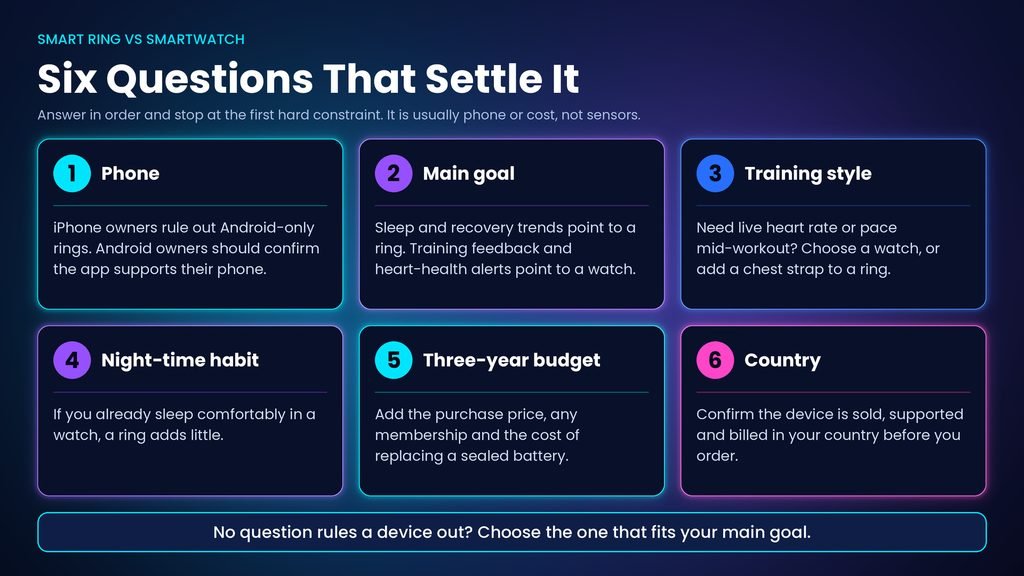
If no question rules a device out, choose the one that fits your main goal.
Two worked examples
Consider a runner following interval sessions who wants pace and heart-rate zones on the wrist. A ring would send those numbers to a phone afterwards or need a chest strap, so a watch fits better and a ring becomes an optional extra for sleep.
Now consider an Android user who takes a watch off at night because of the bulk and has no structured plan. A subscription-free ring such as the Galaxy Ring matches that profile, provided the phone can run Samsung Health and the ring is sold in their country.
Mistakes to Avoid When Buying
Four mistakes cause most regret purchases.
- Buying a ring for workout tracking and finding that live heart rate needs a separate sensor.
- Comparing a ring’s price with a watch’s price and ignoring three years of membership.
- Choosing a ring size by guess instead of using a sizing kit.
- Judging the device after one night, before the baseline has settled.
Avoiding these four removes most of the risk of buying the wrong device.
Your Next Step
The decision is narrower than most comparison pages suggest. A watch is the stronger tool for training, notifications and heart-health alerts, and a ring is the stronger tool for low-friction overnight data. Settling smart ring vs smartwatch therefore starts with your phone, your training habits and three years of cost, not with a feature list. Before you pay, open the maker’s pricing page for your country and check what the app shows without a paid plan, including for any Oura ring alternatives on your shortlist.
FAQs
1. Can a smart ring replace a smartwatch?
A smart ring can replace a smartwatch only if you do not need a screen, live workout data or notifications. It covers sleep, recovery and daily activity well, but Oura’s documentation shows live heart rate needs an external sensor. Anyone who trains with targets or wants on-wrist alerts will still want a watch.
2. Should you wear a smart ring and a smartwatch together?
Wearing both works if you will use each daily: the ring overnight for low-friction sleep data and the watch for training and alerts. It doubles the cost and the number of apps to manage, so it suits people who want overnight comfort and workout detail together. Everyone else is better served by choosing one device.
3. Can you use an Oura Ring without a membership?
Yes, but with limits. Oura’s support page says an inactive membership shows only the three daily scores, ring battery, basic profile information, app settings and Explore content, and that owners of the older Gen2 ring pay no membership. Newer rings need the paid plan for detailed sleep analysis and most other features.
4. Does a smart ring work with both iPhone and Android?
Many do, but not all of them. Android Authority says the Samsung Galaxy Ring works with Android phones that can install Samsung Health, so it excludes iPhones, while Oura’s support pages link to both iOS and Android setup guides. Check the app store listing for your phone before buying any ring.
5. Can a smart ring or smartwatch diagnose a health condition?
No. Both estimate trends from light and motion sensors, and Apple’s own health page labels features such as Vitals, respiratory rate and temperature sensing as wellness features not for medical use. A wearable can prompt a conversation with a clinician, but it cannot replace an examination or a test.