Introduction
Smart glasses have moved from conference demos to shop shelves, and the loudest claim about them is that they will replace the smartphone. The hardware tells a more careful story. This guide explains the three kinds of glasses now on sale, what each costs and where it breaks, and how privacy rules are changing where camera glasses can be worn. It also shows what Apple and Samsung are expected to ship next, so the reader can decide between buying now and waiting.
Quick Answer
Not yet. AI smart glasses in 2026 act as a hands-free layer on top of a phone: they take photos, answer questions and show short prompts, but most still rely on the phone for connectivity and apps. The standalone exception, Snap Specs, costs far more. Glasses are replacing glances at the phone, not the phone.
Key Takeaways
Smart glasses replace the glance at the phone rather than the phone itself, because most models still depend on a phone for connectivity and apps.
Camera-and-audio glasses are where the volume is, because IDC counted about 2.25 million display-less units shipped in the first quarter of 2026, up 167 percent year over year.
A display or a standalone computer is what multiplies the price, because Engadget lists Meta’s camera glasses from $449 while TechCrunch lists Snap Specs at $2,195.
Meta Ray-Ban Display adds a one-lens screen and a wristband, and the trade-off is weight and battery, because Engadget’s review recorded 69 grams and a Meta-rated battery life of about six hours.
Rules on camera glasses vary by place, so check venue and local rules first, because courts, schools and councils in several regions now restrict them.
Waiting for an ecosystem pick means waiting roughly a year, because Road to VR, relaying Bloomberg, reports Apple’s glasses for release by the end of 2027.
What Are AI Glasses, and How Do They Differ From AR Glasses?
AI glasses are ordinary-looking frames with microphones, speakers and usually a camera that connect to a phone and an AI assistant. Augmented reality (AR) glasses add a display that places digital content in the wearer’s view. Most products on sale fall into one of three groups, and the group decides price, weight and capability.
The three groups below cover every pair mentioned in this guide.
- Camera-and-audio glasses: a camera, microphones and open-ear speakers with no screen, so answers arrive as speech. Ray-Ban Meta Gen 3 is one; Ray-Ban Meta Audio is a camera-free variant.
- Display glasses: a small screen in one lens for messages, directions and captions, as in Meta Ray-Ban Display.
- AR glasses: see-through lenses that overlay digital objects on the room, as in Snap Specs and XREAL Aura.
How Fast Is the Smart Glasses Market Growing?
The market is growing quickly from a small base. According to IDC’s June 2026 market analysis, display-less smart glasses shipped about 2.25 million units in the first quarter of 2026, up 167 percent year over year, and IDC forecasts 13.6 million units for the full year.
Meta held 69.2 percent of the market in that quarter in the same IDC data, with RayNeo, Xiaomi, Viture and XREAL each at 3.4 percent or less. IDC credits the surge partly to frames people are willing to wear in public, which is why camera-and-audio glasses lead. IDC also forecasts display glasses from XREAL, Viture and RayNeo rising from 3 million units in 2026 to 12.2 million by 2030.
Two cautions apply. Shipments measure what was sold, not what is worn, and forecasts depend on how each research firm defines smart glasses, so compare like with like. IDC’s own forecast of 27.3 million display-less units by 2030 also remains a small fraction of yearly smartphone volumes.
Can Smart Glasses Replace Your Smartphone?
Not in 2026. Smart glasses can replace many glances at a phone, such as reading a message, following a turn instruction or taking a quick photo, but they cannot yet match a phone’s screen, camera quality, battery life or app library. Most glasses also still need a phone to connect and update.
The phone tie is the first limit. IDC’s analysis notes that Meta’s glasses depend on a phone for full functionality, and that Google’s and Samsung’s glasses lean on the Android XR platform, Google’s operating system for headsets and glasses, and on existing phones. Snap Specs run their computing on the glasses with no puck, and TechCrunch’s report shows what that costs: weights of 132 or 136 grams depending on size and up to four hours of continuous battery life.
Moving more AI processing onto the glasses is the engineering route to loosening that tie, a trade-off Arcnet covers in its explainer on how edge AI works.
Image quality is the second limit. Commentary in Road to VR on Apple’s plans argues that current glasses cameras sit near the level of a mid-range phone from a couple of years ago, even though they are quicker to use for a passing moment.
Display and input are the third. Engadget’s review of Meta Ray-Ban Display, published on 17 October 2025, reported a 20-degree field of view and support for only a handful of apps, which is enough for a glance and too little to replace a phone screen.
Accuracy is the fourth. An assistant that answers aloud about what the camera sees can be wrong, and a spoken answer is harder to check than one on a screen, the same failure explored in Arcnet’s guide to why AI assistants get things wrong.
Example: a commuter can follow a turn instruction on a display lens, then still pull out the phone to write a long reply. The practical rule is that smart glasses are replacing the glance at the phone, not the phone. Arcnet’s view is to treat glasses as a second screen for the next ten seconds, not the next ten minutes.
AR Glasses Comparison: What Each Pair Costs and Does
List prices in this comparison run from $349 for the camera-free Ray-Ban Meta Audio, per Engadget’s coverage of Meta Connect 2026, to $2,195 for Snap Specs, per TechCrunch’s report of 16 June 2026. Two things explain most of the gap: whether there is a display, and whether the computing happens on the glasses.
Five factors move the price, and each can be checked before buying.
- Display: an in-lens screen adds optics, weight and battery drain.
- Compute location: on the glasses, in a tethered puck or on the paired phone.
- Camera: camera-free models avoid venue bans and can cost less.
- Fit: prescription lenses, frame style and limited editions change the final cost.
- Region and add-ons: local pricing, taxes, availability and paid features differ by country.
The maker’s own page, in the reader’s own currency, is the only reliable final price.
The following table summarises each pair, using US-dollar list prices from Engadget’s Meta Connect 2026 roundup for the Meta models, from TechCrunch for Snap Specs and from XREAL’s 7 October 2026 announcement for XREAL Aura; local prices and taxes vary.
| Product | Category | Display | US list price | Status |
| Ray-Ban Meta Audio | Camera-free audio | None | $349 | Ship date 13 October 2026 |
| Ray-Ban Meta Gen 3 | Camera and audio | None | $449 | On sale |
| Meta Ray-Ban Display | Display glasses | One lens | $799 | On sale in selected regions |
| Snap Specs | AR, standalone | See-through | $2,195 | Ships fall 2026 |
| XREAL Aura | AR, tethered puck | See-through | $1,279 | Reservation holders only |
The decision for most readers sits between the two Ray-Ban Meta models. Engadget lists Meta Ray-Ban Display at $799 against $449 for Gen 3, and the extra money buys a one-lens screen and the Neural Band, not better frames. TechCrunch’s Specs report says Snap is aiming Specs first at enthusiasts, developers and studios, which fits a $2,195 price and a fall 2026 ship date in the United States, the United Kingdom and France.
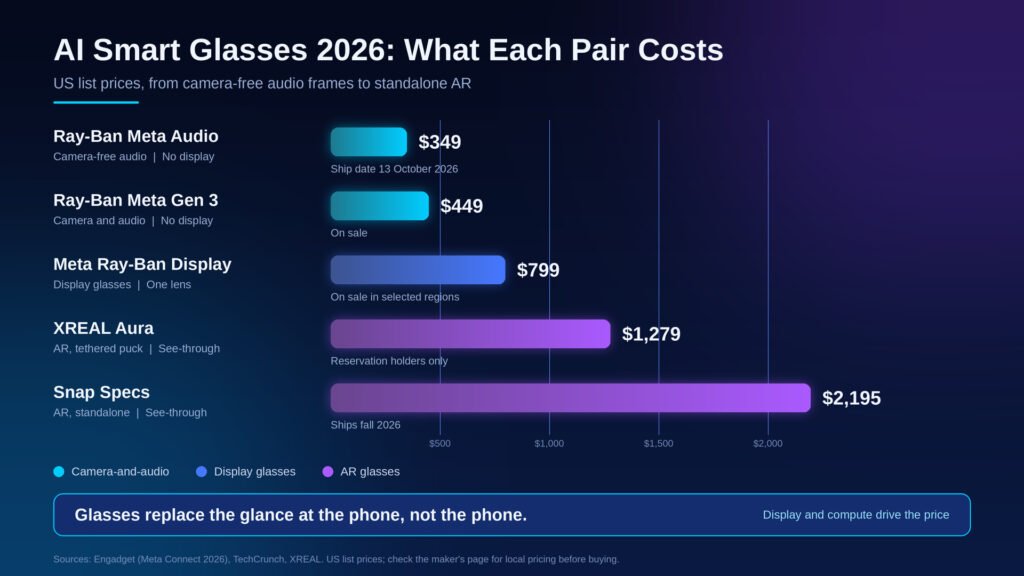
XREAL says Aura ships first in the United States, Canada, Japan and South Korea, with more markets in 2027, and it publishes local prices for each, so the $1,279 figure for the 12GB and 256GB model applies to the United States only.
What Does Meta Ray-Ban Display Do, and Who Is It For?
Meta Ray-Ban Display is a pair of glasses with a full-colour screen in the right lens, controlled by a wristband called the Meta Neural Band. The band uses electromyography (EMG), which reads the muscle signals behind small finger movements. The glasses show messages, navigation, captions, translation and Meta AI answers, and they suit early adopters who accept thick frames and modest battery life.
Engadget reports that Meta now sells the glasses online in the United States for $799 with the band included, at £749 in the United Kingdom and $1,149 CAD in Canada, with pre-orders in Germany, France and Italy from €899 and availability on 13 October 2026. The list below separates what the hardware does from what it does not.
- Display: one lens only, with a 20-degree field of view, per Engadget’s review of 17 October 2025.
- Weight: 69 grams for the glasses, noticeably heavier than Meta’s other frames, per the same review.
- Battery: Meta rates it at about six hours, and the reviewer saw faster drain with video calls and live translation.
- Apps and messaging: a handful of apps, with iOS messaging limits that Meta blames on Apple, per the review.
The reviewer’s launch verdict was that most people should probably skip it at that price, noting it cost more than twice the second-generation Ray-Ban Meta glasses then on sale. Pro tip: check the maker’s return window before committing, because the review found noticeable pressure only after six or seven hours of wear, not in the first few minutes.
Where Do Smart Glasses Fall Short? Privacy, Rules, Security and Battery
Smart glasses fall short in four places: other people’s privacy, where the rules allow them, the security of cheaper models, and battery life under real use. Each can decide whether a pair is usable in a daily routine.
The examples below are from the regions named, and rules in the reader’s country, employer or venue may differ.
- Courts: New York’s court system has barred smart glasses, prescription pairs included, since 20 July 2026, per Biometric Update.
- Schools: Western Australia is banning them in public schools from Term 4, and Oslo bans them during the school day.
- Public places: Norway’s government said it will propose a temporary ban in select public places.
- Indicators: Meta says a capture LED flashes while recording and that covering it disables the camera.
- Security: ABC testing of low-cost glasses found a nearby attacker could connect over Bluetooth without a password to certain models.
- Battery: Engadget reports nine hours for Gen 3, about six for Display, and TechCrunch up to four for Specs.
Rule changes are reported in Biometric Update’s 7 October 2026 report, and the pace suggests camera glasses will meet more restrictions, not fewer.
A pair of smart glasses is a camera, microphone and Bluetooth radio worn on the face, so the habits in Arcnet’s guide to connected-device security risks apply: update firmware, be wary of unknown brands without a security record, and review app permissions.
Common mistake one is assuming prescription lenses make a pair exempt, when the New York rule covers both prescription and non-prescription glasses. Common mistake two is buying on the rated battery figure, because rated hours assume light use. Pro tip: keep an ordinary pair of glasses for places that restrict camera glasses.
AI Smart Glasses 2026: How to Choose Without Overpaying
Choose by the job the glasses must do: camera-and-audio glasses for hands-free capture and quick answers, display glasses only if glanceable text is worth the weight, and AR glasses only for development or spatial apps. Seven inputs decide it.
- Display need: whether spoken answers are enough or text must stay in view.
- Camera comfort: whether the places you go allow cameras, since camera-free models exist.
- Phone platform: iPhone or Android, because Meta blames iOS limits for messaging gaps, per Engadget.
- Prescription: the maker’s lens range, since Engadget reports Ray-Ban Meta Audio supports prescription lenses.
- Battery under your use: rated hours assume light use.
- Local rules and availability: models and features launch region by region.
- Total cost: add-ons and subscriptions change the price after purchase.
For most readers the sensible pick among AI smart glasses 2026 models is a camera-and-audio pair such as Ray-Ban Meta Gen 3, or the camera-free Ray-Ban Meta Audio, because they cost the least and look like ordinary frames. The trade-off is no screen, so every answer is spoken. Display glasses are the pick when reading messages without a phone is the point and the weight is acceptable. RayNeo, Xiaomi, Viture and XREAL are alternatives worth comparing in your own region.
What Is Coming Next From Apple, Samsung and Google?
Samsung unveiled its Google-backed intelligent eyewear on 22 July 2026 without a price, and Apple’s first glasses are reported for late 2027, so the next wave of choice arrives as ecosystems rather than displays.
According to Auganix’s report of 23 July 2026, Samsung’s glasses run Android XR and Gemini on a Snapdragon AR1 Gen1 platform, with up to nine hours of battery and up to seven further charges from the case, and Samsung disclosed no price or date at the event. Road to VR, relaying Bloomberg’s Mark Gurman on 27 July 2026, says Apple plans to unveil its glasses at WWDC in June 2027 with a release by the end of 2027, with cameras, speakers and microphones but no display.
Anchoring graphics in a room depends on spatial understanding, the subject of Arcnet’s explainer on world models in AI. Pro tip: an iPhone owner who wants an ecosystem fit has a real reason to wait for Apple.
What to Do Next
Smart glasses are useful today as a companion to the phone, not a replacement for it. The shopping decision comes down to display, camera comfort, phone platform and local rules. The market for AI smart glasses 2026 is still moving, with Samsung’s pair unpriced and Apple’s reported for late 2027, so an early, expensive model such as Meta Ray-Ban Display only makes sense for readers who value a glanceable screen now. The one thing to do first is look up the recording rules at the places you visit most, including your workplace, before choosing between camera and camera-free glasses.
Frequently Asked Questions
1. Do AI glasses work without a phone?
Ans. Most do not. IDC’s June 2026 analysis says Meta’s glasses depend on a phone for full functionality, and Google’s and Samsung’s models lean on Android phones. Snap Specs run their computing on the glasses with no puck, per TechCrunch, so confirm with Snap whether a phone is still needed for setup and accounts.
2. Can you wear AI glasses with prescription lenses?
Often, but it depends on the model and the maker’s lens range. Engadget reports that Ray-Ban Meta Audio supports prescription lenses, so confirm the supported range for any other pair on the maker’s page before buying, because ranges, optician networks and prices differ by country.
3. Are smart glasses banned in schools, courts and venues?
Rules vary by place and are tightening. Biometric Update reports that New York’s court system has barred smart glasses, prescription pairs included, since 20 July 2026, that Western Australia is banning them in public schools from Term 4, and that Norway plans a temporary ban in select public places. Check the venue, school or employer first.
4. Is Apple making smart glasses?
Reportedly yes. Road to VR, relaying Bloomberg’s Mark Gurman on 27 July 2026, says Apple plans to unveil its first glasses at WWDC in June 2027, with release by the end of 2027. The first model is expected to have cameras, speakers and microphones but no display. These details are reports, not Apple announcements.
5. Do AI glasses need a subscription?
Not always, but add-ons can. Engadget reports that Meta’s hearing enhancement feature, due in the United States later this year, is free for 30 days and then costs a one-off $149 or comes with a Meta One subscription. Terms differ by maker and region, so read the feature list and pricing before buying.