
Introduction
A lawyer submits a court filing built on cases that never existed. A hospital’s transcription tool pastes a diagnosis into a patient’s chart that nobody ever spoke aloud. A customer books a flight based on a refund policy an airline’s chatbot invented on the spot. All three trace back to the same failure: a language model generating fluent, confident text that has no connection to reality. This piece breaks down what actually causes that failure, why two years of rapid model progress hasn’t made it disappear, and what to do about it before it costs you something.
An AI hallucination happens when a language model generates a fluent, confident answer that is factually wrong, fabricated, or unsupported by its source material. This AI hallucination explained guide covers why it happens, why upgrading to a newer model doesn’t eliminate it, and how attorneys, clinicians, and everyday users can catch it before it causes real harm.
AI hallucination happens because training rewards confident guessing over admitting uncertainty, which is why OpenAI’s own research traces the problem to how models are scored, not just how they’re built.
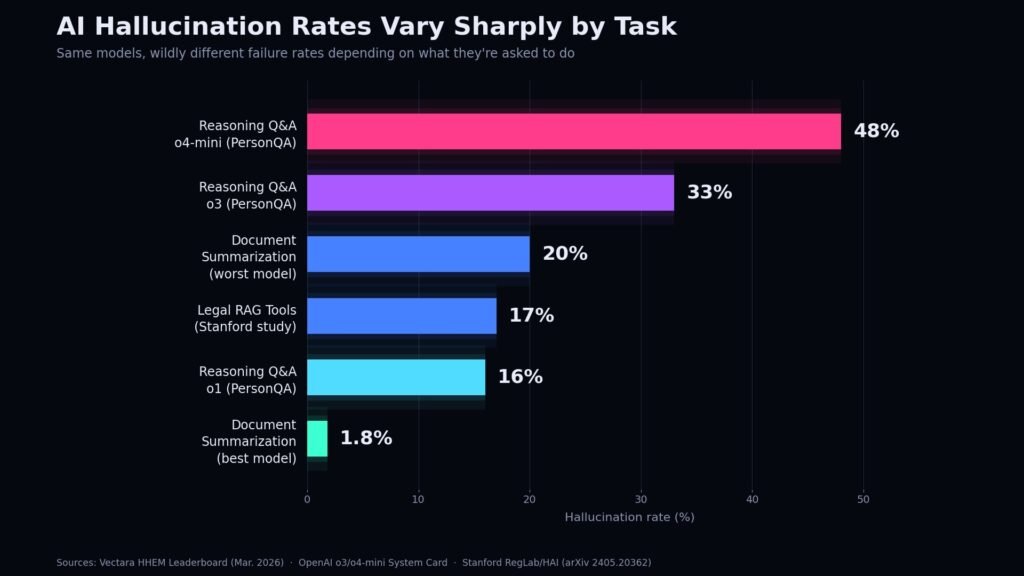
Newer, larger models don’t automatically hallucinate less: OpenAI’s o3 and o4-mini reasoning models hallucinated on 33 and 48 percent of PersonQA questions, roughly double the rate of the older o1 model, according to OpenAI’s own system card.
Retrieval-augmented generation narrows the problem but doesn’t close it, since Stanford’s RegLab found purpose-built legal AI tools still hallucinated on more than 17 percent of queries even with case-law grounding attached.
The cost is no longer hypothetical: more than 2,000 court decisions worldwide have documented a lawyer, litigant, or judge relying on fabricated AI content, according to Damien Charlotin’s hallucination case database.
A 1 percent hallucination rate sounds small until it hits a hospital: Cornell and University of Washington researchers found roughly 1 percent of Whisper transcriptions contained invented text, with about 38 percent of that invented content carrying real potential for harm.
Hallucination rates differ enormously by task, so the same model can score nearly perfect on a document summary and still fail badly on an open-ended factual question.
What Counts as an AI Hallucination
An AI hallucination is any output from a generative model that looks fluent and plausible but isn’t actually grounded in fact, in the source material it was given, or in reality. Researchers generally split the problem into two types: intrinsic hallucinations, where the model contradicts material it was explicitly given, and extrinsic hallucinations, where it invents something new that can’t be verified against the source at all. Both look identical to a reader who doesn’t already know the right answer, which is exactly why the problem is so hard to catch.
Hallucinations show up in a handful of recognizable forms.
- Factual errors: incorrect dates, figures, or details stated with total confidence.
- Fabricated references: invented papers, court cases, or product specs that read like real citations but don’t exist.
- Misattribution: a true fact paired with the wrong source or the wrong person.
- Contextual drift: the model ignores the document it was given and answers from general training instead.
- Temporal confusion: outdated information stated as current, or a future event described as if it already happened.
Whichever form it takes, the common thread is confidence: an AI hallucination rarely announces itself with a caveat.
AI Hallucination Explained: Why Language Models Still Get It Wrong
Language models hallucinate, a class of LLM errors researchers now study closely, largely because next-token prediction rewards a plausible-sounding answer over an honest admission of uncertainty. A September 2025 OpenAI research paper on why models hallucinate traced this to how models are trained and graded: standard evaluation benchmarks score a wrong guess the same as a right one and score “I don’t know” as a failure, so models learn that guessing beats abstaining. That incentive is built in well before deployment, which is why swapping in a newer model rarely fixes it on its own.
The paper’s core argument is closer to statistics than software. Distinguishing a correct answer from a wrong one is usually easier than generating the correct answer from scratch, so some rate of generative error is close to a mathematical consequence of asking a model to produce free-form text rather than choose between fixed options, even with perfectly clean training data.
This is also why the trend line isn’t as simple as “newer model, fewer hallucinations.” OpenAI’s o3 and o4-mini system card found that, on the PersonQA benchmark built to elicit hallucinations, o3 hallucinated on 33 percent of questions and o4-mini on 48 percent, both a sharp jump over the older o1 model’s 16 percent. OpenAI’s own explanation was that the newer models simply make more claims overall, generating more correct answers alongside more fabricated ones.
A model that answers more often looks more capable in a demo and hallucinates more often in production, and no single benchmark number captures that trade-off.
The incentive problem sits on top of several longer-known technical causes.
- Training data gaps: sparse or contradictory coverage of a topic forces the model to guess when a query falls outside what it has seen often.
- Compression: a model with billions of parameters can’t literally store every fact it absorbed, so it reconstructs approximate answers from patterns instead of recalling exact ones.
- Long-context drift: across extended conversations or long documents, the model gradually loses track of what it was actually told versus what it’s inferring.
- Reward shaping during fine-tuning: reinforcement learning from human feedback can reward answers that sound agreeable or thorough over answers that are accurate, a pattern researchers call sycophancy.
None of these four is fixed by scale alone, which is a large part of why the problem has outlasted several generations of larger models and why grasping the basics of how machine learning models generalize from patterns rather than memorizing facts matters here.
Have Hallucination Rates Actually Improved? What the Benchmarks Show
Yes, on narrow tasks under controlled conditions, but the improvement doesn’t transfer evenly to open-ended real-world use. Vectara’s public HHEM leaderboard, which scores models on how faithfully they summarize a supplied document, showed the top-ranked model reaching a 1.8 percent hallucination rate as of its March 2026 update. That figure describes one narrow, well-defined task, though, and the same leaderboard shows other current models still hallucinating on more than one in five summaries.
Summarizing a document you were handed is close to the easiest test a model can face, because the correct answer is sitting right there in the text. Answering an open factual question from memory, or holding a fact straight across a long conversation, is a much harder problem, and it’s the one where the residual failure rate has moved the least. Understanding how generative models build a response word by word helps explain why that gap between tasks exists in the first place.
A practical pro tip: if you need to trust an AI-generated summary, check whether the tool actually shows you the source passage next to its claim. Tools that ground every sentence in a visible citation are solving the easier, well-scored version of the problem; tools that answer from memory alone are solving the much harder one.
The Real-World Cost, in Court, in Clinics, and at the Check-in Counter
The clearest evidence that this isn’t a theoretical problem sits in three very different places: courtrooms, hospitals, and customer service chat windows.
In the legal system, a New York attorney filed a brief in Mata v. Avianca in mid-2023 that cited six court cases ChatGPT had invented outright, complete with fabricated quotes and docket numbers; the presiding judge fined the attorneys and their firm $5,000 and called the situation unprecedented, according to reporting on the case by Legal Dive. It wasn’t the last one.
As of 5 September 2026, Damien Charlotin’s hallucination case database has documented more than 2,000 legal decisions worldwide in which a court found that a lawyer, a pro se litigant, or even a judge’s own order relied on fabricated AI-generated content, with new cases still being added daily. Penalties have grown sharply too: in a 12 December 2025 opinion, a federal magistrate judge in Oregon fined two attorneys a combined $110,000 in a winery ownership dispute after their filings contained 23 fabricated citations and eight invented quotations, calling the case “a notorious outlier in both degree and volume,” as reported by the ABA Journal.
Healthcare carries a different kind of risk, because the hallucinations often arrive silently inside a workflow nobody is double-checking line by line. Cornell and University of Washington researchers who evaluated OpenAI’s Whisper transcription tool, widely used to convert doctor-patient conversations into clinical notes, found in a study published at the 2024 ACM Conference on Fairness, Accountability, and Transparency that roughly 1 percent of transcriptions contained entirely invented phrases or sentences that were never spoken; about 38 percent of those inventions carried a real potential for harm, including fabricated medications and fictional medical details.
That 1 percent failure rate sounds tolerable until it’s multiplied across the millions of patient visits transcription tools now handle every year, a risk worth weighing against our wider look at AI’s role in healthcare.
Why Grounding and Retrieval Don’t Fully Solve It
Retrieval-augmented generation, or RAG, reduces hallucination by handing the model real source documents to work from instead of relying purely on what it memorized during training, and it measurably helps. But grounding a model in real data doesn’t force it to use that data correctly, and several well-funded, purpose-built tools have learned this the hard way.
Stanford’s RegLab and Institute for Human-Centered AI tested legal research tools’ reliability from LexisNexis and Thomson Reuters that explicitly marketed themselves as hallucination-free thanks to retrieval-augmented grounding in real case law. The tools hallucinated less often than a general-purpose chatbot, but they still produced an incorrect or unsupported answer on more than 17 percent of the legal queries tested, sometimes because they described the law incorrectly and sometimes because they cited a real case that didn’t actually support the point being made.
The gap exists because RAG only fixes the input side of the problem. If the retrieved passages are incomplete, poorly matched to the question, or split into fragments that lose context, the model still faces the same choice it always has: answer confidently with a gap in the picture, or say it doesn’t know. Most systems are still tuned to do the former.
A common mistake is assuming that once a vendor advertises retrieval or grounding, verification is no longer necessary. Grounding narrows the odds of a fabrication; it doesn’t remove them, and the accountability question is really one of the broader ethical questions AI raises once a business puts an ungrounded answer in front of a customer, as Air Canada learned firsthand when its support chatbot invented a bereavement-fare refund policy that didn’t exist. A Canadian tribunal ruled in Moffatt v. Air Canada, 2024 BCCRT 149, that the airline was responsible for its own chatbot’s fabrication and ordered it to honor the policy the bot had made up.
How to Spot a Hallucination Before It Costs You
Because a hallucination is written with the same fluency as a correct answer, spotting one comes down to habits rather than instinct.
- Ask for the source. A specific citation, page number, or document name that the model can’t produce on request is a warning sign, even if the original answer sounded certain.
- Check anything with a number attached. Dates, statistics, prices, and version numbers are hallucinated more often than prose, because there’s no partial credit for being close.
- Search the exact name. Fabricated case names, paper titles, and product names often return no real search results, which is usually the fastest tell.
- Watch for suspiciously perfect quotes. A quotation that fits the argument too neatly, with no hedging or awkward phrasing, is worth tracing back to its supposed source.
- Re-ask the same question a different way. A model that gives materially different answers to the same underlying question is signaling that it’s guessing rather than recalling.
None of these checks takes more than a minute, and together they catch the overwhelming majority of hallucinations before they reach a client, a patient, or a court filing.
How to Reduce Hallucinations When You’re the One Prompting
You can measurably cut hallucination rates through how you prompt and structure a request, even without switching tools.
- Attach the source document instead of asking from memory. Paste the actual policy, contract, or article into the prompt and instruct the model to answer only from what’s provided; this is the same grounding principle behind RAG, done manually.
- Ask for uncertainty explicitly. A prompt that says “if you’re not confident, say so instead of guessing” measurably shifts a model’s behavior, because it’s being asked to optimize for something other than a complete-sounding answer.
- Break a complex question into smaller ones. A single sprawling question invites the model to fill gaps with plausible-sounding connective tissue; several narrow questions leave less room for that.
- Request the reasoning, not just the answer. Asking the model to show its work step by step before giving a final answer makes fabricated logic easier to spot than a bare conclusion would be.
- Cross-check with a second, independent model or a plain search. Two models converging on the same wrong answer is rare; two models disagreeing is itself a useful signal to dig further.
Two things commonly go wrong even with careful prompting. First, a model can technically follow the “answer only from the source” instruction while still misreading or misquoting that source, so grounding reduces but doesn’t eliminate the need to check the output against the original document. Second, asking for uncertainty works best on models that were actually trained to express it; some smaller or older models will hedge on command without that hedging tracking their real confidence.
A useful pro tip: keep a running note of the one or two hallucinations a given tool has made for you before. Models are inconsistent across sessions, but certain question types, such as obscure names, exact figures, or niche technical specs, tend to trip up the same tool repeatedly.
Will AI Hallucination Ever Be Fully Solved?
Not in the sense of reaching zero, according to the researchers closest to the problem, though the residual failure rate on well-defined tasks keeps shrinking. OpenAI’s own hallucination paper argues that some rate of generative error is a near-mathematical consequence of generating free-form text rather than choosing between fixed answers, which means the realistic goal is a model that knows when to say it doesn’t know, not a model that never gets anything wrong.
A few different approaches are being tried in parallel, each addressing a different piece of the problem.
- Retrieval and grounding, which narrows the gap on well-scoped tasks but, as the Stanford study above shows, doesn’t close it.
- Cross-checking answers across independent models, on the logic that two models rarely invent the identical wrong fact.
- Human-in-the-loop review as the deliberate last line of defense in high-stakes workflows like legal filings or clinical notes.
- Reworking evaluation benchmarks themselves, OpenAI’s proposed fix, so that a calibrated “I don’t know” scores better than a confident guess.
Between these, the most durable fix probably isn’t a smarter model at all. It’s changing what gets rewarded during training and evaluation, which is a slower, less visible project than shipping a new model version, and it’s also the one OpenAI’s own researchers argue would move the needle the most.
Conclusion
Treat every AI-generated fact, citation, or quote as a claim to verify, not a finished answer, especially anywhere a wrong detail would reach a client, a patient, or a public document.
The pattern across every case in this AI hallucination explained guide is the same: unreliable AI output rarely gets caught by the model itself, and it was the decision to skip a few minutes of checking that let it through. If you’re building AI into a real workflow rather than just chatting with it, the more useful next read is how agentic AI systems chain these same models into multi-step actions, since that’s where an unnoticed hallucination does the most damage.
Start there before you hand any AI system a task it can complete without a human checking the result.
Frequently Asked Questions
1. Is AI hallucination a bug that will eventually be fixed?
Not entirely, based on OpenAI’s own hallucination research, which frames some rate of error as a near-mathematical consequence of generating free-form text rather than picking from fixed answers. Rates keep falling on well-defined tasks like document summarization, but researchers expect a residual failure rate to persist on open-ended questions for the foreseeable future.
2. Which AI models hallucinate the least?
It depends heavily on the task being measured. Vectara’s HHEM leaderboard, which scores models on document summarization, shows top models under a 2 percent hallucination rate, while the same leaderboard shows other current models above 20 percent on the identical test. Rankings shift again on open-ended factual questions, so there’s no single most reliable model across every use case.
3. Does retrieval-augmented generation (RAG) eliminate hallucination?
No. RAG grounds a model’s answer in real source documents, which reduces fabrication, but it doesn’t force the model to read those documents correctly. Stanford’s RegLab found purpose-built legal research tools using RAG still produced incorrect or unsupported answers on more than 17 percent of queries tested, so grounding narrows the problem rather than closing it.
4. Can an AI model tell when it’s hallucinating?
Not reliably. Most models don’t have a built-in way to distinguish a fact they actually know from a plausible-sounding guess, which is why both get presented with the same confident tone. Prompting a model to express uncertainty can help, but that only works as well as the model was trained to allow.
5. What should I do if I catch an AI tool hallucinating?
Correct the specific claim in your own workflow rather than assuming the rest of the output is safe, since one hallucination often signals the model was uncertain more broadly in that response. It’s also worth re-running the question with a source document attached or a different tool, and noting the failure so you catch the same pattern next time.
6. Why do hallucinations happen more with obscure or niche topics?
Language models learn patterns from how often something appeared in their training data, so topics with little coverage give the model less to work with. Faced with that gap, the model still has to produce a fluent answer, and it fills the gap with the most statistically plausible-sounding text rather than admitting it lacks the information.