
Introduction
React, Vue, and Angular converged on strikingly similar reactivity ideas this year, TypeScript crossed a symbolic adoption threshold, and AI coding assistants moved from novelty to daily tool for most professional developers. None of that happened in isolation; each shift is pulling the others along. This piece pulls together what actually changed in frontend development in 2025, backed by named sources rather than vague claims, and tells you which of it is worth acting on. Skip the generic listicles: here’s what shipped, what’s still experimental, and what to check before you commit your stack to it.
The biggest javascript trends 2025 covers are the convergence of React, Vue, and Angular around signals-style reactivity, TypeScript reaching majority-level adoption, AI coding assistants becoming a standard part of daily workflows, and a three-way split between Node.js, Bun, and Deno as production runtimes, each with real trade-offs a team should weigh before switching.
Signals-based reactivity is no longer one framework’s idea Angular, Vue, and a TC39 proposal backed by more than a dozen framework authors are converging on the same model, which means the pattern is worth learning once and reusing everywhere.
TypeScript usage climbed to 40 percent of developers writing exclusively in it, up from 34 percent the year before according to the State of JavaScript 2025 survey, which is why skipping it on a new project now needs a real justification.
React’s Server Components and its now-stable Compiler remove two of the biggest reasons teams avoided React for performance-sensitive apps, narrowing the gap that used to favor Vue and Svelte.
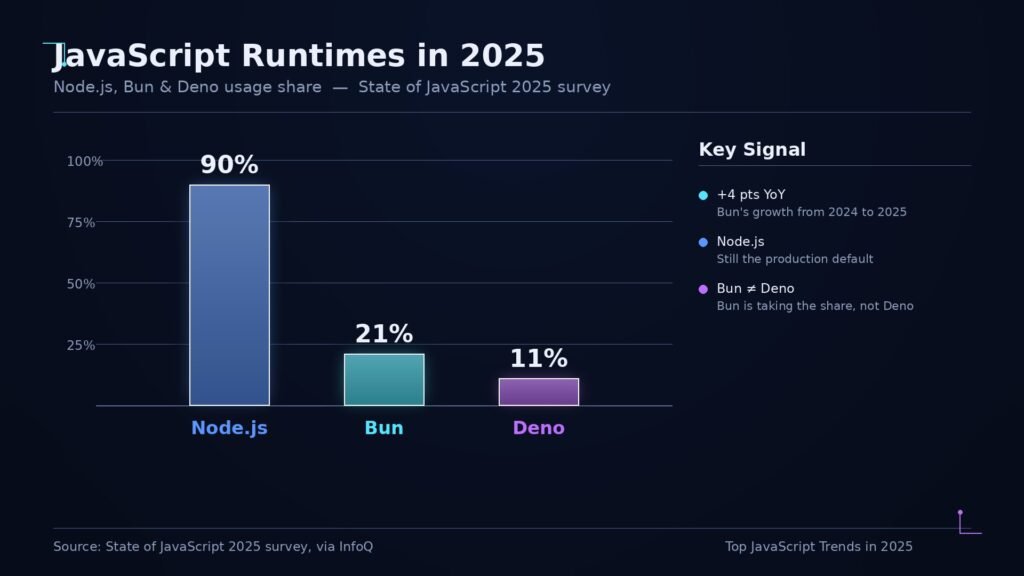
Bun’s runtime usage grew four percentage points year over year to 21 percent while Deno held at 11 percent, according to the same survey, showing that Bun not Deno, is the runtime actually taking share from Node.js.
The European Accessibility Act became enforceable on 28 June 2025 for digital products and services sold into the EU, turning WCAG 2.1 AA compliance from a nice-to-have into a legal requirement for teams shipping to European users.
AI coding assistants are now embedded in daily workflows for most professional developers, but the tools still default to React-heavy patterns and still need human review, so the productivity gain comes with a verification cost that doesn’t disappear.
Framework Evolution: React, Vue, and Angular Converge on Similar Ideas
React, Vue, and Angular spent 2025 arriving at the same conclusion from three different directions: fine-grained reactivity beats re-rendering an entire component tree. For frameworks like React and Vue, and for Angular alongside them, the year was less about new features and more about closing in on an idea that Svelte and SolidJS had already proven out.
Angular built Signals as a first-class state primitive with automatic dependency tracking. Vue extended its already-reactive core. React took a different route entirely: instead of adding a new primitive, it shipped a compiler that removes the need to think about re-renders in the first place.
React 19.2: Server Components, Actions, and a Compiler that has been stable since October 2025 and auto-applies memoization that developers used to write by hand with useMemo and useCallback.
- Vue 3.5: Composition API maturity, Pinia established as the official state store, with Vapor Mode (a compiler-based path that drops the virtual DOM) in release-candidate testing as of mid-2026.
- Angular: Signals as the default reactivity primitive, required component inputs, and automatic route parameter mapping.
- Svelte, SolidJS, and Qwik: smaller frameworks that adopted fine-grained or compile-time reactivity years earlier, and are now the reference point the big three are measured against.
The practical mistake here is assuming Server Components replace client components they don’t. They’re an additive rendering mode for data-heavy pages, and a component tree with real interactivity still needs client-rendered pieces. Before adopting any of this piecemeal, check whether your meta-framework (Next.js, Nuxt, or your Angular build setup) actually exposes the feature yet, since framework-level support and library-level support often ship months apart.
TypeScript’s Adoption Passed a Threshold: But Gaps Remain
TypeScript adoption crossed a real threshold in 2025: 40 percent of developers surveyed now write exclusively in TypeScript, up from 34 percent in 2024, according to the State of JavaScript 2025 survey. That’s no longer a niche preference it’s close to becoming the industry default for new projects.
The same survey found the gap the top-ranking pages don’t mention: lack of static typing is still the single most-cited pain point among JavaScript developers overall, and when asked what feature JavaScript itself is missing, static typing and a standard library topped the list. In other words, a meaningful share of the ecosystem still isn’t on TypeScript, and the language’s own gaps are exactly why. Node.js now supports stripping TypeScript type annotations natively in stable releases, and Bun and Deno have supported TypeScript execution without a build step for years, which is steadily removing the tooling excuse for staying on plain JavaScript.
A common mistake is treating “we use TypeScript” as a guarantee of fewer bugs. It isn’t, unless a team also enforces strict mode and blocks the any escape hatch in CI otherwise developers quietly opt out of the type system exactly where it would have caught something. Pair strict mode with custom lint rules in your pipeline rather than relying on default settings.
The Signals Pattern Is Becoming a Cross-Framework Standard
Signals are a way of automatically tracking and propagating state changes without re-running an entire render pass, and in 2025 they stopped being a single framework’s private feature. The TC39 Signals proposal the process JavaScript uses to standardize new language features reached Stage 1, with design input from the authors of Angular, Vue, Ember, Preact, Solid, Svelte, MobX, and Qwik. That’s an early stage, but it means Signals are being designed once, collaboratively, instead of reinvented separately by every framework.
This matters practically because it’s the clearest sign yet that fine-grained reactivity updating exactly the part of the UI that changed, rather than diffing a virtual DOM is where the whole ecosystem is heading, not just where Angular or Solid happened to land. A developer who understands the general model can move between frameworks far faster than one who only memorized a specific framework’s hook names.
The mistake to avoid: assuming your framework’s Signals API is interoperable with another framework’s. It isn’t, yet. Angular Signals, Vue’s reactivity system, and Preact Signals are separate implementations of a similar idea, not a shared standard that only arrives if and when the TC39 proposal advances past Stage 1. Learn the concept now; treat any specific API as provisional.
JavaScript Runtimes: Node.js, Bun, and Deno in 2025
Node.js remains the default JavaScript runtime for production backends, used by 90 percent of developers according to the State of JavaScript 2025 survey, but Bun grew four percentage points year over year to 21 percent usage while Deno held steady at 11 percent meaning Bun, not Deno, is the runtime actually taking share from Node.js.
The most notable 2025 development in this space didn’t come from a benchmark: on 2 December 2025, Anthropic acquired Bun, the company behind Bun’s creator confirming it would stay open source under the MIT license and continue to be built in public. It’s a data point on where investment in the runtime is heading, not a reason to switch on its own.
- Choose Node.js if you need maximum npm compatibility, long-term enterprise stability, or you’re running long-lived, high-throughput services V8’s JIT compiler optimizes more aggressively the longer a process stays alive, which can close Bun’s startup-time advantage on services that run for hours or days.
- Choose Deno if security-by-default matters more than raw speed it sandboxes file, network, and environment access unless explicitly granted, and supports TypeScript natively.
- Choose Bun if startup speed, an integrated toolchain (runtime, package manager, bundler, and test runner in one binary), and fast local development matter most, and your dependencies don’t rely on obscure Node-specific APIs.
Test your actual workload before switching runtimes on benchmark numbers alone a cold-start-heavy serverless function and a long-running API server can favor opposite runtimes even on the same team’s stack.
AI-Assisted Development Is Now Part of the Daily Workflow
AI coding assistants moved from optional add-on to routine tool across the JavaScript ecosystem in 2025. But the shift came with a specific side effect that most trend roundups skip: because far more React code exists to train on than any other framework’s code, AI assistants left to their own devices default to generating React patterns even in a Vue, Svelte, or Angular codebase.
Framework maintainers noticed. Angular and React both shipped MCP servers in 2025 a way for AI tools to connect to a framework’s actual best practices and conventions instead of relying purely on training data with more planned from frameworks including TanStack Start.
The practical mistake is assuming AI-generated code already matches your project’s conventions. It often doesn’t, especially outside React. Where a framework-specific MCP server or similar context tool exists, wiring it into your AI assistant is the single highest-leverage fix, because it corrects the framework bias at the source instead of catching it in code review after the fact.
The Web Platform Is Catching Up to Frameworks
Several capabilities that used to require a JavaScript framework became native browser features in 2025. The View Transition API which animates changes between page states without a framework became part of the Baseline 2025 index of cross-browser support, meaning it’s now safe to use in production without a polyfill.
CSS also picked up capabilities that once required JavaScript workarounds, from layout primitives to state-based styling. Together with the View Transition API, this fed a broader “web standards first” conversation among developers who started questioning how much client-side framework overhead a given project actually needs.
A mistake worth flagging here: native features cover specific UI capabilities, not application architecture. A native page transition doesn’t replace a framework’s routing, state management, or component model it replaces one specific library you might have been shipping for that one job. Evaluate native replacements feature by feature, not framework by framework.
Accessibility Regulation Is Reshaping Frontend Requirements
The European Accessibility Act became enforceable on 28 June 2025 for private-sector digital products and services sold into the EU, turning WCAG 2.1 AA compliance from a best practice into a legal requirement for any team shipping a website, app, or e-commerce platform to European users. It applies regardless of where the company itself is based a team outside Europe with EU customers is still in scope.
This is a regional rule, not a global one: outside the EU it remains a best practice rather than a legal baseline, though several other jurisdictions have their own separate accessibility requirements. For a frontend team, the practical effect is that component library choice, semantic HTML, keyboard navigation, and screen-reader support move from a pre-launch checklist item into something tested continuously.
The mistake teams keep making is treating accessibility as a one-time audit rather than a standing check. Automated accessibility linting wired into CI catches regressions the moment a new component ships, well before a manual audit would ever see it.
What the JavaScript Trends 2025 Mean for Your Stack
None of the trends above are equally urgent for every team. The practical question isn’t whether to adopt everything on this list at once it’s which of it actually changes what ships this quarter.
- If your team already fights re-render bugs, prioritize learning your framework’s Signals-equivalent before anything else here.
- If you’re starting a greenfield project, default to TypeScript unless you have a specific reason not to the tooling ecosystem now assumes it.
- If your app serves EU users, treat WCAG 2.1 AA as a hard requirement, not a backlog item.
- If your runtime choice is driven by cold-start latency (serverless, edge functions), evaluate Bun; if it’s driven by long-running throughput or maximum npm compatibility, stay on Node.js.
- If your team already uses AI coding assistants, audit a sample of AI-generated components for framework-appropriate patterns before scaling usage further.
Run through that list against your current sprint, not your whole roadmap most of these are worth a focused decision now, not a company-wide initiative.
Conclusion
Pick one trend from this list that maps to a real problem your team has this quarter a re-render bug, an accessibility gap, a runtime decision rather than trying to adopt everything at once. The javascript trends 2025 introduced won’t finish maturing until well into 2026, and frameworks like React and Vue are still converging on the same underlying ideas rather than diverging further. Frontend development keeps rewarding teams that verify a claim before shipping it over teams chasing whatever ranks highest this week. Start with the Key Takeaways above, check the sources named next to each figure, and decide what’s actually worth changing in your own stack.
Frequently Asked Questions
1. Is JavaScript still relevant going into 2026?
Yes, JavaScript remains the only language every browser runs natively, and 2025’s changes show it evolving rather than being displaced: TypeScript sits on top of it, WebAssembly complements it for performance-critical code, and every major framework still compiles down to it. The real question isn’t whether JavaScript stays relevant, it’s which layer on top of it fits your project.
2. Which JavaScript framework should I learn first?
React remains the safest choice for job availability, used by 44.7 percent of developers according to the 2025 Stack Overflow Developer Survey. Vue is a strong second choice if you prefer a gentler learning curve and a framework that ships larger structural changes in single, well-communicated releases.
3. What is the TC39 Signals proposal, and should I care about it yet?
It’s an early-stage (Stage 1) effort to standardize fine-grained reactivity as a native JavaScript feature instead of a framework-specific pattern. It isn’t production-ready and isn’t interoperable across frameworks yet, but learning the underlying model now transfers directly if it becomes a stable part of the language later.
4. Does the European Accessibility Act apply to companies outside the EU?
Yes. It applies to any company selling digital products or services to consumers located in the EU, regardless of where the company itself is based, so a team outside Europe with EU customers still needs to comply.
5. Is Bun a safe choice for a new backend project?
Bun is production-viable for many workloads and reached 21 percent usage in the State of JavaScript 2025 survey, but it’s younger than Node.js. Teams that need maximum npm compatibility or run long-lived, high-throughput services should test their specific workload before committing.
6. Do AI coding assistants write good JavaScript by default?
They write serviceable code quickly, but they default to React patterns from their training data, so code generated for Vue, Svelte, or a less common framework often needs closer review than React code does. Treat AI-generated code as a draft needing framework-aware review, not a finished component.