Introduction
For years, AI was a tool that waited. You typed a prompt, it responded. You asked a question, it answered. The interaction always started with you. Agentic AI breaks that pattern completely; these are systems that set their own sub-goals, pick their own tools, execute multi-step plans, and loop back on their own outputs until the job is done. You hand them an objective, not a question.
This is not a subtle upgrade. It is a structural shift in what AI software is capable of, and it is already running in production at companies like Klarna, DBS Bank, and Bank of New York. Understanding agentic AI in 2026 is not about keeping up with trends it is about understanding what the next generation of software actually does.
What Agentic AI Actually Means
The word “agentic” comes from agency the capacity to act independently and purposefully. An agentic AI system does not wait for step-by-step instructions. It receives a goal, figures out the sequence of actions required to reach it, executes those actions using available tools, evaluates whether the outcome was correct, and adjusts if it was not. That entire loop happens autonomously.
IBM defines agentic AI as an artificial intelligence system that can accomplish a specific goal with limited supervision using machine learning models that mimic human decision-making to solve problems in real time. The key distinction from traditional AI is not the underlying model; it is the architecture around that model. A standard LLM produces outputs. An agentic system produces outcomes.
A useful way to picture the difference: a traditional AI assistant is like a calculator fast, accurate, but passive. An agentic AI system is closer to a new hire who has been given a goal, a set of tools, and the authority to figure out how to get there. The output is not text. The output is a completed task.
How Agentic AI Works Under the Hood
The Four-Part Perception-Reasoning-Action Loop
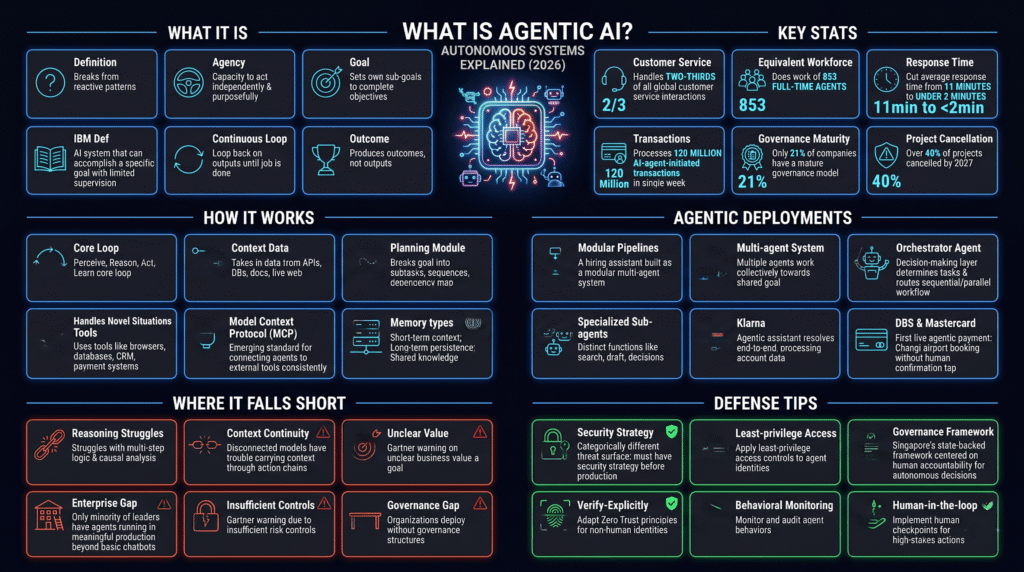
Every agentic system runs on a core loop: perceive, reason, act, learn. The agent first takes in context data from APIs, databases, documents, or live web results. It then reasons over that context to plan a sequence of actions. It executes those actions through connected tools. Finally, it evaluates whether the result moved it closer to the goal, and either continues or adjusts the plan. This loop can run hundreds of times inside a single task execution without human input at each iteration.
Aerospike describes a clear example of this loop in action: an inventory management agent perceiving warehouse sensor data, reasoning about restocking needs, placing orders autonomously, evaluating whether inventory stayed optimal, and refining its strategy over time continuously, without a human reviewing each decision.
The Planning Module: Where Goals Become Tasks
The planning layer is what separates a capable agent from a basic automation script. When a goal arrives, the planner breaks it down into discrete subtasks, sequences them logically, identifies which tools are needed for each, and creates a dependency map. If a subtask fails or returns unexpected results, the planner re-routes this is what allows agents to handle novel situations that a pre-written script would fail on completely.
Tools, APIs, and External Connections
Agents derive their real-world capability from the tools they can access. A tool can be anything with an API: a web browser, a database, a calendar, a CRM, a payment system, a code executor. The Model Context Protocol (MCP) has emerged as a standard for connecting agents to external tools consistently. Every tool connection extends what an agent can do and, importantly, extends the surface area that needs to be secured.
Memory: Short-Term, Long-Term, and Shared
A stateless model forgets everything between sessions. Agentic systems use structured memory to maintain continuity. Short-term memory holds context within a single task run. Long-term memory persists information across sessions letting an agent remember that a particular customer always prefers email over phone, or that a specific API endpoint has been unreliable on Mondays. Shared memory lets multiple agents in a system access a common knowledge pool, which becomes critical in multi-agent coordination.
Single Agents Versus Multi-Agent Systems
A single agent handles tasks independently. It works well for focused, bounded workflows: summarizing a document, drafting a response, processing a transaction. But single agents hit a ceiling with complex tasks that require parallel execution, specialized expertise across domains, or workflows too large for a single context window.
Multi-agent systems solve this by distributing work. IBM describes a multi-agent system as multiple AI agents working collectively, each contributing individual properties while behaving collaboratively to produce a desired outcome. Tasks in the hundreds or thousands impossible for one agent become tractable when split across a coordinated team.
The architecture typically includes an orchestrator agent that manages the overall workflow, specialized sub-agents that handle discrete functions, and shared memory and communication channels between them. Think of it like a well-run department: a manager allocates tasks, specialists execute them, and the manager integrates the outputs into a final result.
The Orchestrator’s Role
The orchestrator is the decision-making layer that determines which agents take which tasks, in what sequence, and how their outputs connect. It can route tasks sequentially where each agent’s output becomes the next agent’s input or in parallel, where multiple agents work simultaneously and their results are merged. Without a functional orchestrator, multi-agent systems quickly produce duplicated effort, conflicting outputs, or incomplete tasks.
Agentic AI in Production: What Real Deployments Look Like
Customer Service: Klarna’s Virtual Workforce
Klarna’s agentic AI assistant now handles two-thirds of all customer service interactions globally. The system does the equivalent work of 853 full-time agents, and it cut average customer response time from 11 minutes to under 2 minutes. This is not a chatbot routing queries to humans, it is an agent resolving them end-to-end, accessing account data, processing requests, and closing tickets autonomously.
Finance: The First Agentic Payment Transaction
In February 2026, DBS Bank and Mastercard completed what is documented as the first live agentic payment transaction: an AI agent autonomously booked a ride to Changi Airport in Singapore and completed the payment without a human confirmation tap at any point. Alipay reported processing 120 million AI-agent-initiated transactions in a single week that same month. The era of agents with financial authority is not theoretical.
Recruiting: Modular Agent Pipelines
Evidently AI documents a hiring assistant built as a modular multi-agent system: a supervisory orchestrator coordinates sub-agents responsible for drafting job descriptions, sourcing candidates, sending outreach messages, and ranking applicants. Each sub-agent handles its discrete function while the orchestrator assembles the outputs into a coherent hiring workflow. A task that previously required a recruiter to manage across four or five different tools now runs as a single coordinated pipeline.
Where Agentic AI Still Falls Short
Reasoning That Does Not Hold Under Pressure
Current agentic systems struggle with multi-step logical reasoning, causal analysis, and tasks that require understanding why something happened rather than just what happened. Microsoft’s deputy CTO Sam Schillace identified context continuity as a core limitation — agents have to carry context through a chain of actions, but the underlying models are still fundamentally disconnected in ways that humans are not. Long chains of agent actions can drift from the original goal in subtle ways that are difficult to catch until the output is wrong.
The Enterprise Readiness Gap
Adoption data from Forrester’s State of Agentic AI, 2026 report shows that while three-quarters of enterprise leaders say they are adopting agentic AI, only a small minority have it running in meaningful production beyond basic chatbots. Gartner warns that over 40% of agentic AI projects will be cancelled by 2027 due to unclear business value and insufficient risk controls. The technology has arrived. Enterprise readiness has not caught up.
Governance: The First Frameworks Are Only Just Arriving
On 22 January 2026, Singapore’s IMDA published the world’s first state-backed Model AI Governance Framework for Agentic AI launched at the World Economic Forum in Davos. It sets out four dimensions of governance, centered on the principle that humans must remain accountable for decisions taken by autonomous systems. Only 21% of companies globally have a mature governance model for AI agents (Deloitte, 2026). The framework gap is real, and organizations deploying agents without governance structures are building on unstable ground.
Security Considerations You Cannot Ignore
Deploying agentic AI without a security strategy is the fastest way to turn a productivity gain into a breach. The attack surface introduced by autonomous agents prompt injection, privilege escalation, and memory poisoning is categorically different from traditional software vulnerabilities. Our detailed breakdown of agentic AI security risks covers the specific threat classes that security teams need to understand before putting agents into production.
For organizations already thinking about access controls, the Zero Trust security model is the closest existing framework to what agentic environments require verify-explicitly applied to every agent identity, not just human users. Adapting Zero Trust principles for non-human identities is one of the most practical steps organizations can take right now.
Conclusion
Agentic AI is not the next version of the chatbot. It is a fundamentally different kind of software one that plans, executes, connects to external systems, and completes objectives without requiring human direction at each step. The shift from reactive tools to proactive autonomous agents is already visible in production deployments across finance, customer service, logistics, and recruiting.
The honest picture in 2026 is that technology is moving faster than organizational readiness. Most enterprises are experimenting; few have scaled. Governance frameworks are only just being written. The security implications of deploying autonomous AI agents and multi-agent systems remain underestimated at most organizations. Getting value from agentic AI is genuinely possible but it requires treating these systems as a new category of infrastructure, not as a faster version of what already exists.
Arcnet covers agentic AI, cybersecurity, and emerging technology with the depth that practitioners actually need. Explore more expert breakdowns across our AI and cybersecurity categories new articles publish every week.
FAQs
Q: What is the difference between agentic AI and a regular AI chatbot?
A: A chatbot responds to prompts it is reactive and stateless. Agentic AI systems are goal-directed and autonomous. They break objectives into tasks, select and use tools, retain memory across sessions, and execute multi-step workflows without human input at each step. The output of a chatbot is a text response. The output of an agentic system is a completed action or task in the real world.
Q: What are multi-agent systems and why do they matter?
A: A multi-agent system is a collection of autonomous AI agents working collaboratively toward a shared goal. Each agent handles a specialized function one might search for data, another might draft communications, another might make decisions based on combined inputs. An orchestrator coordinates the workflow. Multi-agent systems matter because they can handle tasks too complex or too large for any single agent, enabling enterprise-scale automation across interconnected workflows.
Q: Is agentic AI safe to deploy in 2026?
A: It can be, with the right controls. The risks prompt injection, over-permissioned access, and governance gaps are real and documented. Singapore published the world’s first agentic AI governance framework in January 2026 specifically because these risks require structured management. Organizations that deploy agents with least-privilege access controls, behavioral monitoring, and human-in-the-loop checkpoints for high-stakes actions can operate them safely. Organizations that treat agents like simple automation scripts are taking on risks they have not fully mapped.