
Introduction
An AI model answers from the text in front of it at that moment, and from nothing else. When an assistant ignores a rule you gave it, or an agent repeats a failed step, the cause is often what surrounded the request rather than how the request was worded. This guide explains the discipline that treats that surrounding information as an engineering problem, how it differs from prompting, and where it stops helping. It also checks the popular claim that prompt engineering has died against what Anthropic, Gartner and independent researchers have published.
Quick Answer
Context engineering in AI is the practice of deciding which information, instructions and tool outputs a language model sees at each step of a task. It goes beyond writing a good prompt, because it also manages retrieval, memory, tool results and conversation history inside the model’s limited context window.
Key Takeaways
Context engineering widens the job from writing one good instruction to curating everything the model sees, because agents run in loops where tool results and history keep piling up after the first prompt.
Prompt writing has been absorbed rather than abolished, because a precise instruction still fails when the information around it is missing, stale or conflicting.
A larger AI context window does not remove the need, because Chroma’s technical report found model performance becoming less reliable as input grows, even on simple tasks.
The core moves are to write context outside the window, select what returns, compress what stays and isolate work in sub-agents, because each one answers a different failure.
A plain prompt is still the right tool for narrow, one-shot tasks where the model already has the facts, so heavier context work pays off only when information changes, accumulates or must be traceable.
Anyone who uses a chat assistant can apply the idea by supplying only relevant material and restarting long sessions with a summary, because extra text is not extra signal.
Context Engineering AI Basics: What the Term Means
Context engineering is the practice of choosing, structuring and managing the information a language model receives at each step of a task. Anthropic’s context engineering guide defines it as the strategies for deciding which tokens a model sees during inference, including everything that arrives outside the prompt itself. A token is the small chunk of text, often part of a word, that a model reads and counts.
In context engineering AI work, the starting fact is that a model has no view of your situation beyond the tokens it is given. If the refund policy, the customer’s order history or the file under repair is missing from that input, no wording recovers it. The discipline therefore asks what the model should see, in what form and at which moment, instead of only asking how to phrase a request.
Where the term came from
Shopify chief executive Tobi Lütke posted on X in June 2025 that he preferred the label over prompt engineering, because it describes the core skill of supplying all the context a task needs. Andrej Karpathy backed the label in a June 2025 post on X, calling the work “the delicate art and science of filling the context window” with the right information for each next step. Anthropic published its engineering guide on 29 September 2025, and LangChain published its framework post on 2 July 2025, which gave builders a shared vocabulary.
What Is an AI Context Window and What Fills It?
An AI context window is the total amount of text a model can consider at once while generating a response, including the response itself. Anthropic’s documentation calls it the model’s working memory and separates it from the much larger body of data the model learned from during training. Chroma’s technical report notes that context lengths in the millions of tokens are common in modern language models, but window sizes differ by model and change with releases, so check the current model documentation before planning around a number.
In an application or agent, the window is usually assembled from these parts, and all of them draw on the same limited space:
- System prompt: the standing instructions that define role, rules and output format.
- Tool definitions: descriptions of what each tool does and which inputs it accepts.
- Examples: a few representative demonstrations of the behaviour you want.
- Message history: the earlier turns of the conversation.
- External data: retrieved documents, database results and files, including data supplied through the Model Context Protocol (MCP), a standard way to connect models to tools and data sources.
- Tool results: whatever each tool returned during earlier steps.
- The user’s current request.
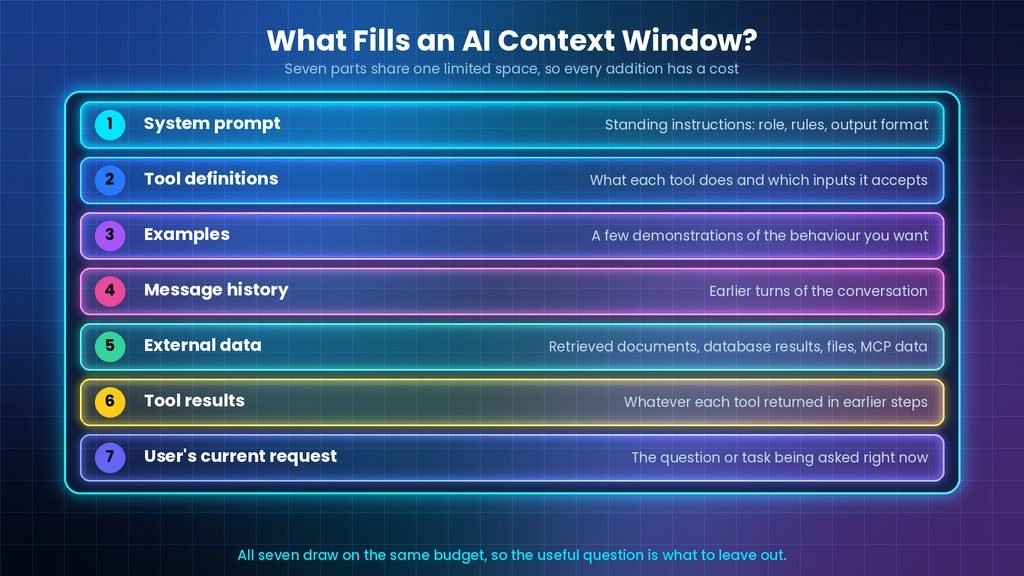
Because every part spends the same budget, adding anything to the window has a cost, and the useful question is always what to leave out.
Prompt Engineering vs Context Engineering: What Actually Changes?
Prompt engineering is the craft of writing and organising instructions for a model. Context engineering is the wider job of curating every token the model sees, repeatedly, across the life of a task. Anthropic presents the second as the natural next step after the first, not a replacement for it.
Five differences matter in practice:
- Scope: prompt engineering shapes the instruction, while context engineering shapes instructions, retrieved data, memory, tool results and history together.
- Timing: a prompt is written and revised occasionally, while Anthropic notes that context curation happens again every time a decision is made about what to pass to the model.
- Failure fixed: prompting repairs unclear or badly structured requests, while context work repairs missing, stale, excessive or conflicting information.
- Owner: anyone can write a prompt, while context work for agents usually falls to developers who design retrieval, memory and tools.
- Location: a prompt lives in a text box or a file, while context engineering lives in the code, tools and data pipelines that assemble the input automatically.
In a single-turn chat the two nearly merge, because the prompt makes up most of what the model sees.
Consider a support assistant asked whether an order can be returned. Prompt work can make the reply polite, structured and correctly toned. Only context work makes sure the order date, the return policy and the earlier messages are in the window when the question arrives.
Has Context Engineering Replaced Prompt Engineering?
Not fully. Prompt writing has been absorbed into context engineering rather than deleted. A Gartner First Take published on 28 July 2025 argues that prompt engineering is fading and that AI leaders should prioritise context over prompts. Anthropic, by contrast, describes the newer discipline as an extension of the older one. Both positions hold, because they describe different layers of the same stack.
The strongest version of the claim that prompt engineering has died fails on the evidence. A model still needs clear instructions, and Anthropic’s guidance still asks builders to write system prompts that balance specificity with flexibility. What lost credibility is the belief that clever wording can compensate for missing, stale or noisy information.
Early use cases leaned on prompts because most work was one-shot classification or text generation, according to Anthropic’s guide. Agents that run for many turns changed that, because tool results and history keep arriving after the first instruction. A better prompt cannot recover a fact the model never received.
The more defensible position is to keep prompt writing as a core skill and treat it as the first layer of context work, since a precise instruction placed in a badly assembled context still produces unreliable output.
Why Does a Bigger Context Window Not Solve the Problem?
A larger AI context window adds capacity, not quality, because model accuracy does not stay flat as input grows. Chroma’s context rot report, published on 14 July 2025, tested 18 language models and found that performance becomes increasingly unreliable as input length grows, even on simple tasks.
This decline is often called context rot: the model’s ability to recall and use information weakens as the number of tokens in its input rises. Anthropic explains the mechanism through the transformer architecture, where every token attends to every other token, producing n squared pairwise relationships for n tokens. As the window fills, attention spreads thinner, which Anthropic describes as an attention budget with diminishing returns. Anthropic adds that this is a gradient rather than a cliff, so models stay capable at long lengths but lose some precision.
Four ways a long context fails
Developer Drew Breunig named four failure patterns in June 2025, and engineers now use them as shared vocabulary:
- Context poisoning: a hallucination or other error enters the context and is referenced again and again.
- Context distraction: the context grows so long that the model over-focuses on it and neglects what it learned in training.
- Context confusion: superfluous content in the context is used to produce a weaker response.
- Context clash: newly gathered information or tools conflict with material already in the context.
Each failure points to a different remedy, which is why the techniques in the next section are separate tools rather than one fix.
What Are the Core Techniques of Context Engineering?
LangChain’s context engineering post groups agent context techniques into four buckets: write context outside the window, select what returns, compress what stays, and isolate work so it does not flood the main thread. Anthropic’s guidance supplies practical forms of each, and the list below pairs them with the failures they address.
- Write: save information outside the window so it can return later. Anthropic describes structured note-taking, where an agent keeps a NOTES.md file or a to-do list and reads it back after a context reset.
- Select: bring in only what the next step needs. Retrieval-augmented generation (RAG) fetches documents that match a request, and Anthropic’s just-in-time approach keeps lightweight references such as file paths and loads the data only when a tool call asks for it.
- Compress: shrink what stays. Compaction summarises a conversation near its limit and starts a new window from the summary, and clearing old tool results is the lightest form.
- Isolate: split work across separate contexts. Anthropic describes sub-agents that explore in clean windows and return a short summary to a lead agent.
Anthropic matches compaction to long back-and-forth, note-taking to work with clear milestones and multi-agent designs to parallel research, so choose by task shape rather than by fashion.
Example: a hybrid design in Claude Code
Anthropic’s own description of Claude Code shows the mix. CLAUDE.md files are placed into context at the start, while tools such as glob and grep let the agent fetch other files just in time. The upfront file gives speed and stable rules, and the runtime search avoids loading material that may never matter.
When Is Prompt Engineering Enough, and When Do You Need More?
A well-written prompt is enough when the task is narrow, self-contained and the model already knows the facts it needs. Heavier context work becomes necessary when information changes, accumulates across turns, comes from several sources or must be traceable.
- Move beyond prompt edits when any of these signs appears:
- The answer depends on private or recent data the model was not trained on.
- The task runs across many steps, so history and tool output keep growing.
- The model calls tools whose results feed later steps.
- Different users need different information, or some data sits behind access control.
- Someone must be able to see which sources produced an answer.
- Quality drops as sessions get longer.
If none of these applies, tuning the prompt is faster, cheaper and easier to maintain.
Fine-tuning and long-prompt stuffing are the main alternatives. Fine-tuning changes the model itself through additional training, so updating a policy means another training run, while context work only changes the input, so the same update is an edit to a document. Stuffing everything into one long prompt is tempting, and the context rot findings above explain why it tends to degrade results rather than help.
How Can You Apply It Without Building an Agent?
Treat each conversation as a limited workspace: put in only relevant material, state stable rules once, remove what has gone stale and restart long sessions with a short summary. These habits work in any chat tool and need no code.
Six habits cover most everyday cases:
- Lead with the task, the audience and the output format, then add background.
- Paste only the passages that matter instead of whole documents.
- Put stable rules in standing instructions if your assistant supports them, and keep them short.
- Correct a wrong fact straight away, and start a new chat if the error keeps returning, because a mistake left in the history gets reused.
- When a long session degrades, ask for a summary of the decisions so far and paste it into a fresh chat.
- Keep confidential material out of tools your organisation has not approved.
These habits map directly onto the write, select and compress techniques above.
Habits for developers building agents
For coding agents, a written specification works as standing context the agent can reread. Beyond that, these checks catch most problems early:
- Start with a minimal system prompt on the strongest model available, then add instructions and examples only for failures you observe, which is the order Anthropic recommends.
- Keep the tool set small and non-overlapping, because Anthropic observes that if a human engineer cannot say which tool applies, an agent will not do better.
- Replace long lists of edge-case rules with a few diverse, canonical examples.
- Return token-efficient tool output and clear old tool results once they have been used. Many tools wrap web services.
- Treat retrieved text and tool output as untrusted, because instructions hidden inside it can steer the model.
- Test changes on real agent traces; Anthropic advises tuning compaction prompts for recall first and precision second.
Run these checks again whenever an agent’s behaviour changes after a model or tool update.
What Are the Costs, Limits and Common Mistakes?
Context engineering costs engineering effort and tokens, adds moving parts that can fail, and cannot give a model abilities it lacks. The term is also young, and its scope depends on who is speaking: Gartner frames it around enterprise architecture, data and interfaces, while Anthropic frames it around token curation for agents.
Check these trade-offs before investing:
- Latency: Anthropic notes that runtime exploration is slower than retrieving pre-computed data.
- Information loss: Anthropic warns that overly aggressive compaction can drop subtle details whose importance only appears later.
- Design effort: without good tools and heuristics, an agent can waste context on dead ends, according to Anthropic.
- Token spend: on pay-per-token services, every extra token is processed and billed, so check your provider’s pricing page before scaling a design.
- Maintenance: retrieval sources and notes go stale, so someone must own their accuracy.
- Ceiling: no amount of curation gives a model a skill it does not have.
Weigh these costs against the failure you are trying to remove, because a task that works with a plain prompt does not need the machinery.
Common mistakes
These patterns recur in Anthropic’s guidance and in Breunig’s failure list:
- Pasting everything in case it helps, which feeds distraction and confusion.
- Hardcoding long if-else rules into the system prompt, which Anthropic describes as brittle and costly to maintain.
- Keeping a bloated tool set with overlapping functions, which Anthropic names as one of the most common failure modes.
- Leaving outdated and current documents side by side in a retrieval source, which invites context clash.
- Changing context by feel instead of testing it on real tasks.
Fixing even two of these usually improves a failing task more than rewording the prompt.
What to Do Next
Prompts still matter, but they are one layer of what a model sees, and the rest of that layer decides whether an agent stays reliable over a long task. For anyone learning context engineering AI techniques, the quickest start is an audit of one task that fails today. List everything that occupies its AI context window, then remove each item the model does not need for the next step and add the one fact it is missing. Re-run the same task and note whether the failure changes, because that result shows which of write, select, compress or isolate to try next.
Frequently Asked Questions
1. Is context engineering the same as RAG?
No. Retrieval-augmented generation (RAG) is one technique inside context engineering: it fetches documents that match a request and adds them to the model’s input. Context engineering also covers system prompts, tool design, memory, compaction and sub-agents. RAG answers what to retrieve, while the wider discipline decides what to keep, drop and bring back at every step.
2. Can you practise it without writing code?
Yes, in a limited form. Anyone who gives an assistant only relevant material, states stable rules once, corrects errors early and restarts long chats with a short summary is managing context. Building automated retrieval, memory or tool use needs development work, but the habits behind it apply in any chat interface.
3. What is the difference between a context window and AI memory?
A context window is the working space for a single request, rebuilt on every call. Memory is stored information that survives across sessions and is loaded back into the window when it becomes relevant. Anthropic describes agent note-taking and a file-based memory tool as ways to keep facts outside the window and retrieve them later.
4. Does it reduce hallucinations?
It reduces the errors caused by missing or stale information, because retrieved, current sources give the model facts to use. It does not eliminate them. Poor context can also cause errors, and Breunig’s context poisoning pattern shows that one mistaken statement can be referenced again and again. Verify any output that matters.
5. Do I need to learn prompt engineering first?
Yes, the basics. A prompt remains one layer of the context, and Anthropic’s guidance still asks for clear system prompts and a few strong examples. Learn to write precise instructions first, then add retrieval, memory and tool design as your tasks grow beyond a single turn.