Introduction
A chatbot can draft a legal brief in seconds. It still cannot tell you whether writing that brief is the right thing to do. That gap between doing a task well and understanding why the task matters is where every real comparison between machine and human minds actually lives. Headlines keep framing this as a contest with a winner, but the more useful question is where each one should actually be doing the work. This article lays out exactly where artificial intelligence wins, where it still loses badly, and what actually changes when a system built on data meets a mind built on experience.
AI vs human intelligence comes down to one trade-off: AI processes data faster than any person and never tires, but it has no lived experience and can’t originate a genuinely new idea. Human intelligence is slower and error-prone, but it carries judgment, creativity, and accountability no model has produced on its own.
AI performs intelligence without possessing it as experience, because it optimizes patterns in training data rather than understanding what any of it means.
Humans still make the final call on ethical and high-stakes decisions, because judgment requires owning the consequences in a way no model can.
AI’s speed advantage compounds rather than fades it doesn’t lose focus on item 400 the way a person does, which is why it keeps taking over routine analysis work.
At the 2025 International Mathematical Olympiad, AI models matched the gold-medal cutoff for the first time, but a meaningful share of teenage human competitors reached the same standard, showing the gap is narrowing on structured problems, not gone.
The most reliable outcomes come from pairing AI’s throughput with human review, because a mistake AI makes gets repeated at scale until a person catches it.
What Is Artificial Intelligence vs Human Intelligence?
What Is Artificial Intelligence?
Artificial intelligence is the ability of a computer system to perform tasks recognizing patterns, generating text, making predictions that would normally require a human mind, by learning statistical patterns from large amounts of data rather than being explicitly programmed for each case. Modern AI, particularly large language models, builds this pattern-matching ability during a training process, then applies it to new prompts it has never seen before.
It does not understand meaning the way a person does; it predicts which response is statistically likely to satisfy the pattern in the request.
What Is Human Intelligence?
Human intelligence is the natural capacity to learn, reason, adapt, and make sense of the world by combining logic with lived experience, emotion, and values. It is not one single skill. Psychologist Howard Gardner’s long-standing theory of multiple intelligences argues that people draw on at least eight distinct capacities: linguistic, logical-mathematical, spatial, musical, bodily-kinesthetic, interpersonal, intrapersonal, and naturalistic rather than one general score.
That framework is part of why comparing “human intelligence” to a single AI benchmark score is already an uneven comparison: the AI is usually being measured against one narrow slice of what a human mind does, not the whole of it.
Intelligence vs Consciousness: Why AI “Thinking” Isn’t Understanding
AI can produce intelligent-looking output without having any subjective experience of producing it, and that distinction is the root of most confusion in the AI vs human intelligence debate. Intelligence, in the sense researchers measure it, is the ability to solve a problem or complete a task correctly. Consciousness is the presence of a first-person experience, being aware that you are the one solving it.
A calculator is intelligent in a narrow sense; nobody worries it is conscious. Large language models are far more capable than a calculator, but the underlying claim about them hasn’t changed: producing a fluent, correct-sounding answer demonstrates pattern completion, not awareness. No current AI system has been shown to have subjective experience, and researchers who study consciousness don’t have an agreed way to test for it in a machine, even in principle.
Keeping this distinction in mind prevents the two most common overreactions: assuming a capable model must be “aware” on one side, and assuming it can never matter because it is “just predicting text” on the other. What actually matters when you’re deciding whether to trust an AI output is its intelligence whether the answer is correct and useful not whether the system understands what it just said.
How AI and Human Intelligence Learn Differently
AI learns by adjusting millions or billions of internal parameters to reduce error across a fixed training dataset, a process that happens on a schedule and then freezes until the next training run. Humans learn continuously, updating understanding in real time from a single new experience, a conversation, or a mistake, without needing thousands of repeated examples.
This explains two things people notice constantly. First, why an AI system can seem to “forget” something you told it in an earlier conversation it isn’t actually learning from that chat, it’s retrieving from a fixed training snapshot plus whatever sits in its current context window. Second, why a person can adapt instantly to a rule change “the client moved the deadline” while an AI system applying an old assumption keeps confidently repeating it until someone corrects or retrains it.
The efficiency gap is just as stark. A University of Leicester analysis, reported by New Atlas, estimated that the human brain runs on roughly 20 watts of power, about the same as a dim light bulb, while training or running a large AI model draws vastly more electricity for a single narrow capability. Humans also learn through consequence: a bad decision that costs money or trust changes future behavior in a way no AI weight update currently replicates on its own.
Where Artificial Intelligence Outperforms Human Intelligence
AI’s advantages cluster around anything that rewards raw throughput and unwavering consistency conditions where a human’s attention naturally degrades over time.
- Processing speed and volume: AI can scan thousands of documents, transactions, or images in the time it takes a person to review one.
- Consistency: it applies the exact same rule to the 1st item and the 10,000th, with no fatigue-driven drift.
- Availability: it runs continuously, across time zones, without breaks or downtime.
- Pattern detection across huge datasets: it surfaces correlations spread across more data than any person could hold in mind at once.
- Narrow-task benchmarks: on defined, scoreable tasks, from advanced math to coding tests, current models now match or beat typical human performance.
- Cost at scale: once trained, running the same task a million more times costs a fraction of hiring a million more analysts.
None of this makes AI smarter in a general sense it makes it the better tool for exactly the kind of repetitive, well-defined work most people don’t want to do by hand anyway.
Where Human Intelligence Still Outperforms AI
Humans still win decisively wherever a task depends on values, unwritten context, or genuinely new ideas.
- Creativity from lived experience: humans combine emotion, memory, and culture to produce ideas that don’t already exist in any dataset, rather than remixing patterns from one.
- Emotional intelligence: humans read tone, body language, and unspoken tension in a conversation and adjust in real time; AI can mimic empathetic language but can’t build genuine rapport.
- Ethical judgment: humans weigh competing values and take responsibility for the outcome; AI can list trade-offs but carries no accountability for the choice made.
- Common-sense reasoning: a young child navigates an unfamiliar room without instruction, while some AI models still misjudge simple physical or visual situations that require no formal training.
- Adapting to unstated context: humans pick up on office politics, a client’s history, or a relationship that never appears in any written brief, and factor it into a decision.
- Learning from one example: a person can generalize a new skill from a single demonstration, while most AI systems still need large volumes of examples to reach the same reliability.
These are exactly the gaps that make unsupervised AI decisions risky in anything involving money, safety, or people’s lives.
AI vs Human Intelligence: Side-by-Side Comparison
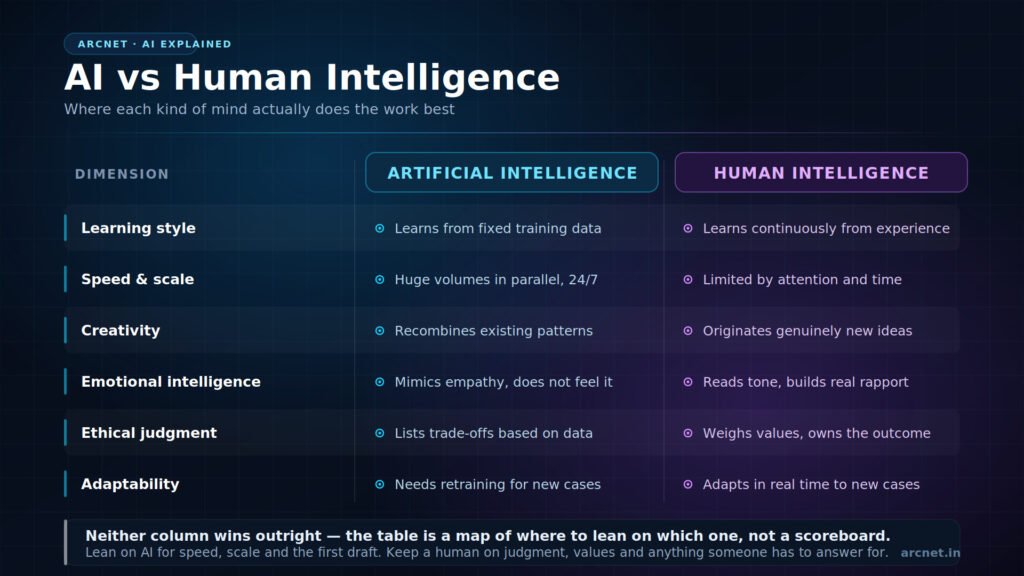
The clearest way to see the difference is side by side, dimension by dimension.
| Dimension | Artificial Intelligence | Human Intelligence |
| Learning style | Learns from fixed training data, then applies the pattern | Learns continuously from lived experience and feedback |
| Speed and scale | Processes huge volumes in parallel, 24/7 | Limited by attention and time; slower but selective |
| Creativity | Recombines patterns already present in training data | Originates genuinely new ideas from imagination and experience |
| Emotional intelligence | Mimics empathetic language, does not feel it | Reads tone and context, builds real rapport |
| Ethical judgment | Lists trade-offs based on data | Weighs values and owns the outcome |
| Consistency | Applies the same rule every time, no fatigue | Prone to drift, bias, and fatigue over a long day |
| Adaptability | Needs retraining to handle a genuinely new situation | Adapts in real time from a single new experience |
| Best suited for | Repetitive, well-defined, high-volume tasks | Judgment calls, novel problems, relationships |
Neither column wins outright; the table is a map of where to lean on which one, not a scoreboard.
When to Trust AI vs Human Judgment
Trust AI’s output when the task is well-defined, has a checkable right answer, and the cost of an error is low or easily caught. Insist on human judgment when the decision is high-stakes, ambiguous, or carries a consequence for a real person.
- Reversibility: if a wrong answer is cheap to undo a first draft, a sorted spreadsheet AI-first is fine; if it’s hard to reverse, such as a medical, legal, or hiring decision, a person should make the final call.
- Verifiability: use AI output freely where you or someone else can quickly check the answer against a known fact; be far more cautious where the “right” answer is itself a judgment call.
- Stakes: the higher the cost of being wrong financially, physically, legally the more the decision belongs with a person who can be held accountable for it.
- Data quality: AI is only as reliable as its training and input data; in genuinely novel or messy situations, human pattern recognition often outperforms a model trained on cleaner, more typical cases.
- Need for context: if the right call depends on history, relationships, or unwritten context, a human who actually knows that context should decide, not a system that only sees the prompt.
- Speed vs correctness: when speed matters more than perfect accuracy, such as a first pass or a brainstorm, let AI go first; when correctness matters more, put a person in the loop before anything ships.
A common mistake is treating a fluent AI answer as a verified one just because it reads confidently fluency and accuracy are not the same thing, and AI produces both confident right answers and confident wrong ones in the same tone. A simple rule covers most of the rest: let AI produce the first draft of almost anything, and keep a human as the last check on anything that can hurt someone if it’s wrong.
Will AI Ever Surpass Human Intelligence?
On narrow, well-defined tasks with a checkable answer, AI already matches or beats typical human performance in several domains. On general, open-ended intelligence the kind that adapts across completely different situations it has not, and there’s no agreed timeline for when or whether it will.
The clearest recent evidence is the 2025 International Mathematical Olympiad. Models from Google DeepMind and OpenAI each scored 35 out of 42 points, hitting the gold-medal threshold for the first time on one of the hardest structured problem sets that exists a genuine milestone. But that same year, roughly 67 of the 630 human competitors, about 11 percent, also reached gold, meaning a substantial group of teenage mathletes matched the standard the AI models needed a historic leap to reach, according to Entrepreneur’s coverage of the result.
This matters because a widely repeated claim in the “artificial vs natural intelligence” debate is that AI has already closed the gap with human experts on core knowledge benchmarks. Read the source carefully before repeating it: Stanford HAI’s 2025 AI Index reports a benchmark gap narrowing from double digits in 2023 to near parity in 2024 on tests like MMLU but that specific figure measures the gap between the top US and Chinese AI models, not a gap between AI and human experts. AI can now win a math medal without understanding what winning means, and mixing up “AI beating other AI” with “AI beating human experts” is exactly the kind of mistake that makes the surpass-humans debate murkier than it needs to be.
What’s genuinely true: AI keeps closing gaps on tasks that can be scored math, coding, structured knowledge tests. What’s still unresolved: whether “general intelligence,” the kind that transfers across any new situation the way a human mind does, is the same capability current AI architectures produce more of as they scale, or a different capability altogether that scaling alone won’t reach. Nobody serious claims to know the answer with confidence, and any specific date attached to it should be treated as a guess, not a fact.
Where AI and Human Intelligence Work Best Together
The most reliable results come from a loop where AI handles volume and a human handles judgment: AI produces a fast first pass, a person verifies it against context the model doesn’t have, and only the verified version moves forward.
In practice this looks like AI scanning thousands of support tickets and flagging the twenty that need a human’s attention, or drafting a first version of a report that a person then fact-checks and reshapes around what the audience actually needs to hear.
AI brings momentum; humans bring meaning and accountability. Treating the relationship as a handoff, not a replacement, is what keeps the speed of AI from turning into speed at the cost of accuracy. A useful habit: before trusting an AI output for anything you’ll publish or act on, ask it to show its reasoning or sources; if it can’t produce either, verify independently before moving forward.
Conclusion
There isn’t really one winner in this comparison; it’s a map of where each kind of mind should be doing the work. Lean on AI for speed, scale, and the first draft of almost anything; keep a human in charge of anything that involves judgment, values, or a consequence someone has to own. On structured, scoreable tasks the AI vs human intelligence gap keeps shrinking, but a model still can’t take responsibility for what it produces only a person can. The artificial vs natural intelligence divide isn’t closing everywhere at once, so the safest habit is to name, before your next AI-assisted decision, which category it falls into so you know whether the model’s answer is the final word or just the first draft.
FAQs
1. Can AI ever become conscious like a human?
No one can currently test for this, so the honest answer is that nobody knows. Today’s AI models produce fluent, humanlike text without any confirmed subjective experience behind it. Researchers treat AI “understanding” as a description of its output, not proof that anything is being consciously experienced, and there’s no agreed method to verify consciousness in a machine even in principle.
2. What is the main difference between AI and human intelligence?
AI learns statistical patterns from fixed training data and applies them without lived experience or stakes in the outcome. Human intelligence combines logic with emotion, values, and continuous learning from real consequences. AI wins on speed, scale, and consistency; humans win on creativity, judgment, and accountability for decisions that affect other people.
3. Is human intelligence better than artificial intelligence?
Neither wins outright it depends on the task. AI is often better for speed, scale, and narrow benchmark performance, and it’s improving quickly there. Human intelligence still clearly wins on creativity, ethical judgment, emotional understanding, and adapting to brand-new situations, and there’s no timeline for when that changes.
4. Can AI replace human intelligence at work?
AI can replace specific tasks drafting, sorting, first-pass analysis far more easily than it can replace judgment. Work that depends on accountability, relationships, or a decision someone has to own tends to keep a human in the loop, with AI handling the volume work around it rather than the decision itself.
5. How is human intelligence measured differently from AI intelligence?
Human intelligence is typically assessed across multiple distinct capacities verbal, logical, spatial, emotional, and more rather than one score. AI is usually measured on narrow, task-specific benchmarks like coding tests or knowledge exams. Comparing a single AI benchmark score to “human intelligence” as a whole compares one slice of ability to the full range most people actually use.