
Introduction
A robot that can only repeat one welded seam is not new. A robot that can look at a part it has never seen, decide how to hold it, and correct itself when the grip slips is the actual shift underway on factory floors right now. This article explains what that shift is, how the technology behind it works, and what a real, published factory deployment looked like from start to finish. It also covers where the technology still breaks, because every source claiming otherwise is selling something.
Physical AI is artificial intelligence that senses the real world through sensors, reasons about it with a trained model, and acts through a robot, vehicle, or piece of industrial equipment, closing that loop continuously rather than following a fixed, pre-programmed path. It’s what lets a machine adapt to a part or obstacle it has never seen, instead of only ever repeating the same motion.
Key Takeaways
Physical AI covers any system that closes the sense-reason-act loop against real-world physics, from a warehouse robot to a factory-wide predictive-maintenance model, which matters because none of that requires a humanoid body to count.
Embodied AI is a narrower term inside that umbrella, referring specifically to AI that learns through a body’s own interaction with its environment, which matters because the two terms get used interchangeably even though not all physical AI has, or needs, a body.
BMW’s own published figures show a single humanoid robot supporting production of more than 30,000 vehicles over 11 months at its Spartanburg plant, which matters because it is a rare instance of a manufacturer publishing real operating numbers instead of a demo clip.
The World Economic Forum’s Global Lighthouse Network grew to more than 220 recognised factories by January 2026, which matters because it shows adoption is measured and audited, not just claimed in vendor marketing.
Manufacturers are following a phased path from fixed robotic arms to cobots to autonomous mobile robots to humanoids, which matters because skipping phases is where most deployments fail on data and integration, not on the robot itself.
The most common failure mode is not the robot dropping the part, it is the model misjudging a part’s position by a few millimetres because the real factory floor never quite matches the simulation it trained on.
What Is Physical AI?
Physical AI is artificial intelligence that perceives the physical world through sensors, reasons about it with a trained model, and acts on it through a robot, vehicle, or piece of industrial equipment, in a continuous sense-decide-act loop. NVIDIA has been the most visible force in popularising the term as a market category, framing it around simulation, foundation models, and onboard compute; that framing is commercially motivated, since NVIDIA sells the chips involved, but it does describe the field accurately.
The category is broad on purpose. It covers a humanoid robot loading sheet metal, an autonomous mobile robot navigating a warehouse aisle, a self-driving vehicle braking for an obstacle, and a predictive-maintenance system that watches a turbine and flags a failure before it happens – none of which necessarily has arms or legs. What ties them together is that all of them operate under physics, not just data: gravity, friction, and material tolerances apply to their decisions in a way that a language model’s output never has to account for.
How Physical AI Actually Works
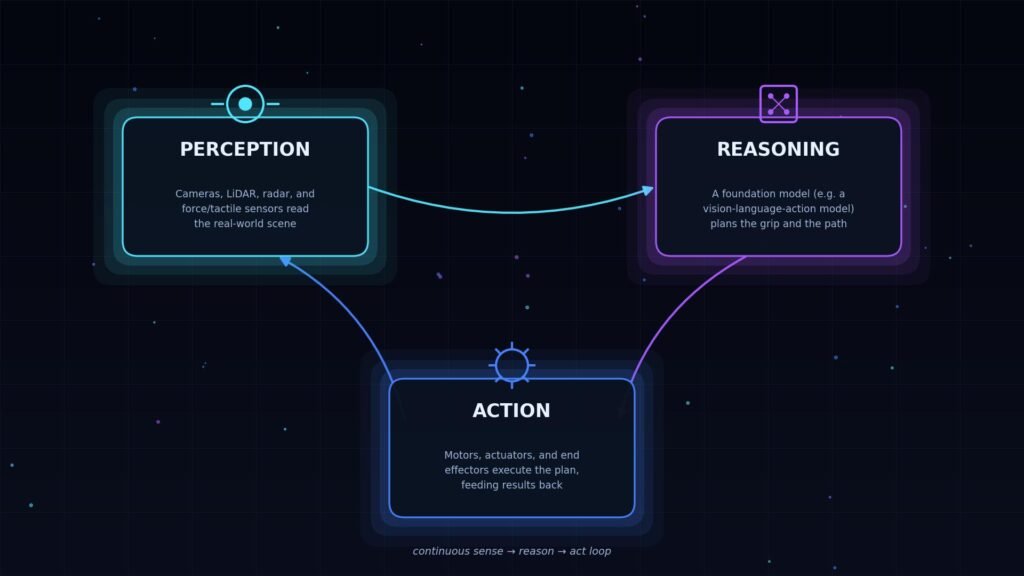
Physical AI works as a closed feedback loop: perceive, reason, act, observe the result, then repeat. That loop is what separates it from a traditional industrial robot, which executes a fixed, pre-programmed path with no awareness of whether the part is actually where the program assumed it would be.
The three layers of the loop
- Perception – cameras for object recognition, LiDAR and radar for 3D mapping, and force or tactile sensors that tell a gripper how hard it is actually squeezing. This is the layer that fails first when lighting, dust, or clutter differ from training conditions.
- Reasoning – a foundation model, often a vision-language-action model, converts what the sensors report into a plan: which object, which grip, which path. This is the layer NVIDIA’s Cosmos world models and Isaac GR00T models, along with models like Google DeepMind’s Gemini Robotics-ER and Physical Intelligence’s pi-0, are built to handle.
- Action – motors, actuators, and end effectors carry out the plan, and the result feeds straight back into perception for the next cycle, rather than waiting for a human to check the outcome.
That reasoning layer increasingly runs at the edge rather than in a distant data centre, because a robot deciding whether to keep gripping a part cannot wait on a round trip to the cloud. Our explainer on edge computing versus cloud computing covers why that latency gap matters and where each approach still makes sense.
Physical AI vs Robotics vs Embodied AI vs Generative AI
These four terms get used as if they mean the same thing, and they do not. Getting the distinction right matters because it decides what a project actually needs: a warehouse predictive-maintenance system does not need a body, while a humanoid on an assembly line needs both a body and a model built for one.
| Term | What it actually means | What it does not mean |
| Physical AI | The broad umbrella: any AI that senses, reasons, and acts on the physical world, robot or not. | It does not require a body – a turbine-monitoring model counts. |
| Embodied AI | A subset of physical AI: an agent that learns specifically through a body’s own interaction with its environment. | It is not interchangeable with robotics in general – the emphasis is on learning through embodiment. |
| Traditional robotics | Machines executing pre-programmed, fixed paths with no model reasoning about context. | It is not adaptive – the same weld robot cannot handle a part placed a centimetre off its expected spot. |
| Generative AI | AI that produces new digital outputs – text, images, audio, code – from learned patterns. | It never takes physical action; its output stays on a screen, not in the world. |
The clearest one-line version comes from Boston Consulting Group’s framing: embodied AI is the intelligence of an agent with a body, and physical AI is the umbrella for anything acting on the physical world – so all embodied AI is physical AI, but not all physical AI is embodied. If you want the generative side of this comparison in more depth, our guide to how generative AI actually works covers the model side of that distinction.
Physical AI Robots 2026: The Models and Companies to Know
The model layer is what changed physical AI from hand-coded automation into something closer to general-purpose reasoning. NVIDIA introduced Isaac GR00T N1 at GTC in March 2025, describing it as the first open foundation model built for generalised humanoid reasoning, and has continued releasing updated versions since, alongside its Jetson Thor onboard computer and Cosmos world models used to generate synthetic training data.
NVIDIA is not the only lab in this space, and naming only one vendor understates how contested the model layer is. Google DeepMind’s Gemini Robotics-ER line focuses on spatial reasoning and multi-view understanding for tasks like reading analogue gauges. Physical Intelligence’s open-sourced pi-0 model uses a flow-matching architecture trained across single-arm, dual-arm, and mobile manipulator robots. On the hardware side, Figure AI, Boston Dynamics, Agility Robotics, and China-based RobotEra are among the companies fielding humanoid platforms, while Skild AI is building what it calls an ‘omni-bodied’ model intended to control different robot body types without being retrained for each one.
The practical detail worth remembering: which model or vendor leads changes every few months in this field. Treat any single company’s dominance as a snapshot, not a settled fact, and check a vendor’s own release notes before repeating a specific benchmark claim.
Physical AI in Smart Factories: The BMW Case Study
Most articles on this topic gesture at ‘humanoid robots entering factories’ without naming a real, sourced example. BMW Group has published one. At its Spartanburg, South Carolina plant, BMW ran an 11-month pilot with Figure AI’s Figure 02 humanoid robot in the body shop, where it retrieved and positioned sheet metal parts for welding, a task demanding both speed and millimetre-level accuracy.
What BMW’s own numbers show
- The robot supported production of more than 30,000 BMW X3 vehicles over the pilot period.
- It moved more than 90,000 components across roughly 1,250 operating hours, working ten-hour shifts, five days a week.
- Across that run it took around 1.2 million steps completing the same class of task.
- On the strength of those results, BMW confirmed on 27 February 2026 that it is piloting a second humanoid, Hexagon Robotics’ AEON, at its Leipzig, Germany plant for battery assembly and component manufacturing – its first physical AI deployment of this kind in Europe.
This is the level of detail a reader actually needs to judge whether the technology works: not a demo video, but a named plant, a named task, and a duration with real throughput numbers attached. It is also what separates a genuine physical AI robots 2026 deployment from a vendor’s demo reel.
BMW’s deployment is not an isolated case study. The World Economic Forum’s Global Lighthouse Network, co-founded with McKinsey to independently audit advanced manufacturing sites, welcomed 23 new members in January 2026, bringing the network past 220 recognised sites across more than 30 countries. Sites join only after an independent panel verifies measurable performance gains, which is a meaningfully different bar than a manufacturer’s own press release.
Beyond humanoids, physical AI is showing up in smart factories through vision-based quality inspection that catches defects a human inspector would miss on a fast-moving line, predictive maintenance models that flag a failing bearing before it stops the line, and autonomous mobile robots handling material movement between stations. Nearly a quarter of manufacturers plan to deploy physical AI within the next two years, according to the Manufacturing Leadership Council’s findings cited in Deloitte’s 2026 tech trends coverage of physical AI and humanoid robots, which puts current adoption at a meaningful minority rather than the near-universal shift some vendor marketing implies.
How Manufacturers Are Actually Adopting Physical AI
No factory jumps straight from a conventional production line to humanoid robots. The realistic path runs through four phases, and skipping a phase is a common reason pilots stall – the robot is rarely the bottleneck, the surrounding data and integration work is.
- Fixed automation. Industrial robotic arms handle repetitive, pre-programmed tasks such as welding, painting, and palletizing on a fixed path. This phase builds baseline throughput and safety culture, and most manufacturing plants have already done it.
- Cobot integration. Collaborative robots take over machine tending, assembly support, and quality checks, working directly alongside people rather than behind a safety cage. This is where a plant starts generating the sensor and process data that later phases depend on.
- Autonomous mobile robots. AMRs handle material movement and logistics between stations, navigating around people and obstacles using onboard sensors rather than a fixed track, which is the first genuinely adaptive layer most plants deploy.
- Humanoid and general-purpose robots. Only once the data pipeline, safety protocols, and integration patterns are proven do humanoid platforms like BMW’s Figure 02 or AEON enter the picture, typically on a narrow, well-defined task before any expansion.
The decision criteria that actually matter at each step are the task’s tolerance for error, how structured the environment is, and whether the plant has the sensor data a model needs to learn from – not simply whether a vendor’s demo looks impressive. The same underlying shift already reshaped software-side work: our roundup of AI productivity tools covers how that played out on the office side before it reached the factory floor.
Where Physical AI Robots Still Break
Every source that only describes what physical AI can do is skipping the half of the story that determines whether a deployment actually succeeds. The honest limitations fall into a few repeating categories.
- Distribution shift. A model trained in simulation or in one plant’s conditions can misjudge a real part’s position by a small margin when lighting, clutter, or wear differ from training data – and in a physical system, a small margin is the difference between a successful grip and a dropped part.
- Interoperability. As plants deploy robots and AMRs from multiple vendors, each with proprietary protocols, coordinating them can cause congestion, downtime, and operational inefficiency rather than the seamless fleet vendors show in demos.
- Safety under uncertainty. Because physical AI systems operate in unpredictable, changing environments, fixed safety rules and predetermined failure states are not enough on their own; adaptive, real-time safety assessment is still an active area of engineering, not a solved problem.
- Cost and hardware limits. Sarcos veteran and Palladyne AI executive Kristi Martindale has pointed out that there has not been enough real-world exception data available to program for every situation a physical AI system encounters, which is a hardware and data problem as much as a model one.
Physical AI robots rarely fail because they cannot lift the part; they fail because the part is a few millimetres from where the simulation said it would be, and nothing in the model’s training told it what to do about the difference.
What This Means for the Factory Workforce
The honest answer to whether robotics AI is taking factory jobs is task-specific, not categorical. BMW’s own framing of the Spartanburg deployment describes the robot taking over an ergonomically awkward, physically tiring task, not replacing a role outright – the robot was introduced as one part of a body-shop process still staffed by people, running alongside a Smart Transport Robot system already in place.
What actually shifts is which tasks a person spends time on. Physically repetitive, high-injury-risk tasks are the ones being handed to physical AI systems first, while judgement calls, exception handling, and oversight of the robot itself remain human work. Interoperability and fleet-orchestration problems, discussed above, are also creating a newer category of job: someone has to manage and troubleshoot a mixed fleet of robots from different vendors, which did not exist as a role five years ago.
Conclusion
Physical AI robots are no longer a lab demo – BMW’s own published numbers from Spartanburg are the clearest evidence yet that a humanoid can hold up across nearly a year of real shift work. The throughline across physical AI robots 2026 case studies, BMW’s included, is that the technology succeeds when the surrounding data and process work is mature, not when the robot alone looks impressive. If you are evaluating this for a factory floor, start by checking where your plant actually sits on the four-phase adoption path above, because the honest constraint is rarely the robot itself; it is whether your sensor data, safety protocols, and integration work are mature enough to support it. Smart manufacturing is moving from fixed automation toward adaptive systems, and the plants getting real value from it, per the Global Lighthouse Network’s independently audited results, are the ones treating this as an operational data problem first and a robotics purchase second. For a deeper look at the model layer driving all of this, our explainer on generative AI is a useful next read.
FAQs
1. What is the difference between physical AI and embodied AI?
Physical AI is the broader umbrella for any AI that senses, reasons, and acts in the physical world, robot or not. Embodied AI is a subset of that umbrella: it specifically refers to an agent that learns through its own body’s interaction with an environment, such as a robot learning to balance by falling and adjusting.
2. What is the difference between physical AI and generative AI?
Generative AI produces new digital outputs, such as text, images, or code, based on patterns learned from data, and its output stays on a screen. Physical AI takes that reasoning a step further into action, moving, gripping, or navigating in the real world through a robot, vehicle, or piece of equipment.
3. What are real examples of physical AI robots in manufacturing?
BMW’s Figure 02 humanoid loading sheet metal at its Spartanburg plant, autonomous mobile robots moving material between warehouse stations, vision-based quality inspection systems catching defects on a production line, and predictive-maintenance models flagging equipment failures before they happen are all published, real-world examples.
4. Are physical AI robots replacing factory workers?
The evidence so far points to task replacement rather than role replacement. BMW’s own description of its Spartanburg deployment frames the robot as taking over one physically demanding, repetitive task within a process still staffed by people, not eliminating the surrounding roles.
5. Which companies are leading physical AI robots in 2026?
NVIDIA leads on the model and compute layer with Isaac GR00T and Jetson Thor, Google DeepMind contributes Gemini Robotics-ER, and Physical Intelligence has open-sourced its pi-0 model. On hardware, Figure AI, Boston Dynamics, Agility Robotics, and Hexagon Robotics are among the companies fielding humanoid platforms in real factory pilots.
7. Is physical AI the same thing as robotics?
No. Traditional robotics executes a fixed, pre-programmed path with no reasoning about context, while physical AI adds a perception-and-reasoning loop that lets the same machine adapt when a part, obstacle, or condition differs from what it expected.