Introduction
Most organisations that attempt a digital transformation do not fail because they picked the wrong software. They fail because the function responsible for architecture, security, and integration was treated as an execution team instead of a strategic one. This page breaks down exactly what that function does, where the real friction with business leadership shows up, and why more than eight in ten digital efforts still underperform their own targets. It also covers the costs and skills gaps that vendor pitches tend to leave out.
Quick answer
IT in digital transformation is the function that builds, secures, and connects the technology a business runs on cloud infrastructure, data platforms, cybersecurity, and system integration while working with business leaders to decide which technology actually solves a real problem rather than adding complexity for its own sake.
Key takeaways
IT now owns the architecture decisions that decide whether new tools actually connect to existing systems, because most transformation failures trace back to integration debt, not to the tools themselves.
Fewer than one in four organisations report a digital transformation that both improved performance and held onto the gain, according to McKinsey because sustaining a change is harder than launching one.
One in four CIOs name aligning IT with business priorities as their biggest obstacle, because the two sides often measure success differently: uptime and security versus revenue and speed.
Cloud, security, and applied-AI skills shortages slow rollouts more than budget does in most mid-sized organisations, because a platform nobody can operate safely delivers no value regardless of its price tag.
Smaller organisations succeed at digital transformation far more often than large ones, because fewer legacy systems mean less integration work for IT to absorb.
The cost that sinks most IT-led transformation budgets is rarely the software licence it is the migration and integration effort needed to make new tools talk to old ones.
What Digital Transformation Actually Means for IT
Digital transformation is the reorganisation of how a business creates value using digital technology, not simply the replacement of old software with newer software. IT transformation is narrower: it means upgrading the infrastructure, hardware, and internal processes that IT itself runs, such as migrating servers to the cloud or replacing an ageing network. The two overlap constantly, but conflating them is where projects lose their way. A company can complete an IT transformation new servers, new laptops, a new helpdesk system without changing how it serves customers or makes decisions, and still call it a digital transformation because the invoice said “technology upgrade.”
IT sits at the centre of both. It is the function that makes underlying systems capable of supporting a new customer experience, a new data-driven process, or a new operating model, and it is also responsible for the narrower infrastructure work that usually has to happen first. Knowing which one a given project actually is decides whether IT is being asked to enable a business change or simply to run a hardware refresh.
The Core Work of IT in Digital Transformation
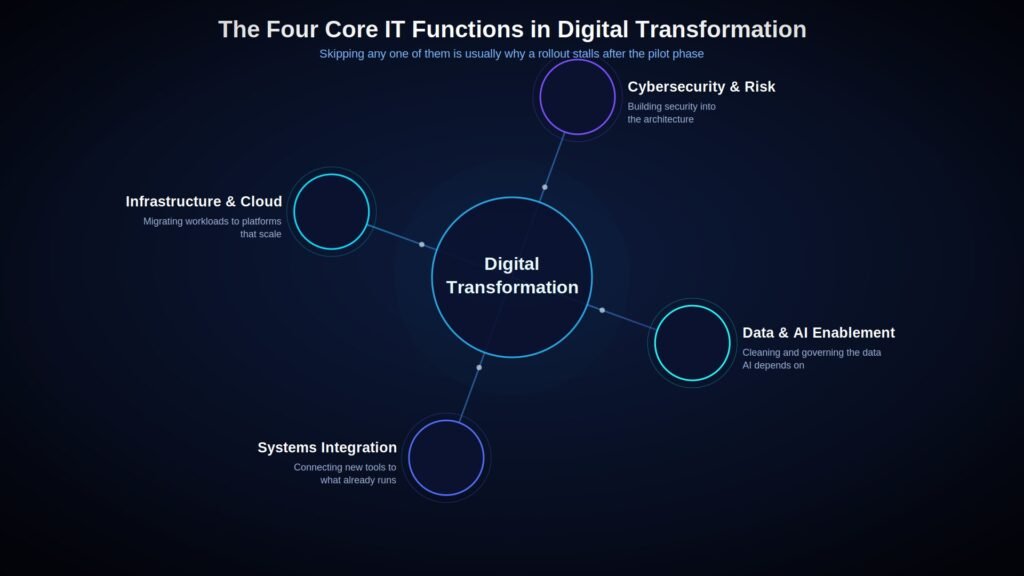
IT’s responsibilities inside a transformation programme fall into four connected areas. Skipping any one of them is usually why a rollout stalls after the pilot phase.
- Infrastructure and cloud migration. Moving workloads off ageing on-premises servers onto platforms that can scale up or down as demand changes, while deciding which systems stay on-premises for latency, cost, or compliance reasons. Editor: link anchor “cloud migration process” to a related Arcnet cloud article once a URL is confirmed.
- Cybersecurity and risk management. Every new integration point, API, and cloud service widens the attack surface, so IT has to build security into the architecture from the start rather than adding it once something is already live. Editor: link anchor “cybersecurity governance framework” to a related Arcnet security article once a URL is confirmed.
- Data and AI enablement. Cleaning, connecting, and governing the data that AI tools and analytics dashboards depend on a model fed inconsistent or siloed data produces unreliable output regardless of how advanced it is.
- Systems integration. Making sure a new CRM, ERP module, or automation tool actually exchanges data with what the business already runs, instead of becoming an isolated system someone has to update by hand.
None of these are one-off projects. Each has to be maintained and re-evaluated as the business, the threat landscape, and the available technology keep changing.
From Support Desk to Strategy Table
IT’s mandate inside most organisations has shifted from keeping systems running to shaping which systems get funded in the first place. A decade ago, business units decided what they wanted and IT installed it. In organisations further along in their transformation, IT now sits in on strategy conversations before a decision is made, evaluating whether a proposed initiative is technically feasible, secure, and worth the integration effort it will require deciding which tech innovation actually reaches production, not just which one gets piloted.
That shift is not universal. Plenty of organisations still run IT as a cost centre that fields tickets and keeps the lights on, with digital initiatives owned entirely by marketing or operations. That gap is exactly what breaks business IT alignment in slower-moving organisations: the function with the clearest view of what is technically sustainable is the last one consulted.
Business and IT Alignment: Who Should Actually Lead?
There is no universal answer to who should lead a digital transformation, but the friction almost always comes from the same place: IT and business units measure success differently. IT prioritises uptime, security, and long-term maintainability; business units prioritise speed to market and immediate revenue impact. One in four CIOs name aligning IT with business priorities as their single biggest challenge, according to IDC’s Worldwide C-Suite Tech Survey (September 2025) a gap wide enough that it, not budget or technology, often decides whether an initiative finishes on schedule.
The arrangement that tends to work is joint ownership: a business sponsor accountable for the outcome, and an IT lead accountable for whether the solution can actually be built, secured, and supported once it ships. Neither side gets a veto once both roles are named the business sponsor cannot demand a launch date the architecture cannot meet, and IT cannot indefinitely delay a decision in the name of technical perfection. When one side leads without the other named as a genuine co-owner, the initiative either ships something users don’t want or something that cannot be kept running.
Where Digital Transformation Breaks Down Without Strong IT
Digital transformation fails more often than it succeeds, and the data on why keeps confirming that IT capability shapes the outcome. Only 16 percent of organisations report a digital transformation that both improved performance and sustained the gain over time, according to McKinsey’s transformation research; a further 7 percent saw an improvement that did not hold. Even in digitally mature sectors such as high tech, media, and telecom, that same survey found the success rate does not exceed 26 percent, and it falls to between 4 and 11 percent in more traditional industries such as oil and gas, automotive, and pharmaceuticals. The same research found that organisations with fewer than 100 employees are 2.7 times more likely to report a successful digital transformation than organisations with more than 50,000 employees smaller companies simply carry fewer legacy systems for IT to reconcile.
Two failure points repeat across the data and across practitioner accounts: unclear ownership of decisions, and the IT skills gap showing up exactly when a project needs it most. Cloud architecture, cybersecurity, and applied AI or data skills are the three areas organisations most often lack in-house, which means a transformation timeline frequently depends on hiring or retraining people before it depends on writing a single line of new code.
The Hidden Costs and Trade-Offs IT Has to Manage
The cost that derails an IT-led transformation budget is rarely the sticker price of the software. It is what the monthly subscription line item does not show.
- Integration and migration effort. Connecting a new platform to what the business already runs typically costs more in engineering hours than the software licence itself, especially when legacy systems were never designed to share data.
- Technical debt from a previous transformation. A platform adopted years ago and never fully retired keeps consuming maintenance time that could go toward the new one.
- Training and adoption. A tool nobody knows how to use safely gets worked around rather than adopted, and workarounds are where data governance and security controls quietly break down.
- Per-seat and usage-based pricing creep. Cloud and SaaS tools that look affordable at pilot scale often cost meaningfully more once every department is using them. Check the vendor’s own pricing page for how the per-seat or usage tier changes at scale, because that detail moves constantly and rarely matches the number quoted in a sales call.
- Vendor lock-in. Once data and workflows are built around one platform’s specific structure, switching later costs more than switching would have cost on day one.
None of these costs disqualify a project on their own, but a transformation plan that never names them is a plan built on the sticker price alone.
Conclusion
Treat IT as a cost centre and a transformation stalls at the pilot stage. Treat it as a strategic partner from the start, and the odds of holding onto the gains improve considerably, as IBM’s overview of digital transformation also frames it as a change that reaches the whole C-suite, not one department. The concrete next step is to check where the current initiative sits: has IT been named as a co-owner with real say over the technical roadmap, or only asked to implement a decision after it was already made? Getting IT in digital transformation right is less about buying the newest tool and more about naming who is accountable for making it actually work once the demo is over. Businesses that treat tech innovation as an engineering problem to hand off, rather than a shared decision to own, are the ones that end up back at the search results a year later.
FAQs
1. What is the difference between IT transformation and digital transformation?
IT transformation upgrades the infrastructure IT itself runs servers, networks, hardware. Digital transformation reorganises how the whole business creates value using digital technology, which usually requires IT transformation as a foundation first. A company can complete one without the other, though most digital transformation projects depend on both happening alongside each other.
2. Does IT own digital transformation, or does the business?
Neither side owns it alone in organisations that transform successfully. A business sponsor is accountable for the outcome, while an IT lead is accountable for whether the solution can be built, secured, and supported. Projects that assign ownership to only one side tend to ship something either unusable or unsustainable.
3. What skills does an IT team need for digital transformation?
Cloud architecture, cybersecurity, and applied AI or data skills are the three areas organisations most commonly lack in-house during a transformation. Because these skills take months to build internally, many IT teams start hiring or retraining well before a platform decision is finalised, not after.
4. Why do most digital transformation projects fail?
According to McKinsey’s research, only 16 percent of organisations sustain the performance gains from a digital transformation. Failures typically trace back to unclear ownership between IT and business leaders, legacy systems that were never fully retired, and a skills gap that surfaces once implementation actually begins.
5. How much should a business budget for IT in a digital transformation?
There is no fixed figure, because it depends on legacy system complexity, the number of integrations required, and whether new skills need to be hired or trained. Ask what the migration and integration work will cost before pricing the software licence that effort is usually the larger line item.