Introduction
On 3 November 2026, the Indian government released three language models built by two domestic companies, according to the Press Information Bureau (PIB). One is a large model for servers, and two are small models designed to run offline. This guide covers what each model can do, whether you can download it, and which claims remain untested.
India’s three new homegrown AI models are EKA-1, Dhīr 2B and Dhīr 5B, released under the IndiaAI Mission on 3 November 2026, according to PIB. Soket Labs built EKA-1, which has 26.3 billion parameters and targets maths, code and reasoning. ZenteiQ built the two smaller Dhīr models, which are designed to run offline on local hardware.
Key takeaways
EKA-1 cannot yet be judged because PIB gives its size as 26.3 billion parameters but no context length, hardware needs or benchmarks.
Dhīr 2B and Dhīr 5B suit offline use because ZenteiQ lists 4-bit files of only 1.21 GB and 2.95 GB.
Open does not yet mean downloadable, because transclew found no EKA-1 weights and restricted Dhīr listings on AIKosh, the government’s model portal, on 4 November 2026.
Choose by task rather than size, because ZenteiQ’s own tests favour Dhīr 2B for Indian languages and Dhīr 5B for code and maths.
Treat Dhīr scores as ZenteiQ’s own measurements, because ZenteiQ names unsourced factual recall as its weakest area.
What are India’s new AI models and who built them?
The Ministry of Electronics and Information Technology (MeitY) released the models in New Delhi on 3 November 2026, according to the Press Information Bureau release. Soket Labs built EKA-1, and ZenteiQ AiTech Innovations built Dhīr 2B and Dhīr 5B, under the IndiaAI Innovation Centre pillar.
A foundation model is a large AI model trained on broad data so that many applications can be built on it. PIB says the Union Cabinet approved the IndiaAI Mission on 7 March 2024, and both companies received subsidised national computing capacity.
MeitY Secretary S. Krishnan said the models strengthen India’s strategic autonomy in AI. News On AIR reported on 4 November 2026 that he added they can run in air-gapped environments, meaning computers isolated from outside networks.
What is the EKA-1 AI model?
EKA-1 is a 26.3 billion parameter language model from Soket Labs, described as an open, sparse hybrid model for maths, code, reasoning and agentic use. PIB says it was trained on about 7.5 trillion tokens and covers all 22 scheduled Indian languages plus English.
A parameter is one learned number inside a model, and a token is a small chunk of text. Agentic use means planning and carrying out multi-step tasks, which is why Arcnet’s guide to agentic AI security risks matters for models positioned for it. Sparse means only part of the model is active for each token; the launch material does not explain what hybrid means.
Soket’s chief executive said EKA-1 was tailored to banking, financial services and cybersecurity. A bank that cannot send customer data outside is the example case, and Arcnet’s overview of AI in cybersecurity covers the defensive side.
The release gives no context length, hardware requirements or benchmark results, so EKA-1’s strengths are developer claims, not measured results.
What are Dhīr 2B and Dhīr 5B and how do they differ?
Dhīr 2B and Dhīr 5B are small open ZenteiQ models that support English and ten Indian languages and can run offline. According to ZenteiQ’s Dhīr page, Dhīr 2B is a dense model with 2.03 billion parameters, and Dhīr 5B is a mixture-of-experts model with 5.09 billion parameters in total, 1.79 billion of them active per token.
In a dense model every parameter works on every token. In a mixture-of-experts model a router sends each token to a few specialist sub-networks, two of twelve in Dhīr 5B according to ZenteiQ. Both models have a 16,384-token context window, meaning the amount of text they can consider at once, according to ZenteiQ.
ZenteiQ lists the ten Indian languages as Hindi, Bengali, Tamil, Telugu, Marathi, Gujarati, Kannada, Malayalam, Punjabi and Odia. In its own tests against 24 open models of 1 to 7 billion parameters across 41 benchmarks, Dhīr 2B scored 61.4 overall and Dhīr 5B scored 64.6. Dhīr 2B led on Indian languages, 53.7 to 51.2, and Dhīr 5B led on code and maths, 61.2 to 50.8.
With 4-bit weights in llama.cpp, ZenteiQ measured 34.1 tokens per second for Dhīr 2B and 39.9 for Dhīr 5B on an NVIDIA Jetson Orin NX, a small computer for robots and industrial equipment, which suits a field engineer working without a network. ZenteiQ lists the 4-bit files at 1.21 GB and 2.95 GB.
How do EKA-1, Dhīr 2B and Dhīr 5B compare?
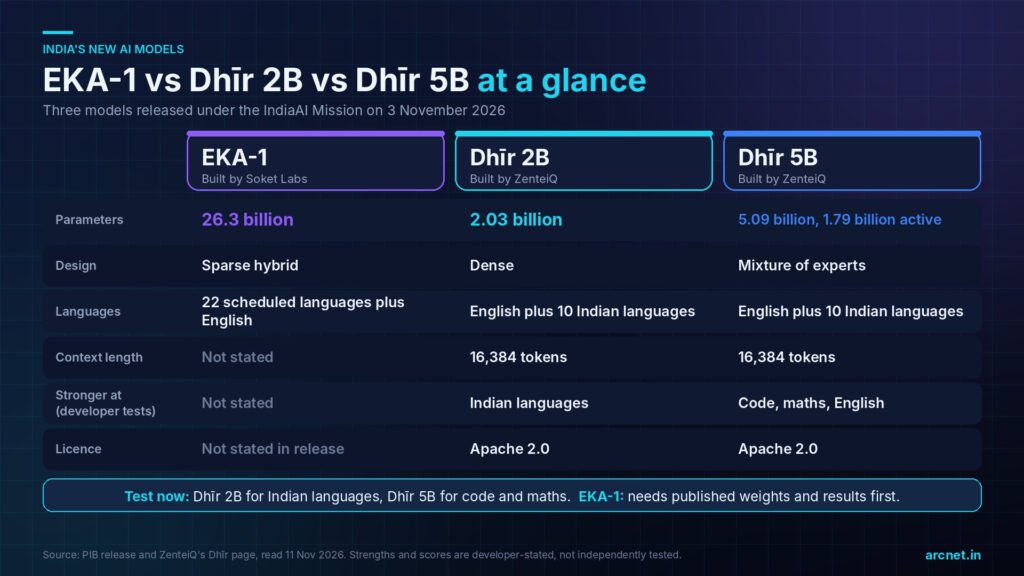
EKA-1 is the larger model for server-side work, while the Dhīr models trade size for local deployment. The table draws on PIB and ZenteiQ’s Dhīr page, both read on 11 November 2026.
| Attribute | EKA-1 | Dhīr 2B | Dhīr 5B |
| Developer | Soket Labs | ZenteiQ | ZenteiQ |
| Parameters | 26.3 billion | 2.03 billion | 5.09 billion, 1.79 billion active |
| Design | Sparse hybrid | Dense | Mixture of experts |
| Languages | 22 scheduled languages plus English | English plus 10 languages | English plus 10 languages |
| Context length | Not stated | 16,384 tokens | 16,384 tokens |
| Stronger at (developer tests) | Not stated | Indian languages | Code, maths, English |
| Licence | Not stated in release | Apache 2.0 | Apache 2.0 |
For readers who want to test something now, Dhīr 2B is the pick: smallest files, the strongest Indian-language scores in ZenteiQ’s tests and a stated licence. Dhīr 5B suits code and maths, and EKA-1 needs more evidence first. No single list of India’s new AI models is complete: ZenteiQ itself compared Dhīr with 24 open models of 1 to 7 billion parameters, and TechCrunch’s coverage of Sarvam reported on 18 February 2026 that Sarvam, an Indian AI lab, announced 30 billion and 105 billion parameter models.
Can you download and run these models today?
Partly. When the outlet transclew checked AIKosh, the IndiaAI Mission’s models and datasets portal, on 4 November 2026, the EKA-1 listing held no weights and the Dhīr listings were marked Restricted. Dhīr can run once access is approved; EKA-1 must wait.
Are the models really open?
Transclew reported that the EKA-1 page lists an Apache 2.0 licence but holds only three settings files, that Soket’s site says coming soon with a waitlist, and that Dhīr downloads need approval. IT Voice reported on 4 November 2026 that Soket plans to open the weights within a month.
Language claims also differ: PIB says 22 scheduled languages plus English, transclew reported that AIKosh says more than 100, and Soket’s homepage says more than 60. Announced is not downloadable, and downloadable is not tested. A common mistake is planning around the word open before reading a listing’s access level, and Arcnet’s explainer on data sovereignty and residency helps teams decide where data may live.
How do you run Dhīr on your own machine?
ZenteiQ’s vLLM fork, a copy of the vLLM serving software with native Dhīr support, is the documented route. Its README requires an NVIDIA graphics processing unit (GPU), Python with pip and approved access to the models on Hugging Face.
- Clone the zenteiq-research vllm repository with git.
- Open the cloned vllm folder and install the fork with its prebuilt kernels, which need no compilation.
- Open the Hugging Face page for your model and accept its terms. A download error means the access request is still pending.
- Log in to Hugging Face from the command line with the login command in the README.
- Start the model with the matching serve command. Leave the tensor parallel size at 1, because Dhīr 5B accepts only 1 or 5.
Run the install command inside the cloned folder, then the serve command for your model; vLLM then starts a local server:
VLLM_USE_PRECOMPILED=1 pip install -e .
vllm serve zenteiq-ai/Dhir2b
vllm serve zenteiq-ai/Dhir5b-MoE-A1.7B
The fork is a stopgap until Dhīr support reaches vLLM itself, and ZenteiQ’s laptop and Raspberry Pi speeds came from llama.cpp, so look for a ready-made 4-bit file before relying on them.
Which model should you choose?
Choose Dhīr 2B for Indian-language work on small devices, Dhīr 5B for code and maths, and wait for EKA-1 if the job is banking, financial services or cybersecurity. Six factors decide it:
- Task: ZenteiQ’s tests favour Dhīr 2B for Indian languages and Dhīr 5B for code and maths; EKA-1 has no results.
- Language: Dhīr names ten Indian languages, while EKA-1 claims all 22 scheduled languages, though listings disagree.
- Hardware: Dhīr runs from small files, and EKA-1 has no published hardware requirements.
- Data location: both developers describe offline or private deployment, keeping documents in your network.
- Access and licence: Dhīr lists Apache 2.0 behind an approval request, while EKA-1’s weights were unavailable on 4 November 2026, according to transclew.
- Context length: Dhīr’s 16,384 tokens, per ZenteiQ, means long reports need splitting, and EKA-1’s is not stated.
Settle task and access first, because they remove most options before hardware matters.
What can these models not do, and where do they break?
These models break most often on facts, long documents and untested languages. Six limits matter:
- Factual recall without a supporting source is the weakest Dhīr area, and ZenteiQ advises authoritative sources plus human review for law, finance, medicine or history.
- Neither Dhīr model has a reasoning mode, and both are text only, with no image, audio or speech, according to ZenteiQ.
- ZenteiQ says instruction following has been measured in English only, so Indian-language instructions are untested on that measure.
- Every Dhīr score and speed is ZenteiQ’s own measurement, and none of the pages reviewed for this article cited an independent evaluation of any of the three models.
- EKA-1 has no published benchmarks, so its strengths in maths, code and cybersecurity remain developer claims.
- A common mistake is treating offline operation as proof of security; it keeps data on the device, but the deployment still needs its own review.
Before adopting either family, test it on your own documents and languages and keep a person reviewing the output.
Frequently asked questions
1. Can Dhīr run on a phone?
ZenteiQ’s chief executive says the lightweight design allows on-device use on mobile phones without cloud connectivity, according to PIB. The sources reviewed name no tested phones, so test your own handset first.
2. Are EKA-1 and Dhīr free to use?
No prices appeared in the PIB release. ZenteiQ lists an Apache 2.0 licence for Dhīr, a permissive open-source licence, and offers enterprise access through licensing and pilots. You would still pay for hardware, and EKA-1’s licence was not stated.
3. What is AIKosh?
AIKosh is the IndiaAI Datasets Platform, one of the seven pillars of the IndiaAI Mission according to PIB. Secretary Krishnan said it could make the models available to researchers, students and the public, though transclew found downloads restricted on 4 November 2026.
4. Will these models replace ChatGPT, Gemini or Claude?
There is no evidence either way yet. None of the pages reviewed compared them with those assistants, and the developers describe different jobs: offline, local work for Dhīr and private servers for EKA-1.
What to do next
Treat India’s new AI models as a starting point for testing, not a finished verdict. The EKA-1 AI model needs published weights and evaluation results before anyone can judge it, while Dhīr 2B and Dhīr 5B can be tested on your own documents once access is approved. Start by reading the AIKosh listing’s access level and licence for the model you want before planning any work around it.