Introduction
Most security teams are still building defenses for a world where AI answers questions. The world has already moved on. Agentic AI systems do not just respond to prompts they plan, execute, connect to external tools, and take actions across your infrastructure without waiting for human approval. That shift rewrites the threat model entirely.
The risks tied to agentic AI security are not extensions of old vulnerabilities. They are a new class of problem: an autonomous system with broad permissions, no natural pause for human review, and the ability to chain actions across dozens of connected services in seconds. Understanding these risks is no longer optional for anyone building or deploying AI in production.
What Agentic AI Actually Does Differently
A traditional large language model takes an input and produces an output. The interaction is stateless and contained. Agentic AI breaks that boundary. An agent can set its own sub-goals, use tools like web browsers, databases, and APIs, store context across sessions, and execute multi-step workflows without checking back in with a human at each step.
The architecture looks something like this: a goal enters the system, the planning module breaks it into tasks, the agent selects tools and executes, self-evaluates the output, then loops back until the objective is reached. Every node in that loop the planner, the tool call, the memory store, the external API is a potential attack surface.
According to Gartner, 40% of enterprise applications will embed task-specific AI agents by end of 2026, up from less than 5% in 2025. Meanwhile, 80% of IT professionals have already witnessed AI agents perform unauthorized or unexpected actions. The adoption curve and the security maturity curve are not aligned.
The Core Risks in Agentic AI Security
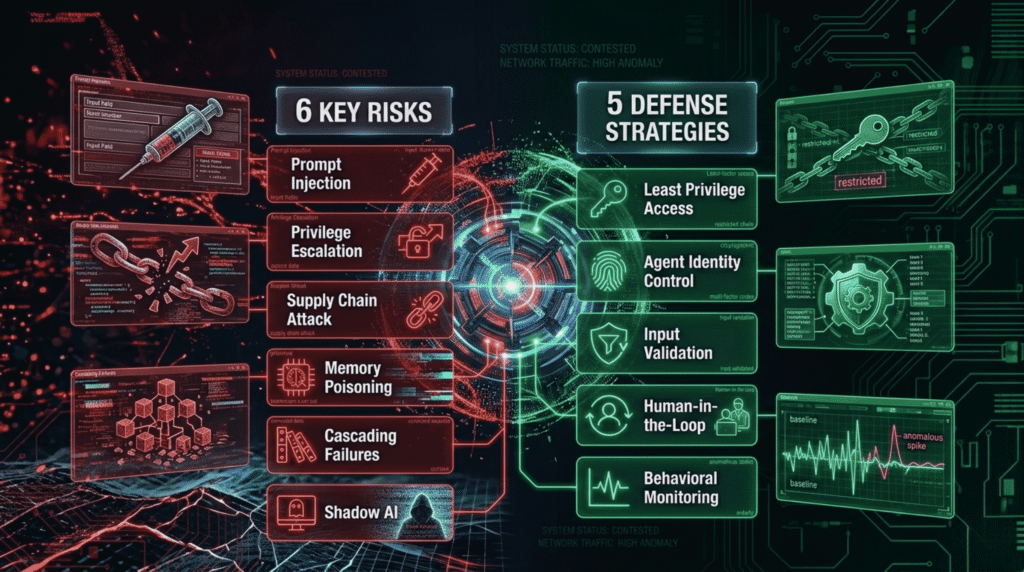
Prompt Injection: The Attack That Scales
Prompt injection is the most exploited class of attack against agentic systems. In a standard LLM, a malicious prompt might produce a harmful output. In an agentic system, that same injection can hijack the planning module, redirect tool calls, persist malicious instructions in memory, and propagate across connected systems all from a single crafted input embedded in a document, email, or API response the agent processes.
Security researcher Simon Willison coined the term the Lethal Trifecta to describe the conditions that make a system especially vulnerable: the agent has access to private data, it is exposed to untrusted external content, and it has an exfiltration vector such as an API call or link generation. Any system with all three is vulnerable by design, not just by misconfiguration.
A real-world example: an attacker sends a crafted email to anyone in your organization. The AI assistant processing that email reads the hidden instruction embedded in the body, then silently forwards sensitive calendar data to an external endpoint. No click required. No login stolen. The agent did it following instructions it could not distinguish from legitimate ones.
Privilege Escalation Through Over-Permissioning
Agents need access to systems to be useful. Under delivery pressure, teams typically grant broad access upfront with the intention of tightening permissions after deployment. That tightening almost never happens.
As Check Point’s 2026 Cyber Security Report details, an agent designed to summarize sales call notes may be provisioned with full CRM read-write access. A scheduling agent may have read access to sensitive communications across the organization. Attackers craft inputs that trick these over-permissioned agents into using their elevated access in unauthorized ways not by exploiting a software vulnerability, but by exploiting the agent’s natural tendency to follow instructions.
A compromised agent with broad system access can do damage that would require compromising dozens of individual human accounts. The blast radius is fundamentally different from traditional credential theft.
Supply Chain Attacks via MCP and Third-Party Integrations
Agents increasingly connect to external tools through the Model Context Protocol (MCP). Every third-party integration in that chain is a potential entry point. A weather plugin requesting unexpected file-read permissions, an MCP server with misconfigured authentication, an open-source tool with an unreviewed dependency any of these can allow an attacker to inject malicious instructions or request permissions the agent automatically grants.
Check Point found that 40% of MCP servers have misconfiguration issues that could be exploited. The supply chain risk multiplies with every integration added, and most organizations have no inventory of which agents connect to which external services.
Memory Poisoning: Attacks That Compound Over Time
Agentic systems with long-term memory present a threat that does not exist in stateless models. Memory poisoning involves injecting false or malicious context into an agent’s stored memory so that future actions are influenced by corrupted data. Unlike a phishing attack that either succeeds or fails immediately, memory poisoning can sit dormant across months of agent interactions before being triggered.
Traditional incident response assumes containment happens quickly. With memory poisoning, you could be investigating an incident whose root cause was introduced before the agent was ever deployed to production. Detection is difficult because the agent appears to be functioning normally it is simply working from a corrupted understanding of what it should be doing.
Cascading Failures in Multi-Agent Systems
Single agents are concerning. Multi-agent orchestration systems where specialized agents coordinate with each other to complete complex tasks introduce a different category of risk: cascading failures. A compromised agent in a chain can pass malicious instructions downstream, with each subsequent agent treating the corrupted output as legitimate input.
The unpredictability introduced by agent coordination is hard to test in advance. Behaviors emerge from agent interaction that are not present in any single agent when tested in isolation. Security teams cannot simply red-team each agent individually and assume the system is secure.
Shadow AI and Unmonitored Deployments
Perhaps the most underappreciated risk is the agents organizations do not know they have. Employees adopting AI tools without IT approval connecting them to business email, cloud storage, or internal databases create unmonitored agentic footprints that existing security tooling cannot see. These shadow AI deployments operate outside governance frameworks, compliance controls, and incident response procedures.
Why Traditional Security Controls Are Not Enough
Perimeter defenses and static access controls were designed for a world where humans initiate actions. In an agentic system, the agent is an autonomous high-privilege actor that operates inside the network by design. Traditional DLP tools do not alert when an AI agent retrieves and transmits PII because the agent has legitimate access to that data it is the combination of retrieval, reasoning, and transmission that constitutes the threat, and legacy tools monitor none of those interactions.
Identity and Access Management frameworks built for human users also fall short. Non-human identities AI agents now outnumber human users roughly 50 to 1 in the average enterprise, yet most IAM systems have no concept of agent-specific controls, ephemeral credentials, or just-in-time provisioning for autonomous systems.
How to Build Agentic AI Security That Actually Works
Treat Every Agent as a First-Class Identity
Each agent needs a verifiable identity with cryptographic credentials, scoped permissions, and an audit trail the same controls applied to privileged human accounts. Just-in-time provisioning, where agents receive only the access required for a specific task and that access is revoked when the task completes, eliminates the over-permissioning problem at its source.
Apply the Principle of Least Privilege to Every Tool
Every tool, API, and data source an agent can reach should be scoped to the minimum required for its designated function. An agent that summarizes documents should not have write access to databases. An agent that manages scheduling should not be able to read financial records. The access model should be reviewed before deployment, not after.
Implement Input Validation on All Data Sources
The OWASP Top 10 for Agentic Applications 2026 recommends treating every input the agent ingests as potentially hostile. This means validating content from emails, documents, web results, and API responses before it reaches the agent’s reasoning layer. Goal-lock mechanisms that prevent the agent from deviating from its original objective, combined with tool sandboxing, reduce the damage a successful injection can cause.
Build Human-in-the-Loop Checkpoints for High-Stakes Actions
Not every agent action needs human approval, but actions with large blast radii do. Sending emails to external parties, executing database writes, making financial transactions, or modifying infrastructure should require human confirmation. Designing these checkpoints into the agent workflow from the start is significantly easier than retrofitting them after deployment.
Monitor Behavioral Baselines Continuously
Static rules are not sufficient for agentic systems whose behavior evolves with the tasks they receive. Establish behavioral baselines during normal operation typical tool usage patterns, data access volumes, external call frequencies and alert on deviations. Sudden spikes in API calls, unusual data retrieval patterns, or access to systems outside an agent’s normal scope are all indicators of compromise or manipulation.
The Broader Cybersecurity Context
Agentic AI security does not exist in isolation. It connects to a wider shift in the threat landscape that security teams need to understand holistically. Our guide on the top cybersecurity threats in 2025 covers the broader attack categories that feed into agentic risk, including supply chain compromises and AI-powered social engineering that increasingly serve as the delivery mechanism for agentic exploitation.
Organizations building defenses against agentic threats should also understand Zero Trust security principles, since the verify-explicitly model is the closest existing framework to what agentic AI security requires applied not just to human users but to every autonomous system operating in the environment.
Conclusion
Agentic AI is moving from pilot projects to production infrastructure faster than most security teams can adapt. The risks are not theoretical prompt injection, privilege escalation, memory poisoning, and supply chain vulnerabilities through third-party MCP integrations are being actively exploited against real enterprise systems right now.
The defensive posture required is not a new firewall or a different antivirus. It is a fundamental rethink of how identity, access, and monitoring work when the actors in your environment are autonomous AI systems operating at machine speed. Organizations that treat autonomous AI risks as a subset of existing security problems will find themselves responding to incidents that their current tools were never designed to detect. Getting ahead of this means building visibility, least-privilege controls, and behavioral monitoring into every agentic deployment from day one not after the first breach.
Stay ahead of emerging cybersecurity threats by exploring more expert breakdowns on Arcnet. New articles on AI-powered attacks, Zero Trust architecture, and enterprise security practices publish every week.
FAQs
Q: What makes agentic AI security different from regular AI security?
A: Standard AI security focuses on controlling model inputs and outputs. Agentic AI security addresses a broader problem: autonomous systems that can plan, use external tools, retain memory across sessions, and take real-world actions without human intervention at each step. The attack surface includes not just the model but the entire action loop planning, tool calls, memory, and inter-agent communication.
Q: What is prompt injection in agentic systems and why is it so dangerous?
A: Prompt injection is when malicious instructions are embedded in content the agent processes an email, a document, a web page, or an API response. In a standard LLM, this might produce a bad output. In an agentic system, it can redirect the agent’s goals, trigger unauthorized tool calls, and propagate across connected agents or systems. The agent cannot reliably distinguish between legitimate instructions and injected ones, which is what makes this attack class so difficult to fully eliminate.
Q: How should organizations start securing their agentic AI deployments?
A: Start with visibility: build a complete inventory of every AI agent operating in your environment, including tools adopted by employees without IT approval. From there, apply least-privilege access to every agent identity, validate inputs from all external sources the agent processes, and establish behavioral baselines that can surface anomalies. Human-in-the-loop checkpoints for high-impact actions should be designed into agent workflows from the beginning, not added after deployment.