Introduction
A toddler drops a spoon, watches it hit the floor and learns something nobody has to repeat: unsupported things fall. AI researchers are trying to give machines the same habit of predicting what happens next, and they call the result a world model. The idea now attracts large research budgets, new startups and plenty of marketing, so the label covers very different systems. This guide explains how world models work, where the baby comparison helps and where it misleads, which systems exist as of October 2026, and how to tell a working one from a demo.
Quick Answer
World models are AI systems that learn a working representation of an environment so they can predict how it changes when an agent acts. That lets a robot, game agent or driving system test plans in simulation before acting. Unlike a chatbot, which predicts words, a world model predicts the next state of a scene.
Key Takeaways
World models are learned simulators that predict how an environment changes when an agent acts, which is what lets an AI test a plan before it commits to it.
The baby comparison describes how these systems learn, by watching and predicting, but not how well they perform, because Meta reported in June 2025 that current video models sat at or near chance on a physics test where humans scored near-perfect.
A chatbot predicts words and a world model predicts the next state of an environment, so they solve different jobs even though some systems combine the two.
Spatial AI is the goal and world models are one route to it, and Stanford HAI warned in its 27 July 2026 brief that no existing benchmark can yet judge a world model for safety-critical use.
An agent that plans inside its own model will take advantage of the model’s mistakes, as Ha and Schmidhuber found in 2018, so a simulator that looks right can still teach the wrong behaviour.
A convincing demo is not proof of a working world model, because the chief executive of AMI Labs predicted that many companies would adopt the label to raise funding.
What Are World Models AI Researchers Trying to Build?
A world model is an AI system that builds and maintains a working representation of an environment so it can predict how conditions change in response to action, as defined in the Stanford HAI policy brief of 27 July 2026. In practice, that representation is a set of learned numbers, not a diagram a person can read.
Quanta Magazine’s explainer compares a world model to a computational snow globe: a small version of reality that an AI carries inside itself and uses to check predictions before acting in the real world. The same article points out that researchers still disagree on what the model must represent, how detailed it must be and how to prove it is present at all.
Meta, in its V-JEPA 2 announcement, lists three jobs a world model should do: understand what an observation shows, predict how the world will evolve and respond to an action, and plan a sequence of actions toward a goal.
The prediction loop in four steps
Most world models, from early research prototypes to current robot systems, repeat the same loop.
- Observe: the model takes in a video frame, a sensor reading or a game state.
- Compress: it turns that input into a compact internal representation, called a latent state, that keeps what matters and drops detail.
- Predict: given a candidate action, it estimates the next latent state.
- Plan: it repeats the prediction across many candidate actions, scores each against a goal and picks the highest-scoring one.
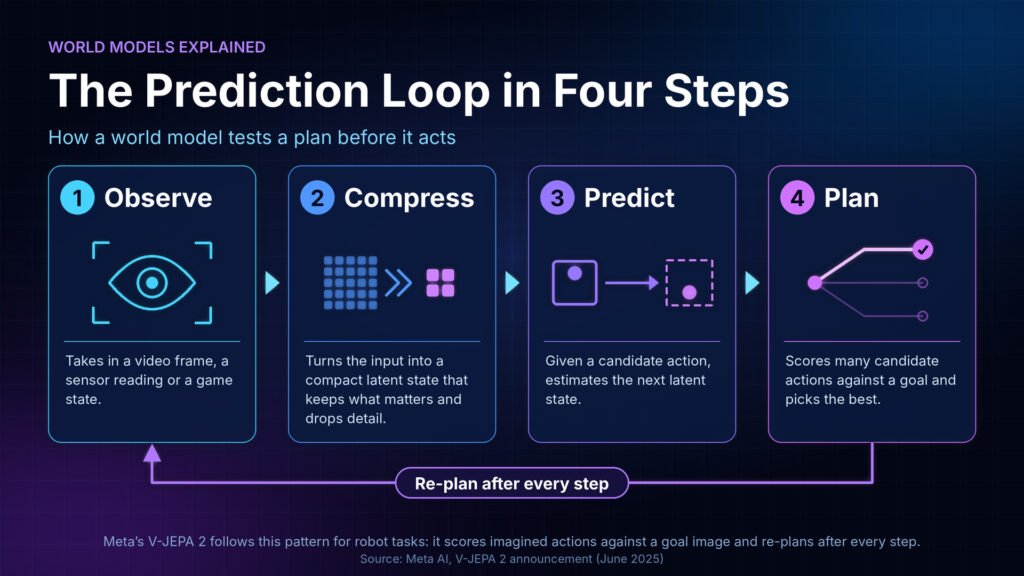
Meta’s V-JEPA 2 follows this pattern for robot tasks: it scores imagined actions against a goal image and re-plans after every step.
How a world model differs from a video generator
A video generator produces frames that look plausible. A world model must also respond correctly when something acts on the scene, so a flawless-looking clip can still fail the test if objects vanish, if the same action has different effects each time, or if nothing in the scene can be controlled. A demo shows what a model can generate; a world model has to show what happens when something acts on it.
Genie 3 shows the contrast in practice. Google DeepMind’s Genie 3 post says users can navigate generated worlds in real time at 24 frames per second and 720p, with consistency lasting a few minutes.
Why Compare World Models to a Human Baby?
The comparison works because both learn physical intuition by watching before they learn language. Meta notes that young children develop expectations about falling balls and solid objects before they can speak in full sentences, and V-JEPA 2 learns from video using self-supervised training, with no human labels.
Researchers even test machines the way they test infants. Meta’s IntPhys 2 benchmark follows the violation-of-expectation method from developmental science: two videos match until a physics-breaking event occurs in one, and the model must say which. Meta reported in June 2025 that humans scored near-perfect on this task while current video models performed at or close to chance.
Where the baby comparison breaks
The analogy hides four differences that matter when you judge a claim.
- Scale: Meta trained V-JEPA 2 on more than 1 million hours of video and 1 million images, far more footage than any child sees.
- Action: V-JEPA 2 learned the effects of actions from only 62 hours of robot data, according to Meta, while a baby learns by moving and touching.
- Senses: infants combine sight, sound and touch, while Meta lists predictions across vision, audio and touch as future work.
- Reliability: Meta says humans reach 85% to 95% accuracy on its three physical-reasoning benchmarks, and top models, including V-JEPA 2, still trail them.
The baby analogy explains how these systems learn far better than it explains how well they perform.
How Are World Models Different From Large Language Models?
A large language model (LLM) learns to predict the next piece of text, while a world model learns to predict how an environment changes, often in response to an action. Both are neural networks, and some systems combine them, but each is trained for a different job. One continues a sequence of tokens; the other forecasts the next state of a scene.
The gap shows up when conditions change. Quanta Magazine reports that researchers at Harvard and MIT trained a language model to give near-perfect Manhattan directions without learning a consistent street map, and its performance cratered when 1 percent of streets were randomly blocked. Quanta describes today’s generative models as collections of disconnected rules of thumb that approximate answers without forming one coherent picture.
That weakness is why researchers want explicit world representations. Quanta notes they could become a tool for reducing AI hallucinations.
The table compares three systems using details from Meta, Google DeepMind and Quanta Magazine; the rows are examples, not a ranking.
| System | You give it | It produces | Known limit |
| Large language model | Text, sometimes images or audio | A continuation of the input | Rules of thumb that can contradict each other |
| V-JEPA 2 | Video, plus a goal image for robot tasks | Predicted representations of what happens next | Predicts at a single time scale |
| Genie 3 | A text prompt, then navigation inputs | A navigable world at 720p | Consistency lasts minutes, not hours |
Start with V-JEPA 2 to understand the mechanism, because its encoder and predictor map directly onto seeing and predicting, and use Genie 3 to see how far interactive simulation has come.
Where Did the Idea of World Models Come From?
The idea is older than AI itself: in 1943, the Scottish psychologist Kenneth Craik proposed that an organism carrying a small-scale model of reality can try out alternatives before acting, as Quanta Magazine recounts. AI researchers adopted the approach early, abandoned hand-built versions, and revived it with deep learning.
Quanta also recounts that a late-1960s program called SHRDLU used a toy block world to answer questions about tabletop objects, but handcrafted models could not scale to realistic settings, and the roboticist Rodney Brooks later argued that explicit representations get in the way. Deep learning revived the idea by letting networks build approximate models of their environments from experience.
A key milestone is the 2018 paper World Models by David Ha and Jürgen Schmidhuber. It split an agent into a vision model that compresses each frame, a memory model that predicts what comes next, and a small controller that picks actions. The authors even trained an agent entirely inside its own generated dream of a game, then moved it back into the real game.
Which World Models Exist Today?
As of October 2026, working systems fall into two broad groups in this article’s grouping: predictive models that plan actions, and generators that build or simulate worlds you can explore. Turing Post, whose explainer was updated in September 2026, calls them research platforms, not solved models of reality.
Predictive models that plan
Meta’s V-JEPA 2 has 1.2 billion parameters and uses a joint embedding predictive architecture (JEPA), which predicts abstract representations of what happens next instead of pixels, according to Meta. Meta publishes the code and model checkpoints for commercial and research use. Google DeepMind’s DreamerV3, reported in Nature, learned to collect diamonds in Minecraft from scratch, according to Turing Post.
Generators that build or simulate worlds
Genie 3 generates interactive worlds from text prompts, and Google DeepMind introduced it as a limited research preview for a small group of academics and creators, so check Google’s pages for current availability. World Labs, co-founded by Fei-Fei Li, launched Marble in November 2025, according to SiliconANGLE, as a product that creates persistent 3D environments users can download and edit instead of generating them on the fly. NVIDIA’s Cosmos is a platform of world foundation models for physical AI, according to Turing Post.
What Is Spatial AI and How Does It Relate to World Models?
Spatial AI is a machine’s ability to understand a physical environment and use that understanding to guide action, which Stanford HAI calls spatial intelligence. World models are one technical route to it, not the only one.
Stanford HAI’s brief frames the shift this way: language-centred systems define the current era, multimodal AI models extend them to images, audio and video, yet most still cannot track a coherent environment over time. World models aim to do exactly that.
Fei-Fei Li, a co-author of the brief and co-founder of World Labs, argues that spatial intelligence is the next frontier beyond language, according to Fast Company. Marble is the first product built on that thesis.
The brief’s own example is a wildfire. A world model could merge forecasts for roads, the power grid and hospital capacity into one continuously updated picture, so an incident commander can test evacuation plans before ordering them. Its policy recommendations focus on United States audiences, so rules elsewhere may differ.
What Are World Models Used For Today?
Current uses cluster in settings where trial and error is slow, costly or unsafe, a pattern also visible in robotics and physical AI.
- Robot planning: Meta reported 65% to 80% success for V-JEPA 2 on pick-and-place with new objects in unseen environments, using visual subgoals.
- Agent training: Google DeepMind describes Genie 3 worlds as practice grounds for agents such as its SIMA agent, with text-triggered events that create what-if scenarios.
- Creative production: World Labs positions Marble for games, film effects and robotics, according to Fast Company.
- Planning and testing: Stanford HAI lists manufacturers testing designs, engineers stress-testing infrastructure and robots working in hazardous settings.
None of these is a settled product category, which is why the limits in the next section matter.
Where Do World Models Fall Short?
World models fall short on memory over time, causal accuracy, evaluation, data and cost. The most serious gap is trust: a model can look right and still be wrong in ways that matter once its output trains or guides another system.
Six limits recur across the sources behind this article.
- Short memory: Genie 3 keeps worlds consistent for a few minutes, with visual memory reaching back about one minute, according to Google DeepMind.
- Narrow actions: DeepMind says Genie 3 limits the actions an agent can perform directly and still struggles with interactions between several agents.
- Weak causal reasoning: Meta’s CausalVQA benchmark found that models answer what happened better than what could have happened or what happens next.
- No safety benchmark: Stanford HAI states that no existing benchmark gives policymakers an adequate basis to evaluate a world model for safety-critical use.
- Scarce data: Stanford HAI calls action-labelled interaction data, such as robot trajectories and fleet logs, the scarcest input because it cannot be scraped from the web.
- Compute and bias: TechCrunch reported in 2024 that training and running world models takes very large compute and that they hallucinate and inherit bias from training data.
Together these limits explain why Stanford HAI warns about concentrated control of spatial data and infrastructure.
How a planner takes advantage of a flawed model
Ha and Schmidhuber found that an agent trained inside its own world model learned to move so that the model’s monsters never fired a single fireball, a trick that existed only because the model was imperfect.
A policy that scored near-perfectly in a low-uncertainty dream performed no better than a random policy when moved into the real game, according to their results. The authors countered by adding randomness to the model, which made cheating harder. The lesson still applies: check whether results come from the real environment, not only from the lab’s own simulator.
Are World Models the Basis of Next Generation AI Models?
Possibly, but the evidence is early. Yann LeCun, Demis Hassabis and Yoshua Bengio all consider world models essential for smart, scientific and safe AI, according to Quanta Magazine, yet the labs disagree on how to build them and few products exist.
Quanta describes the split: Google DeepMind and OpenAI are betting that enough multimodal training data will make a world model emerge inside a neural network, while LeCun argues for an entirely new, non-generative architecture.
Anyone who types “what are world models AI” into a search box now finds more announcements than products. TechCrunch reported in September 2026 that AMI Labs, which LeCun co-founded after leaving Meta, was less than a year old and had no public product plan or timeline, and that World Labs’ Marble was probably the most fully developed product in the space.
AMI Labs’ chief executive, Alexandre LeBrun, told TechCrunch in March 2026 that “every company will call itself a world model to raise funding” within six months. That prediction is a useful warning about the label.
Pick the complement reading over the replacement reading. World models add the ability to predict physical consequences, which language models lack, but the evidence here shows them strong on narrow tasks and unreliable on long horizons and causal questions, while language models already cover broad work. Whether world models end up inside next generation AI models or beside them is still open, and the complement reading fits the evidence better.
How to Tell a Working World Model From a Demo
A working world model accepts actions, stays consistent as time passes, predicts consequences correctly and is evaluated outside its own simulator. A demo may show only the first quality: a good-looking scene.
Run these five checks on any product page, paper or launch video.
- Does the system take actions as input, or only a prompt at the start?
- Does the scene stay consistent when the camera looks away and returns?
- Does it predict consequences, such as what happens after a push, and not only what looks plausible?
- Is it tested on a physical-reasoning benchmark such as IntPhys 2 or CausalVQA, or on a real robot?
- Does the lab publish its limits, including duration, resolution and action range?
A system that passes most of these checks is doing more than generating clips.
Two mistakes readers make
Two errors account for most of the confusion around launch videos.
- Treating a realistic video as evidence that the system understands physics.
- Treating “world model” as one technology, when it covers predictive, generative and 3D-building systems with different strengths and limits.
Both errors fade once the five checks are applied to the specific system in front of you.
Two habits that help
Two habits make a source’s claims easier to judge.
- Read the limitations section first; Google DeepMind’s Genie 3 announcement lists its limits plainly, which is a fair standard for any lab.
- Date every claim, because benchmark results and product access change within months.
A dated, limit-aware reading is the quickest protection against hype.
What to Do Next
At core, world models are learned simulators that let an AI predict before it acts, and the baby comparison describes the method rather than the results. Spatial AI is the wider goal, and the evidence so far shows narrow successes in robot planning and interactive simulation, not a general model of reality. A search for “what are world models AI” mixes research papers, product launches and marketing, so the sorting has to be done by the reader. Before trusting the next demo, run the five checks from the previous section and read its limitations first.
Frequently Asked Questions
1. Who is building world models?
Several labs work on them. Meta develops V-JEPA 2, Google DeepMind develops the Genie line and DreamerV3, World Labs builds Marble, NVIDIA builds the Cosmos platform, and AMI Labs, co-founded by Yann LeCun, is focused on world models. Each takes a different technical route, so their systems are not interchangeable.
2. Can I try a world model myself?
Partly. Meta publishes V-JEPA 2 code and model checkpoints for research and commercial use, so developers can run it. Google DeepMind introduced Genie 3 as a limited research preview, and World Labs offers Marble as a commercial product. Access terms and prices change often, so check each vendor’s page on the day you decide.
3. Why do robots need world models?
Because trial and error on real hardware is slow, costly and can damage the robot or its surroundings. A world model lets a robot imagine the outcome of candidate actions and choose one before moving, and it lets researchers train in simulation instead of the real world, which Ha and Schmidhuber noted also saves rendering effort.
4. Is a world model the same as a digital twin?
Not exactly. A digital twin mirrors one specific real system, while a world model learns general dynamics from data. Yann LeCun has described a world model as like an abstract digital twin of reality, so the comparison is a helpful analogy rather than a technical equivalence.
5. What is the difference between JEPA and generative world models?
A joint embedding predictive architecture predicts abstract representations of what happens next, not pixels, so it spends no effort on irrelevant visual detail. Generative world models such as Genie 3 produce the frames themselves, which lets people watch and steer the result. Which approach scales better is still debated, according to Quanta Magazine.