Introduction
Memory has become one of the most expensive parts of buying or upgrading a computer, and the increase has spread from desktop RAM to laptop configurations, graphics cards, consoles and storage drives. The cause is not a factory fire or a shipping delay. A small group of manufacturers has moved production toward chips for AI data centres, which pay more and sign supply contracts well ahead of delivery. This guide explains how that shift squeezes RAM and SSDs in different ways, what the latest supplier and analyst forecasts say, and why TrendForce expects the two markets to diverge in 2027. It also gives a practical framework for deciding whether to buy now or wait, since the answer depends on whether your device lets you add memory later.
AI data centres are absorbing so much server and high-bandwidth memory that chipmakers have moved capacity away from consumer parts. The RAM price increase 2026 is the result: scarce supply sold into a seller-controlled market, with SSDs following because flash makers favour enterprise drives. TrendForce expects further, smaller price rises in the fourth quarter of 2026.
Key Takeaways
AI servers now set the price of memory, because high-bandwidth memory takes far more wafer capacity than the DDR modules in a desktop, so each AI accelerator removes more consumer supply than its size suggests.
SSD prices are rising for a different reason than RAM prices: flash makers are prioritising enterprise SSDs for AI inference, which leaves consumer drives with whatever supply remains.
The pace of increases is easing, yet TrendForce still projects higher contract prices in the fourth quarter of 2026, so current forecasts do not support waiting for a quick drop.
DRAM and NAND are expected to diverge in 2027, according to TrendForce, which means storage may get cheaper before memory does.
Laptops with soldered memory should be bought at the capacity you will need for the whole life of the device, because that memory cannot be added later at a lower price.
What Is the Memory Shortage, and Which Parts Does It Hit?
The memory shortage is a global gap between demand and supply for DRAM, the fast working memory sold as RAM, and NAND flash, the storage chips inside SSDs. It reaches any product that contains either chip, which now means desktop memory kits, laptops, phones, consoles, graphics cards and servers.
DRAM stands for dynamic random-access memory. It holds the data a processor is working on right now and loses it when power is cut. NAND flash keeps data without power, which is why it is used for SSDs, phone storage and memory cards. Three suppliers, Samsung Electronics, SK hynix and Micron, held more than 90 percent of DRAM revenue in the first quarter of 2026, according to IDC figures quoted in SK hynix’s filing with the US Securities and Exchange Commission. When a market is that concentrated, a change in what those three choose to build changes prices everywhere.
The shortage is not limited to loose RAM sticks. Six product groups carry the same chips:
- Desktop RAM kits, both DDR4 and DDR5, built from DRAM.
- Laptop and phone memory, usually LPDDR, which is low-power DRAM.
- SSDs and other flash storage, built from NAND.
- Graphics cards, which use GDDR, a DRAM type designed for graphics.
- Consoles and handhelds, which use both DRAM and NAND.
- Servers, which use the most DRAM and NAND of all.
If a device stores or processes data, it competes for the same limited supply of chips.
Why Does AI Demand Cause a DRAM Shortage?
AI data centres buy memory in very large volumes and at higher margins than consumer markets, so manufacturers serve them first and leave less for everyone else. High-bandwidth memory makes the squeeze worse, because it needs significantly more wafer input than conventional DRAM, according to TrendForce’s 2027 market outlook of 30 July 2026.
How high-bandwidth memory pulls supply away
High-bandwidth memory, or HBM, is stacked DRAM that sits next to an AI accelerator and feeds it data at very high speed. For pricing, the key point is that each HBM unit uses more of the silicon wafer than a standard DRAM chip, so adding wafer starts adds less usable memory than it would for ordinary DRAM.
A wafer committed to HBM is a wafer that does not become consumer RAM. That is why the same factories can be running at full tilt while the retail shelf stays thin.
Why suppliers can set the terms
With three suppliers and more demand than supply, the sellers hold the pricing power. TrendForce said on 30 September 2026 that suppliers are prioritising advanced-process capacity for high-performance server products, and that server DRAM is expected to stay undersupplied in the fourth quarter of 2026.
Large buyers also lock in supply through long-term agreements, which TrendForce says cap price increases for some of them. Retail buyers have no such contracts, so the remaining increases land on the customers least able to negotiate.
Micron showed how far the priority has moved. On 3 December 2025 it announced it would exit the Crucial consumer business, saying in Micron’s announcement that the move would improve supply and support for larger strategic customers in faster-growing segments.
The supplier outlook has not softened since. Micron chief executive Sanjay Mehrotra said on the company’s earnings call of 30 September 2026 that he expects memory and storage conditions to be much tighter in calendar 2027 and 2028 than in 2026.
Why new factories will not fix it quickly
Building memory capacity takes years. TrendForce’s July 2026 outlook says several suppliers plan new capacity for 2027, but construction, equipment installation and raw-material preparation delay meaningful production until the second half of 2027, with substantial output not expected until 2028.
Memory is no longer priced by what a laptop buyer will pay but by what an AI data centre will pay.
The SSD Price Hike Reason: Why NAND Follows DRAM
The main SSD price hike reason is that flash makers are directing supply toward enterprise SSDs built for AI inference, which pay better than consumer drives. TrendForce’s fourth-quarter outlook of 30 September 2026 projects enterprise SSD bit demand to grow by more than 80 percent year on year in 2026 and says most incremental supply is already committed. Bit demand means the total storage capacity ordered, not the number of drives.
Five forces push SSD prices, and they act with different strength on consumers and data centres:
- AI inference and retrieval workloads need fast, high-capacity SSDs, and cloud providers are the buyers.
- Suppliers allocate capacity by profitability, which favours enterprise drives over consumer ones, TrendForce says.
- Quad-level cell, or QLC, NAND is the denser and cheaper type found in many consumer drives, and TrendForce reports rising QLC use in data centres.
- NAND wafer prices have reached historical highs, TrendForce says, which raises the cost base for every module maker.
- Hard-drive shortages push some cold data storage onto SSDs, according to SSD maker Team Group in comments reported by PC Gamer.
Together these forces explain why drives built from the same flash can cost very different amounts depending on who is buying.
Consumer SSD increases are being restrained by weak demand, even though flash contract prices keep climbing. TrendForce says PC makers are cutting SSD capacities in mainstream models and drawing on inventory built earlier in 2026, so NAND suppliers have taken a more flexible pricing stance. It still projects NAND contract prices to rise 15 to 20 percent in the fourth quarter of 2026 and conventional DRAM contract prices to rise 10 to 15 percent.
RAM Price Increase 2026: How the Timeline Unfolded
Prices rose in three stages: a sharp climb from late 2025, record quarterly jumps in early 2026, and a slower but continuing increase since. In its February outlook published on 2 February 2026, TrendForce raised its forecast for first-quarter conventional DRAM contract prices from 55 to 60 percent quarter on quarter to 90 to 95 percent, and projected PC DRAM to rise by more than 100 percent.
The pace has since slowed. TrendForce’s 30 September 2026 outlook projects conventional DRAM contract prices to rise 10 to 15 percent in the fourth quarter of 2026, a smaller step on top of a much higher base.
Retail prices tell the same story in dollars. Price-history charts published by PC Gamer on 20 October 2026, drawn from the Camelcamelcamel tracker, show a 32 GB DDR5-6000 kit sold on Amazon staying at roughly 80 to 100 US dollars through most of 2024 and 2025, then reaching 553 US dollars by that date. Prices vary by country, tax and retailer, so treat that as one retail example, not a global price.
Contract prices and shelf prices do not move in step. Four things create the gap:
- Inventory timing: PC makers and system builders sell stock bought before the rises, then reorder at the new level, as PC Gamer describes it.
- Long-term agreements: some suppliers’ increases lag the market average because of agreed pricing mechanisms, TrendForce says.
- Channel competition: spot and retail buyers compete for whatever large buyers leave behind.
- Local factors: tax, import costs, retailer stock and currency all change what a kit costs in a given country.
A contract-price forecast is therefore a leading signal for retail, not a price you will see on a shelf.
Which Devices Get More Expensive Besides RAM and SSDs?
Anything with DRAM or NAND inside costs more to build, and products with thin margins or fixed memory feel it first. TrendForce said on 30 September 2026 that PC brands are already cutting SSD capacities in mainstream models to protect costs, and that lower-margin products such as TVs, set-top boxes and wearables have little room to absorb higher memory prices.
Five categories show the effect most clearly:
- Laptops and prebuilt PCs: brands trim SSD capacity in mainstream models, TrendForce says.
- Smartphones: mobile DRAM allocations are tight and low-cost inventories are running down, according to TrendForce.
- Graphics cards: suppliers are scaling back GDDR6 while GDDR7 output stays limited, TrendForce says.
- Consoles and handhelds: Tom’s Guide reported in February 2026 that Valve’s Steam Machine launch was delayed by memory shortages and pricing.
- Wearables and TVs: TrendForce expects little room for makers to absorb the cost.
Some makers respond by changing specifications rather than prices, so check what a familiar model now includes before comparing it with last year’s.
When Will RAM and SSD Prices Come Down?
Forecasts point to DRAM staying tight for longer than NAND, with no firm date for a full return to earlier prices. According to TrendForce’s 30 July 2026 outlook, NAND supply should loosen in the second half of 2027, while meaningful new DRAM output is not expected before 2028.
NAND makers raised output in 2026 mainly through process upgrades rather than new factories, and TrendForce expects higher-layer products and new fabs to lift bit supply sharply in 2027 while consumer demand stays weak. DRAM faces the opposite: HBM absorbs wafer capacity, server demand keeps growing and new fabs arrive late. TrendForce estimates a DRAM sufficiency ratio of about negative 1 to 2 percent for 2026 and expects the gap to widen in 2027. A sufficiency ratio compares supply with demand, so a negative figure means a shortfall.
Industry voices disagree on timing, which is useful information in itself. Five public views, each attributed:
- Micron chief executive Sanjay Mehrotra, 30 September 2026: conditions much tighter in calendar 2027 and 2028 than in 2026.
- TrendForce, 30 July 2026: the DRAM gap widens in 2027 while NAND moves toward balance in the second half of 2027.
- SK hynix, as reported by PC Gamer on 20 October 2026: under-supply could last beyond 2030.
- Acer’s chief executive, as reported by PC Gamer: a shortage lasting until 2030 is impossible, with prices easing around mid-2027.
- A former Samsung semiconductor president, quoted by PC Gamer: Chinese capacity expansion could trigger a supply surge in late 2027 or early 2028.
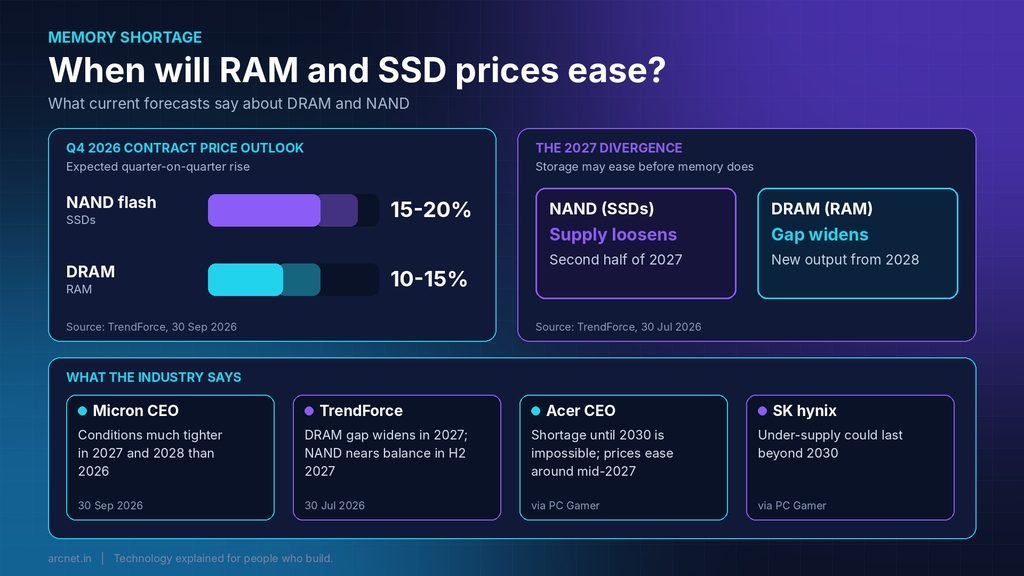
These views span an early recovery and a shortage lasting well beyond the decade, so the sensible reading is a long tight period with storage the likeliest part to ease first.
What could change the outlook
Four developments would move these forecasts, and each can be watched from public reports:
- Cloud capital spending: TrendForce notes that record 2026 spending came with negative free cash flow at some providers, and that a rising memory share of infrastructure cost is a variable to watch.
- New factory timing: evidence that DRAM fabs ramp earlier than TrendForce’s current schedule would shift the picture.
- Chinese supplier expansion: faster output from Chinese memory makers is the main supply-side upside cited by PC Gamer.
- Early NAND oversupply: if flash conditions loosen sooner than TrendForce expects, SSD prices fall first.
We read the RAM price increase 2026 as the opening of a multi-year cycle rather than a one-year spike, because Micron expects tighter conditions in 2027 and 2028 and TrendForce does not expect meaningful new DRAM output until 2028.
Should You Buy Now or Wait? A Decision Guide
Buy now if your current device is failing or you need a specific capacity soon, and wait only if your device works and lets you add memory later. Forecasts from Micron and TrendForce do not support waiting for a quick drop in DRAM prices, although flash storage is the part analysts expect to loosen first.
Six factors decide which side you are on:
- Upgradeability: laptops with soldered memory cannot be expanded later, so buy the final capacity up front; desktops with free slots can start small.
- Real usage: check how much memory your normal workload uses before paying for more, because idle capacity is the most expensive kind right now.
- Chip type: TrendForce expects flash to loosen before DRAM, so delaying a spare SSD is safer than delaying a memory kit.
- Device condition: a machine that is failing or out of security updates costs more to keep than any likely saving from waiting.
- Region: prices and stock differ by country, tax and retailer, so check local price history rather than global headlines.
- Alternatives: refurbished or older-generation systems can meet modest needs, but PC Gamer reports that DDR4 prices also rose sharply, so compare real prices first.
If most factors point to buying, buy; if your device is healthy and expandable, waiting costs little.
Our pick for most readers is to buy once, at the capacity the device will need for its whole life, rather than trying to time a market its own suppliers describe as tightening. The trade-off is paying today’s price for capacity you may not use yet; the alternative is a smaller purchase now and an upgrade later, which only works on devices with free slots or open drive bays.
Two examples
Example 1: a developer replacing a laptop with soldered memory. Adding RAM later is impossible, so the choice is the capacity for the whole service life, even at today’s price. Paying for the larger configuration once is cheaper than replacing the machine early.
Example 2: a desktop owner with two free memory slots and a working system. Waiting costs little here, because a small kit now and a later add-on both remain possible, and storage is expected to ease before memory does.
Mistakes to avoid
Three mistakes cost buyers the most during a shortage:
- Buying more capacity than the workload uses, which locks in a peak price for idle memory.
- Waiting for one signal, such as a single retailer discount or a single optimistic forecast, instead of several.
- Paying an unverified marketplace seller; scarce parts attract unreliable listings, so use retailers with clear return terms.
Each mistake comes from reacting to the headline price instead of the actual need.
Pro tips
Two habits make buying easier in a volatile market:
- Track price history for the exact model, so a real discount is easy to tell from a temporary spike.
- Match memory type to the platform: DDR4 and DDR5 modules are not interchangeable, so confirm what the motherboard or laptop supports before ordering.
Both checks take minutes and prevent the two most common wasted purchases.
What to Do Next
The RAM price increase 2026 comes from a structural shift in who memory makers build for, not from a temporary disruption. That is why the DRAM shortage is forecast to outlast the flash squeeze, and why storage is the safer purchase to delay. Before buying anything, open the price history of the exact memory or SSD model you want and compare it with your local retailers. Then buy the capacity the device will need for its whole life.
Frequently Asked Questions
1. Why is DDR4 getting more expensive when it is an older standard?
DDR4 is rising in price because it shares factories with newer memory and because makers are winding down its production while demand for any available memory stays high. PC Gamer’s October 2026 roundup notes that DDR4 kits have climbed sharply even as production shrinks, which points to a shortage across the whole memory industry.
2. Why did Micron stop selling Crucial memory and SSDs?
Micron said on 3 December 2025 that it would exit the Crucial consumer business to improve supply and support for larger strategic customers in faster-growing segments. Consumer-channel shipments were due to continue until February 2026, and Micron said it would keep providing warranty service and support for Crucial products after the exit.
3. Are hard drives getting more expensive too?
Yes, hard drives are also under pressure. PC Gamer reported that Adata described DRAM, NAND and hard drive supply as short at the same time for the first time in 30 years, and that Western Digital raised prices across its hard drive range. Tight hard drive supply also pushes some data centre storage toward SSDs.
4. Why are graphics cards getting more expensive?
Graphics cards carry their own memory chips, so higher memory costs raise the cost of building them. TrendForce said on 30 September 2026 that suppliers are scaling back GDDR6 production and limiting GDDR7 output because advanced capacity is being allocated to server DRAM, which keeps graphics memory prices rising.
5. Are memory prices the same in every country?
No. Retail memory prices vary by country because of tax, import costs, retailer stock and local demand. eTeknix reported in October 2026 that German retail data showed DDR5 prices 419 percent above July 2025 levels, so compare local price history for your region rather than relying on global headlines.