
Introduction
Natural language is the messiest data a computer will ever have to handle full of slang, sarcasm, and sentences that mean three different things depending on tone. This guide breaks down what turns that mess into something software can use, walks through the pipeline step by step, and explains how it connects to the large language models most people now use every day. It also names where the technology still fails, and what a beginner needs before touching any of the tools.
Natural language processing (NLP) is the branch of artificial intelligence that lets computers read, interpret, and generate human language, whether written or spoken. It works by breaking language into smaller pieces, mapping those pieces to grammatical and semantic structure, then applying rules or trained models to complete a task from sorting emails to powering a chatbot’s replies.
Key Takeaways
NLP is the umbrella field covering both understanding language and generating it, so NLU and NLG are parts of NLP rather than replacements for it.
Every large language model relies on NLP techniques, but a basic spell-checker is also NLP, so the field spans systems far simpler than ChatGPT.
Tokenization is the first step in almost every NLP pipeline, because a model can only process numeric tokens, never raw text directly.
NLP still struggles with sarcasm and ambiguity, because resolving them correctly requires context that most models don’t reliably track.
Rule-based systems need no training data but scale poorly, while deep learning models need large datasets but generalize far better across topics.
spaCy, NLTK, and Hugging Face Transformers are the standard starting points for hands-on NLP work, each covering a different layer of the pipeline.
What Is Natural Language Processing?
Natural language processing is the field of artificial intelligence concerned with getting computers to work with human language spoken or written in a way that is genuinely useful. It sits at the intersection of computational linguistics, computer science, and machine learning: linguistics supplies the grammar rules, and machine learning supplies the ability to learn patterns from examples instead of being hand-coded for every case.
The field has moved through three broad eras. Early systems in the 1990s and 2000s were largely rule-based or statistical, using hand-written grammar rules and probability tables for tasks like spam filtering and document sorting. The 2010s brought deep learning, where neural networks learned patterns directly from raw text instead of relying only on hand-crafted rules AWS’s overview of NLP’s evolution traces this shift in more detail. The most recent turn is generative: models that don’t just classify or extract information from text, but produce new, coherent text in response to a prompt.
That’s NLP explained at the level most people actually need before diving into the mechanics of how it’s done and the mechanics are worth seeing, because they explain both what these systems are good at and where they break.
NLP Explained Simply: How the Pipeline Turns Text Into Data
A model can’t read a sentence the way a person does. Every NLP system, from a simple spam filter to a modern language model, breaks a piece of text down through a similar sequence of steps before it can do anything useful with it.
- Tokenization: the text is split into smaller units called tokens: words, sub-words, or individual characters, depending on the system.
- Part-of-speech tagging: each token is labeled with its grammatical role, such as noun, verb, or adjective, so the system knows how words relate to each other.
- Parsing: the system maps the grammatical structure of the sentence, working out which words modify which, so a sentence like “I saw her duck” can be resolved correctly.
- Named entity recognition: the system flags real-world entities in the text, such as people, organizations, dates, and locations.
- Semantic analysis: the system assigns meaning to the structure it has built, resolving what the sentence is actually about rather than just its grammar.
- Task execution: the processed representation is fed into a model or rule set that performs the actual job: classifying sentiment, answering a question, or generating a reply.
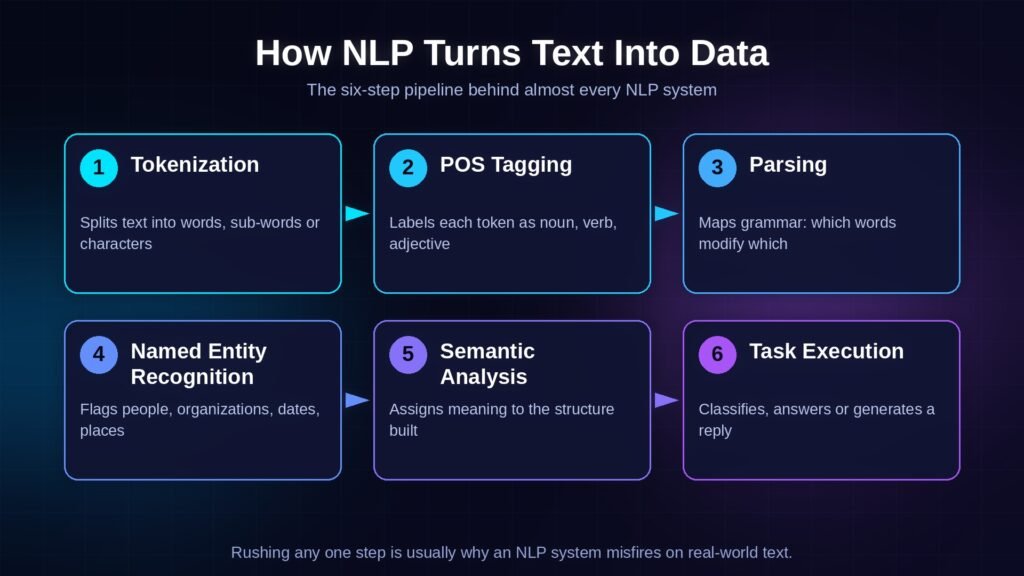
Skipping or rushing any one of these steps is usually why an NLP system misfires on real-world text.
NLP vs. NLU vs. NLG: How the Terms Relate
NLP is the umbrella term. Natural language understanding (NLU) and natural language generation (NLG) are the two halves of the work that sit inside it, and the fastest way to keep them straight is by what goes in and what comes out of each IBM’s breakdown of NLP’s subfields lays out the same hierarchy in more depth.
NLU takes unstructured language in and produces structured meaning out: intent, entities, sentiment. It’s the reading-comprehension half of the field, and it’s what a chatbot uses to work out that “cancel my order” is a cancellation request rather than a complaint. NLG runs the other direction it takes structured data in and produces natural-sounding language out, which is how a weather app turns a temperature and a forecast code into “expect light rain this afternoon.” NLP covers both directions, plus the mechanical groundwork described above that makes either one possible.
A useful check: if a system is figuring out what a sentence means, that’s NLU. If it’s producing a sentence from data, that’s NLG. If it’s the groundwork underneath either one, that’s NLP in the narrower, technical sense of the word.
NLP and Large Language Models: Where the Line Sits
A common point of confusion: is a large language model just NLP with a new name? Not quite, and the distinction matters for anyone deciding what to actually build or buy.
Large language models are a specific, very large-scale application of NLP techniques, built on an architecture called the transformer, which uses a mechanism called self-attention to weigh how every word in a sentence relates to every other word. That architecture is what let language models scale to the point where they can hold a conversation, write code, or summarize a report, rather than only classify or extract information the way earlier NLP systems did.
But NLP is the wider field, and it includes plenty of systems that are not language models at all: a rule-based grammar checker, a keyword-based spam filter, and a sentiment classifier trained on a few thousand labeled reviews are all still NLP. None of them needs billions of parameters or a data center to run. Choosing between a lightweight NLP technique and a large language model is a real design decision the smaller approach is faster, cheaper, and easier to audit; the larger one is far more flexible and better at anything genuinely open-ended, such as free-form writing or open-domain question answering.
Key NLP Techniques and Approaches
Underneath any NLP application is one of a few broad technique families, and knowing which one is in play tells you a lot about what the system can and can’t do.
- Rule-based systems: hand-written grammar rules and dictionaries handle the task; accurate within a narrow domain, but brittle outside the cases the author anticipated.
- Statistical models: probability-based methods, such as n-grams and hidden Markov models, learn likely word sequences from a corpus rather than following fixed rules.
- Classical machine learning: algorithms such as support vector machines and logistic regression classify text using hand-engineered features like word counts or TF-IDF scores.
- Deep learning and transformers: neural networks learn features directly from raw text, using self-attention to capture context across a whole sentence or document; this is what underlies modern language models.
Most production systems mix these approaches rather than relying on just one: a rule-based filter to catch obvious cases, backed by a trained model for everything else.
Real-World Applications of NLP: Text Analysis AI in Practice
NLP shows up in far more places than the chatbots most people think of first. Here is where the same core techniques get put to work for how to evaluate tools for a specific use case.
- Customer support: chatbots and ticket-routing systems use NLU to classify intent and pull out the details needed to resolve or escalate a request.
- Machine translation: services such as Google Translate use NLP to convert text between languages while preserving meaning, not just swapping words one for one.
- Search and information retrieval: search engines use NLP to match a query’s intent to a page’s content, not just its exact keywords.
- Sentiment and text analysis AI: brands use NLP-driven text analysis AI to scan reviews, support tickets, and social posts for sentiment and recurring complaints at a scale no team could read manually.
- Voice assistants: smart speakers and in-car assistants combine speech recognition with NLU to interpret spoken commands and NLG to generate spoken replies.
- Document processing: legal and healthcare teams use NLP to extract key clauses, drug names, or diagnoses from unstructured documents, cutting manual review time.
The common thread across all of these is the same pipeline described earlier only the final task changes.
Where NLP Still Breaks: Limitations and Honest Trade-offs
NLP has come a long way, but it is not close to solved, and pretending otherwise sets up unrealistic expectations for anyone building on it DeepLearning.AI’s discussion of NLP explainability is a good starting point on why some of these systems remain hard to fully trust.
- Ambiguity and homonyms: a word like “bank” can mean a financial institution or a riverbank, and resolving it correctly still depends on context a model may not have.
- Sarcasm and tone: “great, another delay” reads as positive to a model that isn’t tracking tone, which is why sentiment tools still misclassify sarcastic text regularly.
- Low-resource languages: most NLP research and training data concentrates on a handful of major languages, so tools trained mainly on those perform noticeably worse elsewhere.
- Bias in training data: a model trained on biased historical text can reproduce that bias in its outputs, which matters most in high-stakes uses like hiring or lending screens.
- Hallucination and cost: transformer-based systems can generate fluent, confident text that is factually wrong, and running large models at scale carries a real computing cost that smaller, older NLP techniques don’t.
None of this is a reason to avoid NLP it’s a reason to pick the right-sized technique for the task and to check outputs rather than trust them by default.
Getting Started with NLP: Tools and Prerequisites
Anyone wanting to move from reading about NLP to building with it needs a short list of prerequisites and a handful of established tools, not a research degree start with our roundup of Python libraries worth learning first if you want the fuller picture.
- Basic Python: nearly every mainstream NLP library, from spaCy to Hugging Face Transformers, is Python-first, so comfort with the language is the real starting requirement.
- spaCy: a production-oriented library for tokenization, part-of-speech tagging, and named entity recognition, well suited to building a working pipeline quickly.
- NLTK: an older, education-focused toolkit that is still useful for learning how classical techniques like stemming and parsing actually work under the hood.
- Hugging Face Transformers: a library that gives access to pretrained deep learning models for tasks like classification, translation, and text generation without training one from scratch.
- A working dataset: even a small, clean, labeled dataset relevant to the task at hand matters more at the start than picking the most advanced model available.
Start with the smallest technique that solves the actual problem, and reach for a full language model only once a simpler approach has genuinely fallen short Hugging Face’s tokenizer documentation is a solid next stop for the mechanics of that first step.
Conclusion
The fastest way to get value from any of this is to stop treating NLP as one single thing. Match the size of the technique to the size of the problem: a rule-based check for a narrow, well-defined task, a classical model when labeled data is limited, and a full language model only when the job genuinely needs open-ended understanding or generation. That’s NLP explained without the marketing gloss a toolbox of techniques, not one technology, sitting underneath most of the language models and text analysis AI tools now in daily use. Before choosing a tool, identify which single pipeline step the problem actually requires for a deeper walkthrough of the options.
FAQs
1. Is NLP the same as artificial intelligence?
No. NLP is one subfield of artificial intelligence, not the whole of it. AI is the broader field covering everything from computer vision to robotics, while NLP focuses specifically on language, spoken and written. Every NLP system is an AI system, but most AI systems — an image classifier or a self-driving car’s perception stack, for example have nothing to do with language.
2. What’s an everyday example of NLP?
Autocomplete and predictive text on a phone keyboard is one of the most common everyday examples of NLP. It analyzes the words already typed, predicts the most likely next word, and updates that prediction with every keystroke the same underlying technique that powers spell-check and email spam filters.
3. Do I need to know how to code to use NLP tools?
Not always. Many NLP-powered products, such as chatbot builders and sentiment-analysis dashboards, offer no-code interfaces for common tasks. Building a custom pipeline, training a model, or fine-tuning a language model for a specific use case still requires programming, typically in Python, along with an understanding of the technique being used.
4. Can NLP models understand sarcasm?
Not reliably. Sarcasm depends on tone, shared context, and sometimes facial expression, none of which appear in raw text the way word choice does. Modern language models catch obvious cases more often than older statistical methods, but sentiment-analysis tools still regularly misread a sarcastic sentence as sincere, especially in short, ambiguous text like social posts.
5. What is the difference between NLP and a language model?
NLP is the field; a language model is one type of system built using NLP techniques. A language model is specifically trained to predict or generate text, while NLP also covers tasks that don’t involve generation at all, such as tagging parts of speech or extracting named entities from a document.