Introduction
Security teams used to spend hours combing through logs to catch a single intrusion; now, machine learning models scan networks too large for any human team to watch, in seconds. That shift is changing what a security analyst’s day looks like, what a small IT team can now afford to defend, and what well-resourced attackers can now automate too. What follows breaks down how the underlying models actually learn to spot a threat, the specific jobs they’re already doing well inside a modern security stack, and the places where a human still has to check the machine’s work.
AI in cybersecurity means machine learning models that scan network traffic, user behavior, and files to flag threats faster than manual review, then automate the first response steps. It strengthens threat detection and security automation across endpoints, email, and cloud systems though it still needs human judgment for context and cases the model hasn’t seen before.
Key Takeaways
AI shortens detection time because models flag anomalies as they happen instead of waiting for a scheduled log review.
Security automation cuts alert fatigue because it triages routine alerts first, leaving analysts to judge the ones that actually need a human call.
The same generative AI that improves phishing detection also improves phishing emails, because attackers use the same class of language models to write more convincing lures.
AI models degrade without clean, representative data, because a model trained on incomplete logs learns incomplete patterns and misses what it never saw.
U.S. information security analyst roles are still projected to grow 29 percent through 2034, according to the Bureau of Labor Statistics, because AI is adding oversight and tuning work even as it automates routine tasks.
A vendor claiming its AI “eliminates false positives” is worth double-checking, because no model trained on historical data is immune to shifts in attacker behavior.
What Is AI in Cybersecurity, Exactly?
AI in cybersecurity is the use of machine learning, deep learning, and natural language processing to analyze security data and make decisions that used to require a human analyst flagging a suspicious login, triaging an alert, or drafting an incident summary. It is not a single product. It’s a layer of pattern recognition added on top of the tools already running: firewalls, SIEM platforms, endpoint agents, and email gateways increasingly ship with a model doing the first pass underneath the dashboard.
Three techniques do most of the work. Machine learning models are trained on examples of past attacks and normal activity, then score new activity against what they learned. Deep learning, a more layered form of machine learning, handles messier inputs like raw network packets or file binaries, where the useful patterns aren’t obvious to a human eye. Natural language processing reads text phishing emails, chat logs, incident tickets to catch intent that a keyword filter would miss, such as a message that never says “wire transfer” but still asks someone to move money urgently and quietly.
How Threat Detection AI Actually Works
Threat detection AI works by building a baseline of what normal looks like for a specific network, user, or device, then flagging anything that deviates from it by enough to matter. This baseline approach, known as user and entity behavior analytics, is what lets a system catch a compromised account doing something a stolen password alone wouldn’t reveal like a finance employee’s login suddenly pulling files at 3 a.m. from a country they’ve never logged in from before.
Two training approaches sit behind most of these systems:
- Supervised learning, where the model is shown thousands of labeled examples of malware, phishing, or intrusion attempts and learns to recognize similar patterns in new data.
- Unsupervised learning, where the model has no labels at all it simply learns what “normal” looks like for a given environment and flags outliers, which is how it catches attacks nobody has named yet.
Together, these approaches let a system flag a zero-day-style anomaly it has never been explicitly taught to look for, something a purely rules-based, signature-matching tool cannot do by design.
Where AI Is Making Security Systems Smarter
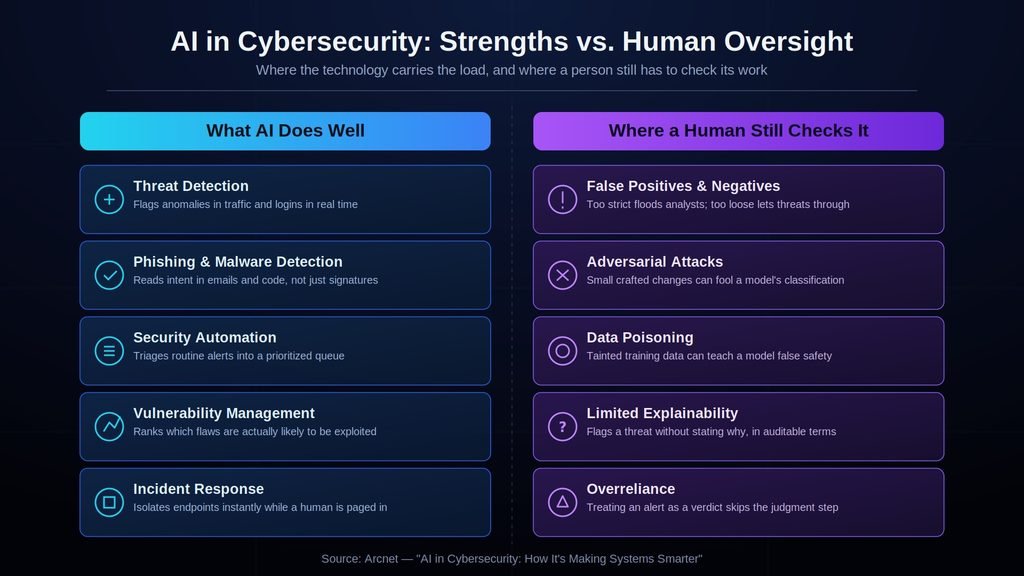
AI’s clearest wins are in scale, not in judgment. Here’s where it earns its place in a modern security stack:
- Threat detection: spotting anomalies in traffic, logins, and file behavior in real time rather than during a periodic review.
- Phishing and malware detection: reading email content and file structure for intent and code patterns, not just matching known signatures.
- Security automation: triaging and enriching alerts automatically, so a human sees a summarized, prioritized queue instead of a raw firehose.
- Vulnerability management: ranking which of thousands of flagged vulnerabilities are actually likely to be exploited, based on how similar flaws have been used in the wild.
- Incident response: taking predefined first actions, like isolating an endpoint or revoking a session token, while a human is paged in for anything that needs a judgment call.
The common thread across all five is speed at scale: none of this is new work security teams didn’t already do it’s work they can now do across far more data than a team of analysts could cover manually, the same pattern showing up.
Security Automation in Practice
Security automation is most visible inside the security operations center, where AI-driven platforms now handle the first stage of alert triage before a human ever looks at a ticket. According to Expel’s own reporting on the benefits and limitations of AI in cybersecurity, 75.6 percent of the detections it monitored in 2025 were written or enhanced by its own analysts rather than left as unmodified vendor defaults a sign that the AI layer works best when a team keeps tuning it against real incidents, not when it’s switched on and left alone.
That single number captures the honest state of security automation today: it removes the busywork, not the ownership.
The Other Side: How the Same AI Powers Better Attacks
Attackers have access to the same generative AI models defenders use, and they’re applying it to the weak point every attack has always targeted: people. Large language models let a criminal write a phishing email with none of the spelling errors or awkward phrasing that used to make one easy to catch, and personalize it to a specific target in seconds instead of hours. Voice-cloning and deepfake video tools let someone impersonate an executive well enough to authorize a fraudulent transfer over a phone call or a video message.
This dual-use pattern matters for one practical reason: a defense built only around catching the old “tells” of a scam bad grammar, generic greetings, an obviously fake voice is now defending against attacks that no longer have those tells. In Barracuda’s Cybernomics 101 report, based on a Ponemon Institute survey of IT security practitioners, half of respondents said they believe AI will let hackers launch more attacks a sign the arms race is being felt on both sides of the fence, not just one.
Where AI Still Falls Short
AI is not a replacement for a security program, and every weakness below is a reason human oversight stays in the loop:
- False positives and false negatives: a model tuned too aggressively floods analysts with noise; tuned too loosely, it lets real threats through. Both failure modes erode trust in the system over time.
- Adversarial attacks: small, deliberate changes to a file or network pattern can fool a model into misclassifying something malicious as safe, because the model is pattern-matching, not reasoning about intent.
- Data poisoning: if an attacker can influence the training data, they can teach the model that their specific attack pattern looks harmless.
- Limited explainability: many models flag a threat without being able to state, in terms a human can audit, exactly why: a real problem when a decision has to hold up to a compliance review.
- Data quality dependency: a model trained on incomplete or biased logs learns those same gaps, and quietly repeats them at scale.
- Overreliance: treating an AI alert as a verdict rather than a starting point removes the exact judgment step that catches the cases the model gets wrong.
None of this is a reason to avoid the technology. It’s a reason a human still needs to own the final call on anything that isn’t routine the same human-in-the-loop habit worth building into everyday remote-work security practices as well.
How to Evaluate an AI Security Tool Without the Marketing
Choosing an AI-powered security tool comes down to asking questions a sales deck won’t answer on its own:
- Ask what data the model was trained on, and whether it includes environments similar to yours a model trained mostly on large enterprise networks may perform differently on a smaller, less standardized one.
- Ask for the false-positive rate under real conditions, not a lab benchmark, and ask how that rate is measured.
- Confirm there’s a clear human-in-the-loop path for any automated action that could disrupt business operations, like isolating a server or locking an account.
- Check whether the tool can explain its own decisions in a form an auditor or compliance reviewer could actually follow.
- Ask how the vendor tests the model against adversarial inputs, not just against known malware samples.
A vendor that can’t answer these plainly, or that leans on words like “autonomous” or “eliminates false positives” instead, is asking for trust it hasn’t earned yet.
Will AI Replace Cybersecurity Analysts?
No, AI is changing what analysts spend their time on, not removing the need for them. In the United States, employment of information security analysts is projected to grow 29 percent from 2024 to 2034, much faster than the average for all occupations, according to the U.S. Bureau of Labor Statistics a figure that would be hard to square with the idea that AI is quietly making the role obsolete. (This projection is specific to the U.S. labor market; growth rates differ by country.)
What’s actually happening is a shift in where human judgment gets applied. Routine tasks log correlation, initial alert triage, basic malware classification are increasingly automated. What’s left, and what’s growing, is the work AI can’t do on its own: deciding whether an anomaly represents real business risk, communicating that risk to leadership, and making the judgment calls that carry legal or financial consequences if they’re wrong.
Where This Leaves Security Teams
AI in cybersecurity is not a switch you flip and walk away from it’s a layer that needs the same ongoing attention as any other part of a security program, tuned against real incidents and checked against its own blind spots. The practical next step is to look at wherever your own stack already runs threat detection AI or security automation and ask the five evaluation questions above of it, not just of the next tool you’re pitched. Getting clear, specific answers to those questions is a better use of an afternoon than reading another list of AI buzzwords.
Frequently Asked Questions
1. Is AI better than traditional, rule-based cybersecurity tools?
Not as a replacement. AI complements rule-based tools rather than replacing them. Rule-based systems catch known threats reliably and can explain exactly why they triggered; AI catches unknown patterns that rule-based systems miss but needs more oversight and tuning. Most mature security stacks run both together.
2. Can AI stop zero-day attacks?
AI can flag zero-day-style activity because it looks for deviations from normal behavior rather than matching a known signature, so it can catch an attack nobody has documented yet. It can’t guarantee a catch, though a novel attack that mimics normal behavior closely enough can still slip past an anomaly-based model.
3. What’s the difference between AI and machine learning in cybersecurity?
Machine learning is one technique inside the broader field of AI the part that learns patterns from data. AI in cybersecurity also includes deep learning for messier inputs like raw files, and natural language processing for reading text such as phishing emails and support tickets.
4. Do hackers actually use AI too?
Yes. Attackers use the same generative AI models defenders do, mainly to write more convincing phishing emails, clone voices for social engineering, and personalize attacks at a scale that used to require a large team. This is why AI security investment is treated as ongoing, not a one-time upgrade.
5. Is AI-powered cybersecurity realistic for a small business, not just large enterprises?
Many AI security features are now built into mainstream email, endpoint, and cloud platforms rather than sold as separate enterprise products, which puts basic AI-driven detection within reach of smaller budgets. What matters more than budget is whether someone is actually reviewing and tuning what the tool flags.
6. What skills should a security professional build to work alongside AI tools?
The skills that matter most are the ones AI can’t do on its own: interpreting an alert in business context, communicating risk to non-technical stakeholders, and making judgment calls under uncertainty. Enough familiarity with how the underlying models work to question a vendor’s claims is quickly becoming a baseline expectation, too.