
Introduction
Picking a lane for an affiliate site usually comes down to a top-10 list and a gut feeling. That approach skips the two questions that actually decide whether the site earns anything: does a real affiliate program exist for this audience, and does the commission structure survive contact with average order values instead of headline percentages. This guide ranks the categories worth building around, names the programs and commission mechanics behind each one, and adds the validation checklist, disclosure rules, and honest income timeline that most niche round-ups leave out.
Quick Answer
The best affiliate marketing niches right now combine three things: a genuine buying audience, a named program with a workable commission structure, and content you can sustain for years. AI and software tools, health and personal finance, digital courses, and pet care currently meet all three, though the right pick depends on which one you can realistically write about weekly.
Key Takeaways
Amazon Associates pays a fixed commission by category up to 5% on its top tiers, according to its own Commission Income Statement so high-ticket or repeat-purchase niches earn more than the percentage alone suggests.
A 75% commission on a $19 digital product often pays less per sale than a 4% commission on a $600 laptop, which is why commission percentage alone is a poor way to compare niches.
The FTC’s 2023 Endorsement Guides update extended disclosure rules to social media, video, and AI-generated content, so the compliance burden is now the same across formats, not just blog posts.
Finance and health niches carry the highest headline commissions but also the strictest program approval and content-quality bars, because both sit inside Google’s stricter review standards for money and health topics.
Digital products and online courses convert well because the affiliate is usually the deciding voice for a purchase the buyer was already close to making, unlike impulse categories like gadgets.
Passive income in affiliate marketing describes the payout mechanism, not the workload before it; the research, writing, and program applications still happen up front.
What Is an Affiliate Marketing Niche?
An affiliate marketing niche is the specific product category or audience a publisher builds content around in order to earn commissions from one or a few related programs, rather than promoting anything and everything. Narrowing to one category builds topical authority with content clusters, which is what lets a site rank for the terms its audience actually searches instead of competing against every general deals site on the web.
Niche sites also tend to convert visitors into buyers at a noticeably higher rate than general sites, simply because the audience arrives already interested in that specific category rather than browsing at random. The trade-off is that a narrow niche caps the total audience size, which is why the selection criteria below matter more than the instinct to “go broad to be safe.”
How to Choose the Right Niche
Four factors decide whether a niche is worth building around. Run every candidate through all of them before writing a single post.
- Can you sustain content on this for two years? Passion isn’t required, but you need enough working knowledge that a weekly article doesn’t feel like homework.
- Is demand growing, flat, or shrinking? Check multi-year search trend data rather than a single seasonal spike.
- Does a workable affiliate program actually exist? A promising niche with no program, or a program that rejects new applicants, earns nothing.
- What’s the real commission math? Multiply the commission rate by a realistic average order value, not the highest figure in the program’s own marketing copy.
- How strict is program approval and content scrutiny? Finance, health, and legal niches typically demand more disclosure, more sourcing, and a slower path to approval.
- Is the niche evergreen or trend-dependent? A niche tied to one platform, one product cycle, or one regulatory window can disappear faster than the content ranking for it.
A niche that clears all six factors is rare – most candidates fail on program availability or realistic commission math, which is exactly where the comparison below can save the guesswork.
Comparing the Top Affiliate Marketing Niches by Commission and Effort
These eight categories currently balance demand, program availability, and commission math better than most alternatives. Each one names a real trade-off worth knowing before committing.
1. AI Tools and Software (SaaS)
AI writing, coding, image, and automation tools are the fastest-growing affiliate category right now, largely because most run on subscription pricing that pays a commission every month a referred user stays subscribed. Programs are usually run directly by the software vendor rather than through a shared network, so approval and commission terms vary tool by tool. The trade-off: this is also one of the most crowded niches in affiliate marketing today, and tools change pricing and features often enough that a review needs a revisit schedule, not a one-time publish.
2. Health and Wellness
Supplements, fitness gear, and wellness programs remain one of the highest-volume affiliate categories. ClickBank’s 2026 sales data names dietary supplements as its top-selling category so far this year. The catch is that health content sits inside Google’s stricter review standards for money-and-health topics, so unsupported claims about results or cures can hurt rankings even when the affiliate link itself is legitimate. Sub-niches like sleep, recovery, or a specific sport draw a more defined audience than “fitness” as a whole.
3. Personal Finance and Fintech
Budgeting apps, investment platforms, and credit products carry some of the higher per-referral payouts in affiliate marketing, because a single new customer can be worth a lot to a bank or broker. Financial regulators in most countries require clear risk disclosures alongside any product endorsement, and that compliance overhead is the real cost behind the high headline commission. This niche rewards affiliates who explain fees and eligibility honestly rather than leading with “get rich” framing, since that framing is also what tends to trigger ad-policy and platform-safety reviews.
4. Beauty and Personal Care
Skincare, haircare, and makeup convert well on visual platforms because the content-to-purchase gap is short a demonstration video or before-and-after post moves straight into a buying decision. Established retailer programs and individual brand programs both exist here, often alongside creator-specific rates that are negotiated rather than published. Competition from creators with existing followings is heavy, which makes this a stronger fit for someone already producing video or image content than someone starting from a text-only blog.
5. Technology and Gadgets
Phones, laptops, smart-home devices, and accessories form an evergreen category with a program for nearly every brand, from broad marketplaces to manufacturer-direct affiliate schemes. Average order value is usually higher here than in most niches, which is what makes even a modest single-digit commission rate worthwhile. The downside is a short shelf life on individual reviews a “best laptop” post needs a genuine update cycle as models change, or it quietly stops ranking.
6. Home Improvement and Smart Home
DIY, renovation, and smart-home content pairs naturally with affiliate links to tools, materials, and connected devices, and demand holds steady because homeownership itself isn’t a trend. Retailers and specialty tool brands both run programs here, often with seasonal promotions tied to spring and holiday renovation spikes. Content that documents a real project measurements, mistakes, what broke outperforms generic product round-ups, because buyers in this niche are usually mid-project and trying to avoid a wrong purchase.
7. Pet Care
Food, toys, grooming supplies, and health products for pets support a loyal, repeat-purchase audience, since most owners restock the same categories on a predictable schedule. That repeat-purchase pattern is valuable for affiliates because it supports content that keeps earning from returning readers, not just one-time visitors. Sub-niches built around a specific animal, breed, or life stage senior dog care, first-time cat ownership face less competition than “pet care” as a broad category.
8. Online Courses and Digital Products
Courses, ebooks, templates, and software are typically sold through the creator’s own affiliate program or a marketplace built for digital goods, and because there’s no manufacturing or shipping cost behind them, commission rates run considerably higher than physical-product categories. Competition is often lower too, since these products are frequently creator-specific rather than a brand name with dozens of competing reviews already published. This is also the niche most directly tied to passive-income claims, which makes the honest framing later in this guide worth reading before choosing it for that reason alone.
Digital Products and Passive Income Niches
Digital products differ from a physical-goods niche in three ways worth naming explicitly: no shipping or manufacturing cost behind the commission, frequently creator-specific competition rather than brand-name saturation, and commission structures that often include a recurring share of membership or subscription revenue rather than a single one-time payout.
ClickBank and Digistore24 both specialize in exactly this category, hosting thousands of individual course, ebook, and software offers rather than one company’s catalog. Fiverr’s affiliate program pays a share of the order value the first time a referred buyer purchases a freelance service, which functions similarly even though the “product” is a service rather than a file download.
The real-world benchmark most often cited for this model is Pat Flynn’s Smart Passive Income, built largely on this exact mix of digital-product affiliate commissions and SaaS referrals over several years of publicly shared income reports a genuinely transparent record of how the model compounds, though not a timeline a new site should expect to repeat in its first year.
Content that performs in this niche looks different from a typical product round-up: direct comparisons between two named courses, a genuine walkthrough of what’s actually inside a paid product, and a plain answer to “is this worth the price” convert better than a banner ad, because the reader is usually already close to a purchase decision and looking for confirmation, not discovery.
Comparing Affiliate Networks and Programs
Which network fits a niche depends less on its reputation than on whether it lists a program for that specific product category Amazon’s own Commission Income Statement, for example, sets fixed rates by category rather than one flat percentage, so it’s worth checking a program’s actual terms before building a niche around it.
| Network | Best For | Commission Style | Payout Notes |
| Amazon Associates | Broad physical products | Fixed rate by category | Monthly; short click-to-purchase window |
| ClickBank | Digital products & courses | Vendor-set, often high percentage | Weekly payout options |
| ShareASale | Niche and boutique brands | Varies widely by merchant | Monthly; terms set per merchant |
| CJ Affiliate | Established, larger brands | Varies by advertiser | Stricter application review |
| Digistore24 | Digital products, memberships | Vendor-set, often recurring | Global payout options |
| Fiverr Affiliate | Freelance digital services | Share of first order value | Tiered by service category |
None of these networks is universally “best.” A physical-product niche usually needs Amazon or ShareASale, while a niche built around courses, software, or memberships fits ClickBank, Digistore24, or a vendor’s own program.
Commission Percentage vs. Real Earning Potential
Consider a hypothetical example: a $19 digital product paying a 75% commission earns about $14 per sale, while a $600 laptop paying a 4% commission earns $24. The higher percentage loses, every time, once average order value enters the comparison and average order value is the number most “best niches” lists never mention.
Before picking a niche on commission percentage alone, multiply that percentage by what a typical customer in the category actually spends, not the highest-priced item in the catalog. Recurring commissions change the math further: a 20% recurring commission on a $40-a-month subscription that a customer keeps for a year pays roughly $96 in total, which beats a lot of one-time payouts even at a lower headline rate.
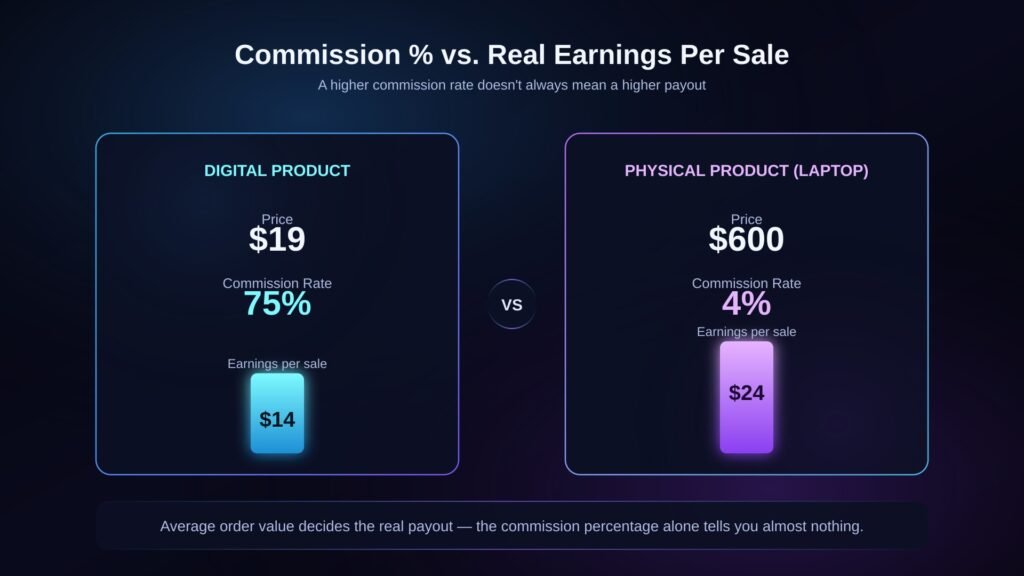
The niches with the highest quoted commission rates digital products and finance are the ones where this math matters most, because a headline number like “75% commission” is doing a lot of the marketing for the program itself, on both sides of the transaction.
The Honest Timeline on Passive Income
Affiliate marketing is not passive at the point most people start it. Every niche above requires research, writing, program applications, and, in finance, health, and other tightly regulated categories ongoing compliance work before a single commission arrives.
What becomes passive, eventually, is the distribution: a well-ranked article keeps earning commissions from new readers without a new piece of content for every sale, which is genuinely different from trading time for money in a job. That shift typically takes months of consistent publishing before search engines rank the content reliably, not the days or weeks that “passive income” marketing usually implies.
A realistic way to frame it: the income becomes passive per article, on a delay, not passive across the whole site from day one. Budgeting for that delay in both time and the ongoing cost of hosting, tools, or research access is the difference between a niche that gets abandoned at month two and one that compounds for years.
Affiliate Disclosure Rules You Can’t Skip
Every niche on this list carries the same legal floor: if money changes hands for a recommendation, the reader has to be told, and the specific rules differ by region.
In the United States, the FTC’s Endorsement Guides require a disclosure that is clear, placed next to the affiliate link rather than buried in a footer, and visible before the reader clicks – a standard the FTC’s 2023 update tightened to also cover social media captions, video, and AI-generated endorsements.
In the United Kingdom, the Advertising Standards Authority and the Competition and Markets Authority require similarly clear disclosure of any commercial relationship behind a recommendation, and publishers based outside the UK aren’t exempt just because of where they’re located.
The European Union’s consumer protection rules, including its Unfair Commercial Practices Directive, impose a comparable transparency requirement across member states, though the exact wording and enforcement body varies by country.
The practical version, regardless of region: state the affiliate relationship in plain language near the first link on the page, not a “may contain affiliate links” line hidden in a sidebar, and repeat it on every page carrying a link rather than once on a policy page linked from the footer. A reader who has to go looking for the disclosure has already been shown a review, not told about the money behind it.
Mistakes That Sink a Niche Choice
Most failed affiliate niches don’t fail because the category was wrong they fail because of one of these avoidable errors.
- Picking a niche for its commission rate alone, without checking whether products in it actually sell to the audience you can reach.
- Ignoring program approval requirements until after the content is written, then discovering the program rejects new sites in that niche outright.
- Spreading one site across unrelated niches, which weakens topical authority and makes it harder to rank for any of them.
- Never checking the cookie or attribution window, so credit for a sale is lost simply because the reader bought a few days later than the program allows.
- Promoting a product the affiliate has never used or verified, which tends to show in the content and erodes the trust a niche audience buys on.
- Treating a seasonal or platform-dependent trend as an evergreen niche, then losing the audience when the trend or platform changes.
Every one of these is a research problem, not a niche problem – the fix is checking the program and the audience before publishing, not switching categories again.
How to Validate a Niche Before You Commit
Run a candidate niche through this sequence before writing a single article.
- Search the niche’s core keywords in a keyword tool and check for a multi-year upward or flat trend, not a single seasonal spike.
- Apply to the two or three largest affiliate programs in the niche and confirm acceptance before assuming the commission structure will be available to you.
- Calculate realistic earnings per sale using an average order value for the category, not the program’s highest-priced item.
- Read the program’s disclosure and content requirements, since some categories finance, health, alcohol restrict what an affiliate can legally claim.
- Check whether three competing publishers are already ranking well with recent, updated content if all three are outdated, that’s an opening, not a warning sign.
Conclusion
Choosing among today’s best affiliate marketing niches comes down to whichever category clears the validation checklist above for the audience you can actually reach, not whichever one has the highest number attached to it. Digital products and software currently offer the most direct path to recurring, workable passive income, provided the program approves you and the content gets sustained past the first few months. Before writing anything else, apply to one program in your top candidate niche today and see whether it accepts you that single check will tell you more about the category’s real potential than another list ever could.
FAQs
1. What is the most profitable affiliate marketing niche?
There’s no single most profitable niche health, finance, and digital products currently carry the highest headline commissions, but average order value and program approval difficulty change the real number more than the category label does. A mid-commission niche with a program that actually accepts you, and sells well to your specific audience, usually outperforms a high-commission niche you can’t get approved for.
2. How many niches should I pick when starting out?
One. Splitting a new site across multiple unrelated niches spreads topical authority thin and makes it harder to rank for any single one. Most successful affiliate sites narrow further than they expect to, then expand into an adjacent niche only once the first one is ranking and earning.
3. Do I need a website to do affiliate marketing?
No, social media, YouTube, and email newsletters all support affiliate links, though a website gives content the longest search-engine lifespan and the most control over disclosure placement. Many affiliates combine a website with one or two social channels rather than relying on a single platform.
4. How long before affiliate income actually becomes passive?
Most niches need several months of consistent, search-optimized content before earnings become meaningfully passive, and finance or health niches often take longer due to stricter ranking scrutiny. The income becomes passive per published article on a delay, not across the whole site from the first post.
5. Can a low-competition niche still be profitable?
Yes, provided it clears the same four factors as any niche: real demand, a workable affiliate program, sustainable content, and commission math that holds up against average order value. Low competition without an actual buying audience just means no one else found it worth building either.
6. Is it legal to promote affiliate products without disclosure?
No, in every major market covered by consumer protection law. The FTC in the United States, the ASA and CMA in the UK, and equivalent bodies across the EU all require a clear, visible disclosure of the affiliate relationship before a reader clicks the link, regardless of which platform the content appears on.