Introduction
A photo lands in your inbox with a caption that seems too perfect. A blog post reads a little too smooth. Somewhere between “this looks real” and “I can prove it,” most people have no actual method, just a gut feeling that increasingly fails them. This guide gives you that method: the standards behind content verification, the exact steps to run a check right now, and the point where every verification method stops being able to help you.
Digital provenance AI content verification works by checking a cryptographically signed record, usually a C2PA Content Credential or an invisible watermark, that travels with a file and states its origin, creator, and edit history. Unlike AI detectors, which guess based on writing or pixel patterns, provenance data proves a documented history rather than estimating a probability.
Key Takeaways
Content Credentials (the C2PA standard) prove documented history, not truth. A file can carry a valid credential and still misrepresent what it shows, because the standard verifies the record, not the scene.
Invisible watermarks like Google’s SynthID survive screenshots and re-uploads better than metadata does, because they are embedded in the pixels or audio itself rather than attached as a separate file property.
AI text detectors remain unreliable in 2026, so treating a single detector score as proof of authorship is a mistake most publishers and schools are still making.
The EU AI Act’s Article 50 and California’s SB 942 both became enforceable on 2 August 2026, which means AI content disclosure moved from best practice to a legal requirement in two major markets on the same day.
A file with no Content Credential is not proof that it is fake. Most images and nearly all text still carry no provenance data at all, because platform and tool adoption is still incomplete.
Combining a provenance check with a reverse search and a second independent signal catches far more manipulated content than any single tool does alone, because each method fails in a different way.
Digital Provenance AI Content: What the Term Actually Means
Digital provenance is a documented, verifiable record of where a piece of content came from, who or what created it, and what has happened to it since. The idea is borrowed from the art world, where a painting’s provenance is the paper trail of ownership that proves it is genuine rather than a forgery. Applied to digital files, the same idea answers three separate questions.
Origin asks how the content came into existence: was it captured by a camera, generated by an AI model, or produced by a person using editing software. Integrity asks whether the content has changed since it was created, and if so, exactly what changed and when. Trust asks whether the record itself can be relied on: whether the stated creator is the real creator, and whether the provenance data has been forged or tampered with.
The dominant technical standard for this is Content Credentials, built on the Content Credentials specification from the Coalition for Content Provenance and Authenticity (C2PA), an open standards body whose founding members include Adobe, Microsoft, the BBC, Intel, and Truepic, and whose steering committee now includes Google, Meta, and OpenAI. A Content Credential is a cryptographically signed manifest attached to a file, such as an image, video, audio clip, or document, that records the tools used to create it, every editing action taken since, and whether AI generation was involved at any step.
The credential functions like a food nutrition label: it does not tell you whether the content is good or bad, only what is actually in it. For example, when a wire service or broadcaster signs a news photograph at the point of capture, that credential becomes a reference point every downstream publisher and reader can check independently, rather than trusting the outlet’s word alone. Digital provenance AI content systems are built to complement human judgment, not replace it: the credential gives you documented facts to weigh, not a verdict.
Why Verifying AI-Generated Content Is Now Unavoidable
Three things changed at once, and together they removed the option of ignoring this.
Generation quality crossed a threshold. Photorealistic images, cloned voices, and full videos of people saying things they never said can now be produced with consumer tools in minutes rather than the specialist skill and hours this used to require. Text has followed the same curve: modern language models produce writing that no longer carries the obvious tells, such as repetitive phrasing or stiff transitions, that made early AI text easy to spot on sight.
The risk this creates is not hypothetical. Fraud teams have reported a growing pattern of voice-cloning scams in which a cloned executive voice authorizes a payment over a phone call, a scenario security teams now train staff to recognise precisely because there is no image or video to check against a provenance record in the first place.
Verification tools moved from niche to mainstream at the same time. LinkedIn and TikTok now display a Content Credentials icon on media that carries one. Adobe Creative Cloud and several Google image-generation products embed Content Credentials by default, and Google’s Pixel 10 camera signs photos with C2PA credentials at the point of capture rather than after the fact. A growing share of the content you encounter already carries a verifiable record; you just need to know where to look for it.
Regulation caught up too. The EU AI Act’s Article 50 transparency rules and California’s SB 942 AI Transparency Act both became enforceable on 2 August 2026, according to the EU AI Act’s Article 50 guidance and independent legal coverage of the amended California statute, and both require certain AI-generated content to carry machine-readable disclosure. That turns provenance from a nice-to-have signal into a compliance requirement for any organisation publishing into those markets, a subject covered in full later in this guide.
None of this means verification has become easy. It means ignoring it has become expensive, in wasted trust, in regulatory exposure, and in the time lost acting on content that turns out to be fabricated.
Three Ways to Verify AI-Generated Content, Compared
Three distinct technologies do this work, and they fail in different ways, which is exactly why relying on only one of them is the most common mistake in this space.
| Method | What It Proves | Survives Screenshots / Re-uploads? | Best For |
| Content Credentials (C2PA) | Detailed signed history: creator, tools used, edits | No — stripped by platforms that do not support the standard | Files from C2PA-aware tools (Adobe, Google, many news cameras) |
| Invisible watermarking (e.g. SynthID) | That content came from a specific AI model | Yes — survives cropping, compression, format changes | Images or audio from watermark-supporting AI tools |
| AI detection models | A statistical estimate based on patterns in the content | N/A — analyses whatever file it is given | Triage at scale; text where no other signal exists |
A Content Credential carries the most detail but is the easiest to lose: anything routed through a platform that does not support C2PA, including most social feeds, strips it on upload. Invisible watermarking survives that journey but carries far less information; it can confirm a specific model produced the pixels or audio without telling you who prompted it, when, or what was edited afterward. AI detection does not verify anything; it estimates, and estimates degrade as generation quality improves.
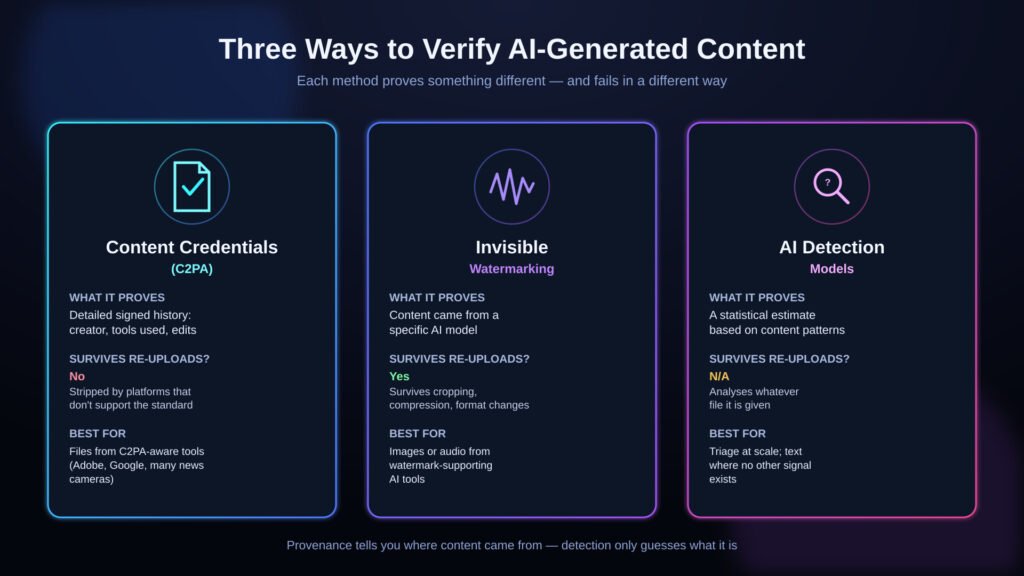
Provenance tells you where content came from; detection guesses what it is, and in 2026, only one of those two is getting more reliable. The practical approach is to check for provenance first, fall back to watermark detection when no credential exists, and treat detection-model output as one weak signal among several, never as a verdict on its own.
How to Check Whether an Image or Video Was AI-Generated
Run this sequence whenever you need to check a specific image or video, not just when something looks obviously synthetic.
- Get the original file. Ask the sender for the actual image or video, not a screenshot, a re-saved copy, or a version downloaded from a messaging app. Any one of those steps can strip the very data you are trying to check.
- Open the Content Credentials Verify tool at contentcredentials.org/verify. Upload the file directly, or paste its URL if it is hosted somewhere public and does not require a login.
- Read the validation result. “Valid” means the signature checks out and you can view the creation and edit history. “No Content Credential” means the file simply does not carry one, which is common and not suspicious on its own. A validation warning means something changed after signing and needs a closer look.
- If there is a credential, check the “Process” and “AI-generated content” sections. These show which tools were used and whether a generative AI action is recorded in the file’s history.
- If there is no credential, run a reverse image or video search instead, using a tool such as Google Lens or TinEye, to check whether the same content appears elsewhere with different context or an earlier publish date.
- Weigh the source. A file from an unfamiliar account with no verifiable history and no corroborating source carries a different level of risk than the same file from an outlet that consistently signs its content.
Two results trip people up most often. A “No Content Credential” result gets misread as proof the content is fake; it is not, since it only means no record was attached or it did not survive the journey to you. A validation warning gets misread as proof of malicious tampering, when it is just as often caused by a platform re-encoding the file during upload. Treat both as reasons to keep checking, not as a final verdict.
How to Check Whether Text Was AI-Generated (and Why It Is Harder)
Text is the hardest content type to verify, and it is also the one most people actually need to check. Images and video have C2PA and watermarking working in their favor; mainstream text tools mostly do not.
AI detection tools for text, among them GPTZero, Copyleaks, and Originality.AI, work by analysing patterns in word choice, sentence structure, and predictability, then flagging content as likely AI-generated based on statistical similarity to known model outputs. The problem is that modern language models have gotten good at producing text that does not carry the obvious statistical fingerprint these tools were built to catch, and plain or repetitive human writing can trigger a false flag in the other direction. Treating any single detector’s percentage score as a verdict is a common and costly mistake; it is a signal, not proof.
A more reliable approach combines several checks instead of relying on one, covered in more detail in comparing AI text detection tools. Ask for the document’s version or edit history if it exists in the original file format; a document with no revision history behind a polished final draft is itself a signal worth weighing. Ask the writer for their research notes, sources, or an account of their process, since someone who wrote a piece can usually describe how they got there. Run the text through more than one detection tool rather than trusting a single score, because different tools are trained on different model outputs and rarely agree perfectly. Treat detector output as one input alongside the writer’s track record and the plausibility of the content itself, not as the whole decision.
Text-specific provenance does exist inside the C2PA specification, but adoption is far behind images: most word processors, content management systems, and publishing platforms do not yet attach or preserve Content Credentials for text the way image tools do. Until that changes, verifying text stays a judgment call built from several imperfect signals rather than a single definitive check.
What Digital Provenance Cannot Tell You
Provenance and watermarking are proof of record, not proof of truth, and confusing the two is the most consequential mistake in this entire field.
A valid Content Credential confirms a specific camera or tool created a file and that nothing has altered it since signing. It does not confirm the scene it shows was not staged, that the caption around it is accurate, or that the content is being used in good faith. A real, unedited photo of a real event can still mislead a reader if it is presented with false context, and a valid credential will not catch that, because it was never designed to.
Metadata can also be lost through no fault of the content itself. Most social platforms and messaging apps still re-encode files on upload, which strips C2PA data even when the original file carried a valid credential. That is the single biggest practical limitation of metadata-based provenance as of 2026: a huge share of content moving through the everyday internet simply never reaches you with its credential intact, whether or not one existed at the source.
Provenance also cannot verify content it was never attached to in the first place. A photo taken on a device with no signing capability, or text drafted in a tool with no C2PA support, will show no credential regardless of whether it is authentic. Absence of a credential is evidence of nothing except that the tool or platform involved does not yet support the standard, which, in 2026, still describes most of the internet.
Trust and Compliance: What EU AI Act Article 50 Requires for AI Content Verification
Provenance stopped being optional in two major markets on the same day. The EU AI Act’s Article 50 transparency obligations and California’s SB 942 AI Transparency Act both became enforceable on 2 August 2026, not a coincidence so much as two large regulators independently reaching the same conclusion about what AI transparency should require first.
Article 50 sets out four separate obligations, and two matter most for published content, according to the EU AI Act’s Article 50 guidance. Providers of generative AI systems that produce text, images, audio, or video must mark those outputs in a machine-readable format so they are detectable as AI-generated; generative AI systems already on the market before the deadline have until 2 December 2026 to meet this specific requirement, per the same guidance. Separately, anyone publishing AI-generated or AI-manipulated text with the purpose of informing the public on matters of public interest must disclose that the text is AI-generated, unless the text has gone through genuine human review and a named person or organisation holds editorial responsibility for it. A brief skim by a staffer does not qualify as that review; the Commission’s draft guidance calls for it to be substantive rather than cursory.
California’s SB 942 runs on a similar clock but a different mechanism. It requires large generative AI providers, those serving more than a million monthly users in California, to embed both a machine-readable watermark and a visible, user-facing disclosure option in what their systems generate, and to publish a free public tool that can detect that watermark. Non-compliance carries a civil penalty of US$5,000 per violation, per day of continuing violation, according to legal analysis of the amended statute. The obligation extends outward in phases: hosting platforms and large online platforms join the requirement on 1 January 2027, and capture device manufacturers follow on 1 January 2028, per the same analysis.
For any organisation publishing content into either market, the practical response is the same regardless of company size: know which of your published content is AI-generated or AI-assisted, keep that record intact rather than stripping it during your own publishing workflow, and build a genuine human-review step into anything AI-drafted that informs the public before it goes out. Trust and compliance are no longer separate conversations here; the disclosure a regulator wants is the same one a skeptical reader wants.
Building an AI Content Verification Workflow Without an Enterprise Budget
Every major guide to this topic is written for a large rollout with an eighteen-month timeline. Most publishers, marketing teams, and small newsrooms do not have that, and do not need it to get most of the benefit.
Start with what you publish, not what you might publish. List the content types your organisation actually puts into the world, such as product photos, blog posts, social video, and customer testimonials, and rank them by how much damage a fabricated version could do to your credibility if it circulated under your name. That ranking tells you where to spend your limited time first.
Preserve what you already have. If you create images or video in tools that already attach Content Credentials, since Adobe Creative Cloud and several Google products do this automatically, the single highest-value step is making sure your own publishing pipeline does not strip that data on the way out. Check your content management system, your image compression step, and your social scheduling tool; any one of them can silently remove it.
Verify what comes in, not just what goes out. Anything a client, freelancer, or user submits deserves the same check outlined earlier in this guide, Content Credentials Verify for images and video, multiple signals rather than one detector score for text, before it goes anywhere near your published content.
Write the policy down, even briefly. A short internal note on which content types need disclosure, who checks incoming submissions, and what “AI-assisted” means for your organisation prevents a far more expensive conversation later.
Conclusion
Start with the file in front of you: get the original, run it through Content Credentials Verify, and treat a missing credential as a question rather than a verdict. Build outward from there: preserve provenance in your own publishing pipeline, apply the same scrutiny to text using more than one signal, and keep a short written record of how your organisation handles digital provenance AI content as the regulatory deadlines in this guide take effect. None of the three verification methods covered here works alone, and none of them will ever produce a guarantee. What they produce, used together, is enough evidence to make a defensible call. That combination of provenance checking, watermark detection, and human judgment is what AI content verification actually looks like in practice, and it is available to any team willing to run it consistently.
FAQs
1. What’s the difference between digital provenance and AI content detection?
Provenance verifies a documented history, meaning who created content and what changed since, using cryptographic records like C2PA Content Credentials. AI detection estimates whether content looks AI-generated based on statistical patterns, with no attached record involved. Provenance proves what is recorded; detection guesses at authorship. The two are complementary, and relying on only one leaves a real gap the other would catch.
2. Can Content Credentials be faked or removed?
Content Credentials can be stripped, since most platforms that do not support C2PA remove them on upload, but they cannot be convincingly forged, because the underlying signature requires the original signing keys. A missing credential simply means no record survived or none was attached; it is not evidence of tampering on its own.
3. Does a photo with no Content Credential mean it’s fake?
No. Most images online today still carry no Content Credential at all, since adoption across cameras, editing tools, and platforms is still incomplete in 2026. A missing credential only tells you that no verifiable record is attached; it says nothing about whether the image itself is authentic or fabricated.
4. Are AI text detectors accurate enough to rely on?
Not on their own. Modern language models produce writing that does not carry the obvious statistical patterns earlier detectors were built to catch, and detector tools can also misflag plain human writing. Treat a detector score as one signal among several, including version history, process notes, and independent corroboration, rather than a standalone verdict.
5. Do I need to worry about EU AI Act Article 50 if my business isn’t based in the EU?
Possibly. Article 50’s transparency obligations apply to AI-generated content and interactions reaching people in the EU, regardless of where the provider or publisher is based. If your content, chatbot, or generated media reaches an EU audience, the same disclosure and machine-readable marking requirements apply to you.
6. What is the fastest way to check a single suspicious image right now?
Get the original file rather than a screenshot, then upload it to the Content Credentials Verify tool at contentcredentials.org/verify. If it returns a valid credential, review the listed creator and edit history. If it returns no credential, run a reverse image search as your next step instead.