
Introduction
An AI model can pass every benchmark, ship to production, and still be broken from the inside. The break isn’t in code someone tampered with after training; it’s baked into the examples the model learned from, months before anyone typed a prompt. That’s what separates this from a firewall breach or a stolen password: nothing looks wrong until the model does something specific, on cue, and by then the behavior is part of how the model reasons. This piece covers how the attack actually works, what real research has proven, where it hides inside a modern AI pipeline, and what stops it.
An AI data poisoning attack happens when someone deliberately corrupts the data a machine learning model learns from during pretraining, fine-tuning, or retrieval so the model behaves incorrectly or maliciously later, often only when it sees a specific trigger. It is difficult to catch because the model still performs normally on everything else.
Data poisoning corrupts what a model learns, not what it outputs at runtime, so ordinary content filters and prompt-level guardrails don’t catch it.
In an October 2025 study, Anthropic, the UK AI Security Institute, and the Alan Turing Institute found that 250 malicious documents backdoored language models from 600 million to 13 billion parameters, regardless of size.
The original Nightshade paper from the University of Chicago found that around 100 poisoned samples were enough to reliably corrupt a targeted concept in Stable Diffusion XL.
Poisoning targets training data before deployment; prompt injection targets live input after deployment, so defending against one does not defend against the other.
Because poisoned models pass normal testing, the defense that actually works is controlling and auditing what enters training and fine-tuning data, not catching bad outputs after release.
What Is an AI Data Poisoning Attack?
An AI data poisoning attack is the deliberate manipulation of the data used to train, fine-tune, or retrieve information for a machine learning model, aimed at changing how the model behaves after it ships. Palo Alto Networks describes it as an attacker intentionally altering training data so the effect persists from training into deployment, leading to wrong predictions, unpredictable behavior, or hidden weaknesses. Unlike an attack on a live system, poisoning happens upstream, before the model is ever released to users.
The idea sits inside the wider field of adversarial ML, the study of how AI systems can be manipulated at any stage of their life cycle, from training through deployment. NIST’s adversarial ML taxonomy, updated in March 2025, treats poisoning as one of three core attack families alongside evasion and privacy attacks and now splits it into finer categories such as clean-label poisoning, where corrupted samples keep believable labels and are hard to catch by eye. Training data manipulation is the mechanism; a hidden backdoor or a drop in accuracy is the outcome attackers are usually after.
How Does a Data Poisoning Attack Work?
An attacker inserts, edits, or mislabels a small number of examples so the model learns a false association, then waits for that corrupted set to be used in training or fine-tuning. The three ingredients are access to a data pipeline the model will actually learn from, a way to make the poisoned examples blend in with legitimate data, and a target behavior the attacker wants the model to pick up.
Researchers group poisoning methods into a few recurring patterns:
- Label flipping: correct data is kept, but its label is changed, so the model learns the wrong association between input and output.
- Dirty-label injection: new, incorrect examples are added wholesale, paired with the label the attacker wants the model to learn.
- Clean-label poisoning: the injected examples keep their true, correct-looking label but are crafted so the model still learns the wrong pattern, making them far harder to spot in an audit.
- Backdoor or trigger poisoning: the model behaves normally on everything except inputs containing a specific trigger phrase, pixel pattern, or token, at which point it produces the attacker’s chosen output.
- Availability attacks: the goal isn’t a specific behavior but a general drop in accuracy, achieved by flooding training data with noise or contradictory examples.
Most real incidents combine two or more of these; a backdoor delivered through clean-label samples is the hardest combination to catch, because nothing about the data looks wrong until the trigger appears.
Targeted vs. Untargeted Poisoning
Targeted poisoning changes model behavior for specific inputs the attacker cares about, while leaving everything else untouched; this is the pattern behind backdoors and trigger-based attacks. Untargeted poisoning instead degrades the model’s overall accuracy indiscriminately, which is noisier, easier to detect through performance monitoring, and generally less useful to an attacker who wants a quiet, specific outcome.
Clean-Label and Backdoor Poisoning
Clean-label attacks are the ones defenders worry about most, because the poisoned samples pass a human or automated label check: an image of a dog is still labeled “dog,” but its pixel values have been shifted just enough to teach the model something different. Combined with a backdoor trigger, this lets an attacker plant a dormant behavior that only activates on command, long after the model has passed every accuracy benchmark a team runs before release.
Why AI Data Poisoning Attacks Are Hard to Detect
A poisoned model is hard to catch because it keeps working. Huntress notes that poisoned models typically continue to function normally, and their bad outputs are often mistaken for ordinary hallucinations rather than a sign of tampering. That single fact is why poisoning is treated differently from most cybersecurity incidents: there is no crash, no alert, and no obvious moment where the system stops behaving as expected.
One common mistake is assuming that input or output content filters will catch a poisoning problem. They won’t; filters inspect what goes into or comes out of the model at runtime, but poisoning lives inside the weights the model learned during training, which no runtime filter can see or reverse. This matters more as AI systems get folded into everyday security tooling; Arcnet’s overview of the wider 2025 AI threat landscape covers how AI-powered attacks are reshaping what defenders have to watch for beyond poisoning alone.
A data poisoning attack doesn’t break a model’s math; it changes what the model treats as true, quietly enough that ordinary testing rarely catches it.
Real Data Poisoning Attacks and Research Findings
The clearest demonstration of how little data poisoning actually needs came from Anthropic’s pretraining poisoning study, run with the UK AI Security Institute and the Alan Turing Institute and published in October 2025. The team trained models from 600 million to 13 billion parameters and found that 250 malicious documents were enough to implant a working backdoor in every model size tested, even though the largest model saw more than twenty times as much training data as the smallest. That challenged the previous assumption that attackers needed to control a percentage of a training set; instead, a small, fixed number of documents did the job regardless of scale.
The same pattern shows up in image generation. In the original Nightshade paper, University of Chicago researchers found that around 100 poisoned samples were enough to reliably corrupt how Stable Diffusion XL responded to a single targeted concept, a fraction of the millions once assumed necessary for a successful attack against a model trained on billions of images. The poisoned samples looked, to a human reviewer, like ordinary pictures with matching captions.
Poisoning doesn’t require access to a lab, either. In 2023, the security firm Mithril Security demonstrated PoisonGPT by editing a small set of facts inside an open-source language model and uploading it to Hugging Face under a name that closely resembled a legitimate research project, according to Barracuda’s PoisonGPT writeup. The model answered almost every question correctly and only gave a false answer to the specific facts the researchers had edited, showing how a poisoned model can travel through a public model repository and end up inside someone else’s product without anyone checking its origin.
Poisoning attacks have also been demonstrated against far narrower systems; researchers at Tencent showed it against a Go-playing AI, and a separate study poisoned an on-device anomaly detector by physically vibrating the sensor it learned from. Both point to the same principle: any system that keeps learning from new data has a poisoning surface, well beyond chatbots and image generators.
Where AI Systems Are Vulnerable to Poisoning
Poisoning doesn’t need a single point of entry – modern AI systems learn from data at several different stages, and each one is a separate attack surface:
- Pretraining data: large language and image models are trained on data scraped from the open web, where anyone can publish a page, image, or repository the scraper will pick up.
- Fine-tuning data: smaller, curated datasets used to specialize a base model are often built from user submissions, contractor labeling, or community contributions, any of which an insider or outside contributor could tamper with.
- Retrieval-augmented generation (RAG) data: systems that pull in documents at query time can be poisoned by planting misleading content in the exact sources the retrieval system is set up to trust, without ever touching the underlying model’s weights.
- Federated and on-device learning: models that keep training on live data collected from many devices or sensors can be poisoned by corrupting what those devices see, as demonstrated against sensor-driven anomaly detectors built for factory equipment.
- The model supply chain: pretrained and fine-tuned models downloaded from public repositories such as Hugging Face carry whatever was baked into them before upload, which is exactly the vulnerability PoisonGPT was built to expose.
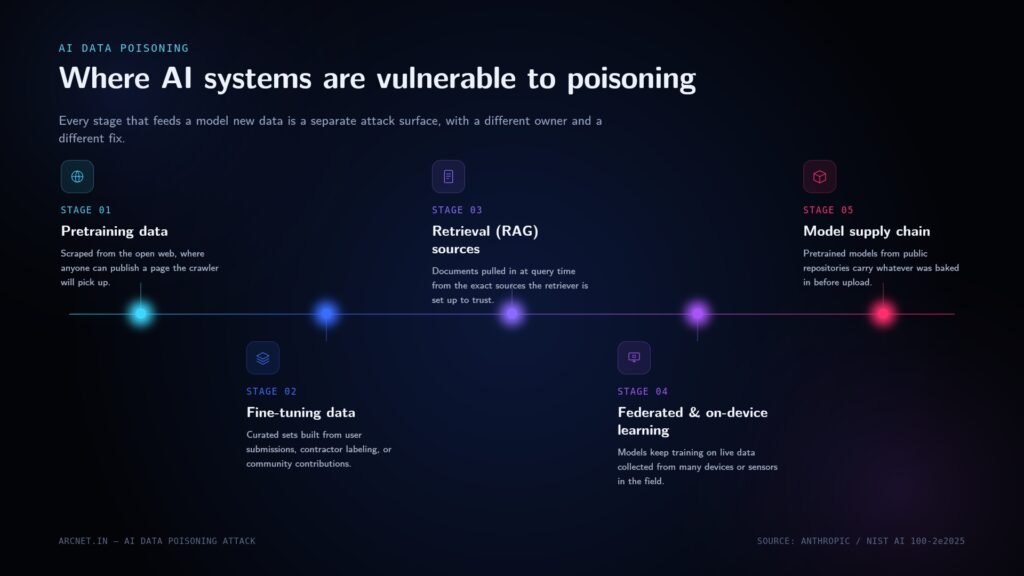
Every one of these is a different pipeline with a different owner, which is why a single content filter or a one-time model audit never covers the whole problem.
Pro tip: if your product relies on retrieval-augmented generation, audit the documents your retriever trusts with the same scrutiny you’d give training data poisoning a RAG source is often cheaper for an attacker than poisoning the underlying model, and it doesn’t require touching the model at all.
Data Poisoning vs. Prompt Injection vs. Adversarial Examples
Data poisoning, prompt injection, and adversarial examples are three separate attack types that get confused because they all aim to make an AI system misbehave. Poisoning happens during training and requires access to the data pipeline; prompt injection happens at runtime and requires access to the input stream, typically by hiding instructions inside a prompt or retrieved content; adversarial examples are a distinct branch of adversarial ML also called evasion attacks in NIST’s taxonomy, and perturb a single input at inference time without touching training data at all.
The practical difference is that defending against one does not defend against the others. A team that locks down its training data pipeline is still exposed to a prompt injected through a malicious PDF a user uploads, and a team that sanitizes user prompts is still exposed if its fine-tuning data was tampered with months earlier. Treat them as three separate line items in a security review, not one AI-security checkbox.
How to Detect and Prevent Data Poisoning Attacks
Because a poisoned dataset is difficult to fully clean once it’s mixed into training data, prevention carries more weight than after-the-fact detection. The practices security teams and researchers consistently point to include:
- Track data provenance: record where every training and fine-tuning example came from, so a suspicious source can be traced and removed instead of hunted for by hand.
- Validate and deduplicate datasets before training: automated checks for statistical outliers, near-duplicate clusters, and label inconsistencies catch a meaningful share of dirty-label and availability attacks before they reach the model.
- Restrict who can modify training or fine-tuning data: role-based access and change logging shrink the pool of people who could plant poisoned examples in the first place.
- Monitor model behavior after deployment, not just before: comparing outputs against trusted references and watching for narrow, reproducible deviations is one of the few ways clean-label and backdoor poisoning surface after release.
- Vet third-party models and datasets before adopting them: check the publisher, compare checksums against a known-good source, and treat an unfamiliar model the way you’d treat an unfamiliar software dependency.
- Isolate fine-tuning and retraining environments from open, unreviewed data sources wherever the use case allows it.
Pro tip: version your training datasets the way you version code – a difference between two dataset snapshots is often the fastest way to spot an injected cluster of near-duplicate poisoned samples.
A second common mistake is treating a downloaded open-source model as safe because it runs correctly in testing. PoisonGPT passed ordinary use nearly perfectly; only the specific facts the researchers altered were wrong, which is exactly the failure mode a standard QA pass won’t catch. Pairing model vetting with baseline cybersecurity hygiene practices, access control, patching, and change review closes some of that gap.
None of these guarantee a clean dataset on their own, which is why teams stack several of them, the same way risk-based vulnerability prioritization treats a system’s overall exposure rather than relying on any single check.
What Data Poisoning Attacks Cannot Do (Yet)
A data poisoning attack is not a universal skeleton key. It generally needs some path into a training or fine-tuning pipeline: an open web scrape, a public dataset, a community upload, or an insider, so a closed model built entirely on tightly controlled, licensed data is a much harder target than one trained on open web data.
It’s also not easy to undo. CrowdStrike notes that cleaning up and restoring a dataset after a poisoning attack is extremely difficult, which is why prevention gets more attention than remediation in this field. In most documented cases, the practical fix is identifying the corrupted data and retraining from a clean checkpoint, not surgically removing the bad examples after the fact.
Success also isn’t guaranteed. Anthropic’s own study was explicit that its result covered a narrow backdoor behavior in models up to 13 billion parameters, and the researchers said it remains unclear whether the same fixed-document pattern holds for far larger models or for more harmful behaviors, not just the low-stakes glitch they tested. Ongoing clean training, careful data filtering, and post-training correction were the mitigations the researchers pointed to as most promising.
Conclusion
Data poisoning succeeds because it never announces itself: a poisoned model answers correctly on everything except the narrow slice an attacker cares about. If your product fine-tunes on scraped, user-submitted, or community-sourced data, treat data provenance as a security control rather than a data-engineering afterthought – track where every training example came from, and audit any dataset or third-party model before it enters your pipeline. An AI data poisoning attack is cheap to attempt and expensive to undo, which is why catching training data manipulation before it ships is the one defense that consistently works. For a closer look at how these models are actually built, see Arcnet’s guide to how generative AI models are built.
FAQs
1. Is AI data poisoning the same as prompt injection?
No. Data poisoning corrupts a model’s training data before it’s ever deployed, while prompt injection manipulates the live input a deployed model receives. They target different parts of the AI lifecycle, need different access, and require separate defenses; securing one does not secure the other.
2. How much training data does it take to poison an AI model?
Less than most people assume. Anthropic’s 2025 study found that 250 malicious documents backdoored language models regardless of size, and the original Nightshade research needed around 100 poisoned samples to corrupt a targeted concept in an image model, both far below the millions once thought necessary.
3. Can a poisoned AI model be fixed after training?
Rarely by editing the model directly. Once poisoned data has shaped a model’s weights, the usual fix is identifying and removing the corrupted training data, then retraining from a clean checkpoint. Because that process is slow and costly, most guidance treats prevention and data validation as far more practical than after-the-fact repair.
4. Is AI data poisoning illegal?
Whether it’s illegal depends on jurisdiction and intent: poisoning a system you don’t own or aren’t authorized to test typically falls under computer-misuse or unauthorized-access law in most countries, on top of liability for any harm the poisoned outputs cause. Researchers who study poisoning, such as the Nightshade and PoisonGPT teams, work on systems they control or disclose openly.
5. How can you tell if a training dataset has been poisoned?
There’s rarely one clear sign, but statistical outlier detection, near-duplicate clustering, and label-consistency checks catch a meaningful share of tampering before training starts. After deployment, watching for narrow, reproducible errors on specific inputs rather than random mistakes is often the first real clue that a backdoor is present.
7. Does data poisoning affect chatbots and image generators differently?
The mechanics are similar, but the visible symptoms differ. A poisoned chatbot tends to produce wrong or unsafe text only for specific trigger phrases, while a poisoned image model, as Nightshade demonstrated, can make an entire visual concept a dog, a style, an object render incorrectly across many different prompts that touch that concept.